Pollination.


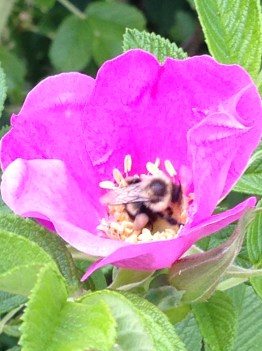
It looks erratic this flightbee-and-flower

Translucent wings trace the air
Destination a red dot
On a random map;
Gestures lost in cuneiform antiquity.

Mere observation fails
To reveal her obscurity
Beckoning in hidden frequencies
Amid the grace of Nature’s waltz;
Whirling gestures mark
A grand and timeless dance
Begun before we knew;
The start of all we see
Among the urgent flowers
And their dusty magic.

They come and go tirelessly
And give and take and give,
Each fitting like a puzzle piece;
A kaleidoscope of intricacies
Which we do not own but borrow, 
Out there in the secret world
Where all is made.

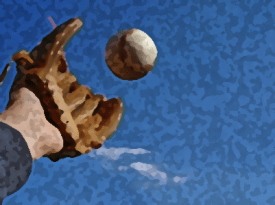
Oiling up your outfielder’s glove for the start of spring baseball.

I am waiting for Spring, for the sun to warm the earth and melt the snow. I take out my baseball glove from the closet, nestled down there among the winter boots. It has been waiting patiently, pensive and oiled, holding a baseball in the pocket and tied with a rubber band. This bit of tradition may or may not make me a better fielder, but it is one of the rites of spring that we dare not defy. Baseball demands it of us.

Opening Day and all things are possible!  The players take a field of green grass under an incandescent blue sky.  All around the air hums with the uniquely busy sounds of baseball.  I am playing center field this day when my buddy Parker comes up to bat. He is clearly the best baseball-gloveplayer on the opposing team and a dangerous hitter. He swings and I see the ball rising toward me and I know he has crushed one. I turn and race back into deep right center. After what seems like an eternity the ball arcs down and I am there with my well-oiled mitt. On the way back to the dugout I pass Parker on the infield. He says, “nice catch”. While hard times surely wait in the unknowable future, on this day all is right in the world.  It don’t get no better than that.

Some feel the game of baseball, with its long pauses and elaborate strategies is too slow for the modern psyche; so hard, impatient and driven by the clock.  Baseball seems a game lifted wholesale from those old black and white film reels, played by men gone gray in the flickering light. But when you put on that glove and take the field, you glimpse a simpler time and share a moment across generations.

Nice catch.

New England Clam Chowdah.

Over the years I have become wary of certain foods, number one among them the lowly clam. And no, do not attempt to confuse the issue with a discussion of oysters which, as far as I concerned arrived on planet Earth at roughly the same time as clams, both fleeing justice at the hands and tentacles of Glup, high wizard of the Martian warrior clan.

chowdah-1.jpgSome early earthlings popped open the shell of one of these alien intruders and ATE the
insides, likely making that horrendous slurping noise which today we call The Most Horrible Sound In All The World. The Martians fled in terror.  Thanks a LOT Glub; perhaps we’ll send you avocados or goat cheese and see how you like THEM apples. Please ignore the tortured metaphors.

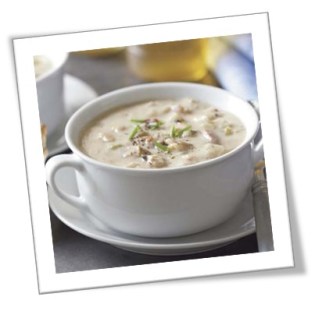
But inside a bowl of New England Clam Chowdah the spineless mollusk undergoes an amazing transformation — from guck to glorious. I do not question such things but merely accept this universal gift from the Glubster, who is clearly one wicked smaht Martian.

Rubber Slippers.

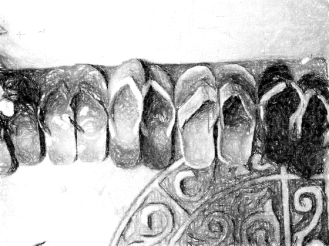
In Hawaii it is customary to take off one’s shoes before entering the home. It is a sign of respect and most likely a tradition carried over from Japan during the years of early immigration. It is not uncommon to see rows of rubber slippers by the front door of homes in Hawaii.

I used to burubbah-slippahsy the cheapest kind of “rubbah slippah” available, usually the 99 cent specials.  These might last several years during which time the rubber would become deeply imprinted with the shape of the bottom of my foot. You received added karma from the Hawaiian gods by sporting nut brown feet with slipper tan lines. If God had intended us to wear shoes, I am sure these worn slippers came close to divine podiatry, stigmata included.

I am nothing if not a creature of habit, so once in a while I would violate dress code and wear slippers to the office in Honolulu. Of course I always kept a pair of actual shoes and socks in my lower desk drawer should the boss call. I wonder if my career subsequently suffered from such behavior, but the trade-off may have been worth it.

One of my professors in graduate school used to make his own slippers from old pieces of truck tire he would find on the side of the road. I still think of him now and then, the ultimate recycling man, a hero in Michelin feet.

Watching the divers go down to harvest sea urchins on Jeju-Do.

diver

Off the southern tip of South Korea lies the island of Jeju-Do.  It is a favorite tourist destination in Northern Asia and in my view one of those “undiscovered” places, so says Mr Paradox.  Once I watched women divers bringing up sea urchins in small buoyed net bags and place them on the rocks. These divers are the haenyo and have carried on this tradition for generations. They really dive for all types of shellfish, but on this day it was mostly spiny black sea urchins.  I watch in queasy fascination as they cracked open the hard shell, scooped out the insides (uni), dipped it into hot sauce and ate them then and there. Those with more sophisticated palates  than mine will understand that eating these puppies raw is the ONLY way to eat uni.  What does raw uni taste like?  Call me a coward, but I have no idea.

Strengthening breezes indicating an approaching storm.

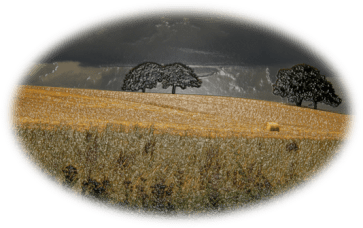
We have all noticed it on warm still days. The wind begins to pick up and the sky darkens in the distance. I imagine the plants and animals of the earth sense it long before we do, receptors feeling the pressure change as a whisper in secret code; a language we lost long ago. The rolling brown fields patiently ready themselves and await the thunder, the lightning and the soaking rain, accepting this bargain in stoic anticipation. The trees bend and dance, storm-Picture1intoning their ancient hymns and accepting their role as keepers of life on Earth.

As a youth in Hawaii I used to run marathons, and whilst training I would often get caught outside in the weather, miles from home. There is something primal in that, a way to be part of the world sometimes forbidden by our cloistered civilization.. We are sixty percent water and our blood races with an inner sea, yet we avoid the rain as if pushed by invisible forces on opposite poles.

But when I was out there running —  tired and hot — and the rains came down hard and cool and clear, I would sometimes shout in pure joy at the roiling sky; arms upraised in solitary celebration, alive within the storm.

I am here, I am here. We are here.

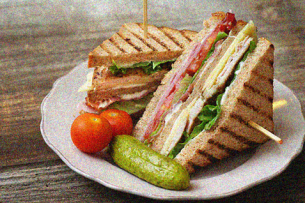
Classic Club Sandwich

club-smallI am not sure why I find the combination of elements which go into the classic Club
Sandwich so perfect, but there it is. Maybe it’s the toothpick which holds it together or the side dill pickle, but when I see one of these puppies on the menu the result is predestined. My traitorous eyes may roam over other selections, but those feeble attempts at rebellion are doomed to fail. In the end, whilst my head may be screaming salad, my heart is with the Club.  There can be only one.

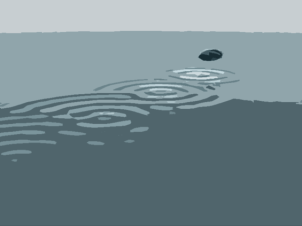
Skipping a flat stone across a pond.


I would guess a good percentage of human beings have skipped a stone across a glassyskip
pond, or at least attempted to do so. It’s odd how this shared activity connects so many of us across age, gender, wealth, religion and culture. We are excellent fence builders, finding every conceivable way to highlight our differences and take pride in our apparent uniqueness. But the things that make us unique are not our visible characteristics; rather it is in the way we think and express ourselves in word and image and song. For example, MY expression in song is very unique and quite unforgettable, try though you might <insert grinning emoji here>.  Once in a while we come across a thing of such commonality that we amaze ourselves with just how pure and simple our mutual humanity can be. Find a stone. Throw a stone. Count the skips. Welcome to the world.

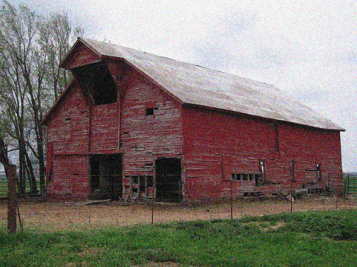
Old Barn.

Weather beaten and frayed
Rusty hinges cry against the wind;
Many years spent
staring down the sun
And keeping the rain’s tin hammers barn
From having their way.

Light filters past motes
That hang like fireflies,
The quiet song of the loft
Brings a smile to weary eyes
And the dry smell of hay
Clings to clothes and memories.

Stubborn old walls resolute;
Watched folk and their beasts
Pull food from the land
And rest a night too short
Before the rhythm rises
And the floorboards shake
With the drumbeat of the world.

Nothing built lasts on Time’s wheel
But that old barn never asks
To be more than what it is;
Out there in the still dark air
Holding back the tide
‘Till morning comes.

Fractals.

Sometimes I think my understanding of the world is ten miles wide and one-inch-deep, but I still find stuff very cool within the limits of my paramecium sized brain. One such concept is fractal geometry and the concept of perimeter.

At some point we all studied perimeter and calculated how far around it was for certain shapes like a circle, a square or a triangle.

But those objects are theoretical shapes described by a set of rules. They help us model, predict and extend our understanding of what is called “the real world”. What about “real” objects? How far around is, say, the island of Oahu in Hawaii? One could walk around it I suppose and measure each step, and that will give us an approximation of the perimeter. The closer and closer we get the more accurate is our measurement, but we realized we can’t know the exact perimeter like we would the perimeter of a geometric circle calculated by formula.  For a real object like Oahu we only have an increasingly fine estimate.frac
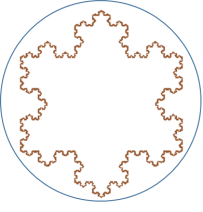
The object here is what is called a Koch snowflake, and is an example of a fractal. You can imagine that as you fly in closer to this image, each of the little “knobs” becomes a replica of the larger image, and this continues no matter how close you zoom in. The perimeter of this object become greater and greater, but the area remains entirely constrained within the circle. Eventually the perimeter of this fractal becomes infinite whilst the area remains finite, or bound.Kochsim

The real world does not consist of perfect cones, circles and spheres; it is messy and chaotic, rough rather than smooth. The “edge” of an island is elusive depending on how close you get to the surface. The study of fractals has opened up new ways to think about chaotic events and to understand how they may behave.