Sometimes I think my understanding of the world is ten miles wide and one-inch-deep, but I still find stuff very cool within the limits of my paramecium sized brain. One such concept is fractal geometry and the concept of perimeter.
At some point we all studied perimeter and calculated how far around it was for certain shapes like a circle, a square or a triangle.
But those objects are theoretical shapes described by a set of rules. They help us model, predict and extend our understanding of what is called “the real world”. What about “real” objects? How far around is, say, the island of Oahu in Hawaii? One could walk around it I suppose and measure each step, and that will give us an approximation of the perimeter. The closer and closer we get the more accurate is our measurement, but we realized we can’t know the exact perimeter like we would the perimeter of a geometric circle calculated by formula. For a real object like Oahu we only have an increasingly fine estimate.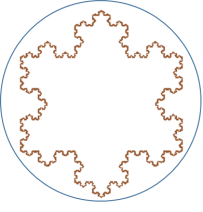
The object here is what is called a Koch snowflake, and is an example of a fractal. You can imagine that as you fly in closer to this image, each of the little “knobs” becomes a replica of the larger image, and this continues no matter how close you zoom in. The perimeter of this object become greater and greater, but the area remains entirely constrained within the circle. Eventually the perimeter of this fractal becomes infinite whilst the area remains finite, or bound.
The real world does not consist of perfect cones, circles and spheres; it is messy and chaotic, rough rather than smooth. The “edge” of an island is elusive depending on how close you get to the surface. The study of fractals has opened up new ways to think about chaotic events and to understand how they may behave.

 whoisfenton