I am certainly no mathematician. I find it cool at the level I understand things, making me an interested third party I suppose. I do know that mathematics is the symbolic language we humans have developed to try and understand the world. It forms the basis of science and engineering and thus, the built world.
Sometimes math concerns itself introspectively with math itself. The structure of mathematics hinges on progressively elaborate stages, new ideas built upon previous ideas, each meeting the stringent requirement of proof. Math works because it is logically complete, reliable and repeatable.
One area that I have found amazing is the study of numbers, which on the surface sounds like the most boring thing on Earth, but for me it contains its own odd beauty. I found this picture of the number Pi which is defined as the circumference of a circle divided by its diameter. It is equal to:
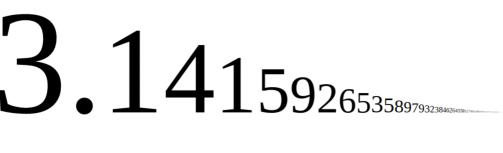
No matter how large the circle this ratio is always the same.
The picture depicts just how strange the number Pi is. As you attempt to calculate it you discover that no matter how precise you are, the group of numbers to the right of the decimal point gets longer and longer and this sequence of numbers never repeats. This means that Pi cannot be represented exactly as a fraction or ratio; such numbers are called irrational numbers. Pi is something else as well and we’ll get back to that shortly. Numbers that can be represented as fractions are called rational numbers.
How many rational numbers are there? Just when you think you found all of them you just add 1 and there is another one, so you don’t really reach the last number, ever. I like to call this a LOT, but mathematicians call this an infinite set, or in the case of rational numbers, a countably infinite set. Ok, not sure what that means but does it imply that there are sets of numbers which are uncountably infinite and is uncountably even a word?
Welcome back to our good friend Pi, an example of an irrational number. The set of all irrational numbers is provably an uncountably infinite set. While the rational number set and the irrational number set are both infinite, the set of irrational numbers is in some odd way the larger of the two, meaning that there are more irrational numbers than rational numbers. This sentence is usually followed by blank stares and the sound of heads exploding, as well they should.
And finally even though we have said that Pi is a member of the irrational group of numbers, it also has specific characteristics which make it a special irrational number – a transcendental number. All transcendental numbers are irrational, but the reverse is not true. I don’t know about you, but the fact that some numbers are called transcendental is the coolest thing ever, even as the concept leaves my neurons gasping for air.
Mathematicians think about things like this because they never know where such seemingly abstract thoughts may go. Perhaps to infinity and beyond.

 whoisfenton