I have done my share of traveling and no longer harbor the desire to take long trips. I still travel although these days it is mostly on foot. I used to walk our dog Kody around the neighborhood at night, both as a form of exercise and as part of the normal household chores. Put the dishes away, take out the trash, rake leaves, pay the bills, walk Kody. Last year Kody passed away, but I have continued to walk at night; first as a form of respect for my friend but also because I have begun to enjoy the experience itself. Walking at night is a private thing for the most part, a time to collect your thoughts as they swirl about, past and future dimly lit interchanges on the way to now. The moon and stars follow me but otherwise take little note of my passage.
I carry a small LED flashlight and will sometimes surprise a group of deer sampling the local flora. Caught in the beam of my lantern they seem ethereal; like creatures composed half of light and half of stone. Deer startled in this way normally leap away and bolt for cover, but in Spring the larger males will stand their ground or even advance upon you to measure the threat you represent. When this happens it’s my turn to leap away and bolt, although with me this takes the form of slightly faster walking accompanied by a desperate humming sound. I have expanded my route and will from time to time come across new paths and trails which connect the various neighborhoods in Chapel Hill.
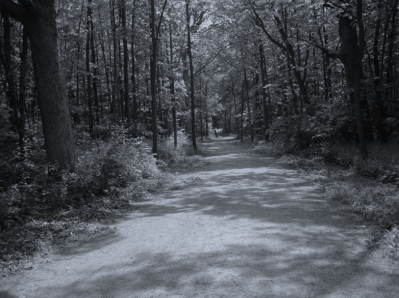
I have begun to view these little voyages into the fading world as a form of inner exploration; pushing the boundaries of all I feel and remember. I write these words; leaving a dappled trace here and there surrounded by the crouching angels of memories past and those yet to be made. The angels rise as one poised to leap and fly, but instead we move off together into the vagabond night, the promise of time reclaimed.


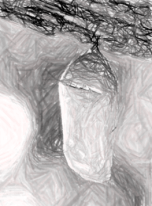 masterpiece. That a caterpillar can seal itself inside a cocoon and emerge transformed into a wholly different being is a completely unexpected and remarkable outcome. We can watch a frog grow from a tadpole but that conversion takes place in plain sight so to speak, and while it remains amazing it is at least understandable. The caterpillar locks itself away, and like an insect version of Harry Houdini appears later changed utterly as if by magic. And this is not some cheap parlor trick done with ropes, pulleys and mirrors, but actual transformation — as if Houdini, placed shackled in his sealed box, were to spring forth as a ring-tailed lemur, the man forever replaced. In the world of insects this conversion is quite common and likely evolved as a highly practical survival strategy. Metamorphosis places the young and adult versions of the same creature into different worlds, worlds that do not compete with one another. Imagine the amazingly complex interplay of events necessary to create this process over the eons. Some might be tempted to point to a higher being and say this proves the existence of God. But I find the science and the subsequent search for truth far more compelling than the guiding hand of a supreme being. But that’s just me.
 whoisfenton