Playing marbles.


marbles-1There was a time long ago when we would get an old stick and draw a circle in the dirt or draw one with chalk on the threadbare upstairs carpet. Each of us had a small sack of glass marbles as we crouched down around the circle. We put several marbles inside the ring as a form of ante. The “shooter” would “knuckle down” and fire his best marble at the pile within the circle, holding the marble in his knuckles and using his thumb as propulsion. The goal was to hit a marble in the pile and send one or more rolling out of the circle, at which point the shooter claimed the marble(s) and shoots again. It takes longer to explain it than to do it.

My brothers and I played countless such games of marbles growing marble-3up. The marbles were given labels like clearies, cat-eyes, solids and the highly-prized steelies, usually nothing more than steel ball bearings, but here given a mystical status beyond mere industry. The loss of a prized marble was a source of angst; the winning of a rare type brought forth an odd euphoria, like discovering the Holy Grail.

The game of marbles is played the world over, under many different names and guises. It uses a common language which brings people together, like members of an exclusive club called The Human Race.  So draw a ring, grab your special steely that never loses and knuckle down under a clear blue sky.
Carrying warm chestnuts in your pockets on a cold winter night in Seoul.

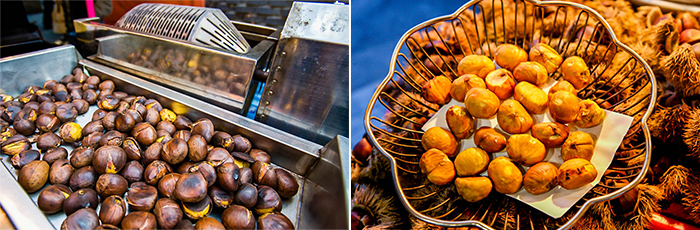
Winter in Seoul descends as an bullet-gray sky — windy, dry and cold. Once established She hangs on with the arctic tenacity of a jilted lover. The wind cuts through you and sends you scurrying into the underground, a labyrinth of wide walkways beneath the streets, lined with small shops. Hand warmers have evolved over the years, but back when I spent time there, it was common to buy steamed chestnuts from a vendor and put them in your pockets. Besides saving your hands from turning into frozen mallets, the nuts were also a snack food.

seoul-chestnuts

While I don’t miss those winters, I do miss the hospitality of the people, the history infused in ancient dynasties, the wisdom in the temples, and the soft sheen of a Celadon vase. And I remember the chestnuts, warm and comforting, offering the distant promise of spring.

Fungal mats.

Sometimes the most amazing things exist literally beneath our feet, occupying a subterranean space unseen in day to day life on the surface. We do see the fruiting bodies of these fungal mats and call them mushrooms, but the actual entity is the connected life-form living in the soil.a424377aae106fe76d377df116a28481

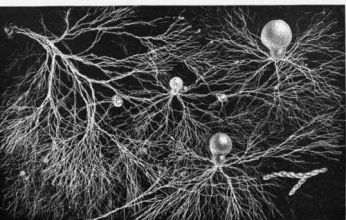
One such fungal mat discovered in Oregon is being thought of as the largest single organism on the planet, occupying over 2300 acres of soil — nearly 3.6 square miles.  It also may be nearly 9000 years old.   Imagine a single genetic individual organism that large that has lived so long. 

Pictures of the connected filaments, or mycelium, of fungal mats bear a striking resemblance to the network of neural cells we carry around in our heads.   I wonder if, in its way, this great being has been dreaming there in the dark all these millennia, arriving at truths beyond our grasp?  What language, what songs, what memories?

The public water fountains in Portland, Oregon.

It has been years since I had the pleasure of visiting the lovely northwest city of Portland Oregon. Portland is one of those places that stays with you long after you leave. The distant Mt Hood beckons as a kind of terrestrial anchor holding the Cascade Range tightly to the earth, so high that it catches the clouds themselves to leave desert beyond.  The Multnomah tribal name for Mt Hood is Wy’east.  Its mythology is filled with legend– stories of love and sorrow and of great battles won and lost.fountain

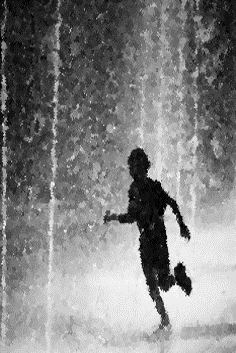
Portland is called a “walking city” with downtown streets festooned with public drinking fountains called Benson Bubblers. They are named after philanthropist Simon Benson, who donated the money to establish the fountains in 1912.

I am old enough to remember drinking from the water hose in the heat of summer, and even old enough to remember bending down to drink from a cold underground spring, tadpoles visible on the bottom.  How times have changed. Our water now comes to us in plastic packages delivered by large industrial trucks with colorful advertisements on their sides.

Portland asks us to remember earlier, simpler times. The bubblers are tadpole free and mountain clean, a simple gift to all who pass this way.

The erratic flight of bats at night near street lights.

For me, of all the creatures that live in the night the bat stands alone. During the cold Maryland winter my brothers and I would open the ceiling hatch, get out the ladder and go up into the attic. The bats would be there, wintering over right next to the warm chimney bricks.  We would gaze upon them with a kind of envy, so mysterious and alien were they, hanging upside-down with a quiet rustle of leathery wings (them not us). My mother was terrified of them and would stand at the base of the ladder and beg for us to be careful, convinced that each bat was laden with a virulent form of rabies; literally death on wings.

These little beings of such fearsome aspect are for some, like my mother, the stuff of nightmares. For others the bat is forever linked to a certain comic book hero who races through the streets of Gotham City, laying waste to the bad guys. For me though the bat plays a part in our world well beyond the printed page or silver screen.bat

When I walk at night I like to watch them swoop and dive under the street lights, using their sophisticated radar to track and catch insects. Their flight is wholly distinct from the graceful soaring arcs of birds; rather, it consists of a series of abrupt discontinuous changes in direction. This pattern must be efficient — a hunting brown bat will eat its body weight in insects every night. Imagine how many more insects there would be without the bat out there doing its part.

The brown bat has recently been under siege by a kind of fungus which attacks their skin during hibernation.  It has proven to be over 70% fatal to certain species and some large colonies in the northeast have been completely decimated. Has this fungus appeared because of some change we have wrought upon the world, or is it just another lifeform which exists to provide balance in all things? If I have to pick a side I will side with the bat, if only to keep Gotham safe.

Writing down a dream you had.

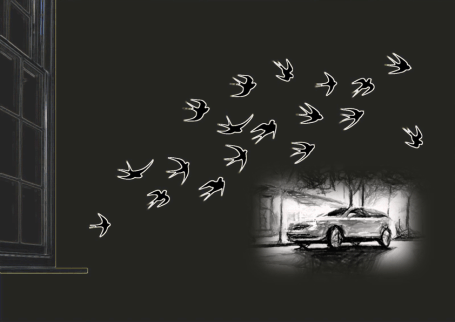
There is a pattern to my dreams. They often seem to involve my losing track of something important and trying to find it. The thing that is lost is usually my car, which I have parked somewhere, gone to a meeting or something and now it’s not where I left it.

night-car-1

I am convinced it has been stolen but in these dreams I don’t seem to know what to do. So I end up worrying, trying to convince myself that maybe it will show up at any moment. A corollary to this dream has me being late for a meeting and getting lost on the way. I know the address of the building and can see it in the urban distance, but no matter how hard I try I never seem to get closer – and the clock is ticking. So I have this car that seems to have gone missing and a meeting which is about to begin without me. Perfect.

After waking in a cold sweat more than once, I started writing these subconscious vignettes down. The process of recording the dreamscape seemed to help break the pattern, like finding the key to an old door. It’s funny how the mind keeps on working at night after the rest of you has shut down. My car is out there somewhere, but maybe I’ll just catch a cab and trust that the cabby can find the building.

Bibimbop.

bibimbop1

I lived in South Korea for several years and grew to love the country and the people there. Korean food is distinct from all other foods I have sampled in its dependence on vegetables that grow on or directly beneath the ground. It is rough-hewn, simple and aromatic. Kimchee, the fermented cabbage is a staple at nearly every meal. I will admit that I was never brave enough to sample more than a tiny percentage of the Korean culinary landscape, but one dish I dearly love to this day is bibimbop.  Bibimbop literally means “mixed rice”. It consists of rice, thinly sliced beef, spinach, soybean sprouts, mushrooms and is often topped with an egg. It arrives at your table in a sizzling clay pot in which you mix the parts together with a dollop of gochujang; spicy soybean paste. The mixing of the food in the hot pot cooks the egg, a requirement for me because, guck. I know my description doesn’t sound very yummy, but next time you go to a Korean place, try the bibimbop and amaze your friends!

Murmuration.

Most of us have seen film or watched real-life flocks of starlings change direction in mid-flight, morphing into fantastic three dimensional shapes. It’s natural to ask, how do they do this together? And equally, why?  This synchronized aerial dance is given an uncommon name, murmuration, which leaves most spellcheckers curled into a fetal position wondering, what fowl trick is this? I am only clever once per day, so please pay a small tithing to Henry, God of Puns.

murmuration

As kids we would play the game of Telephone, where one child would whisper the secret phrase or sentence into the ear of the child to left (“Fred is weird”), who would repeat what they heard to the child to their left and so on, until the last child (Fred) is asked to repeat what they heard (“Feeglebop”), much to the merriment of all and relief to some. A physicist would say that in the game of Telephone the signal-to-noise ratio is low, meaning lots of noise and little signal.

In a murmurating flock of starlings the signal-to-noise ratio is very high and this allows for a small motion left or right or up or down by one bird to be instantly mimicked by neighboring birds — and thus the message traverses the flock almost perfectly and the birds don’t collide. And what is this mysterious message?  Since murmuration almost always occurs in the presence of a nearby predator, it seems to be, “there is a hawk nearby”.  Without the high signal-to-noise ratio half the birds might hear, “Let’s get some french fries”, leading to some rather frenzied transactions at the drive-thru. Murmuration allows the entire flock to conduct evasive maneuvers and not leave some poor devil who zigged when he should have zagged hanging out there destined to *become* a happy meal.

One more odd thing about murmuration. There does not seem to be a leader or conductor of the flock. Any single bird at any moment can initiate this real time choreography, which might account for the extraordinary swirling complexities of the flock.