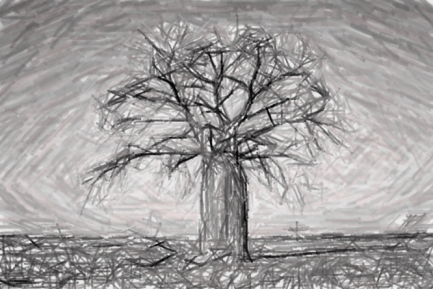
Nature has a pattern of producing forms of nearly infinite variety. One of the most compelling and unusual is the baobab tree found on the arid plains of eastern Africa and Madagascar. The baobab is sometimes called The Upside Down tree because its branches resemble the root systems of other trees, as if had been planted by some early farmer who failed to follow instructions.
The wood of the baobab is quite soft and water saturated, allowing the tree to survive in the desert during long periods of drought. Lacking traditional rings, the age of the baobab has until recently only been estimated through the traditions and folklore passed down from the native peoples who live amongst these ancient beings. Carbon dating techniques now place the baobab’s life expectancy at one thousand years, give or take a century.
When a baobab dies the thick trunk collapses in on itself, the resultant wood particles blown away on the desert wind. Thus, the tribes of East Africa believe that the baobab does not die, it just disappears. These strange trees have been out there for centuries, silent gatekeepers holding witness to the slow ebb of life in the desert.
I have never seen a live baobab nor stood next to one, but that would be something to do one day — to listen to their stories out there in the cathedral of dry sand and subtle wind. Perhaps they might want to know why we race hither and yon, building and rebuilding the world? And why we insist on doing so upside down?

 whoisfenton