Uncanny valley.

I have long been intrigued by the advancements in computer graphics over the years. Extremely high resolution animations are commonplace on PCs today. Immersive 3D is moving from a curiosity to a useful tool.

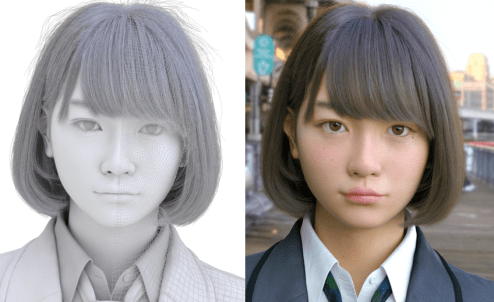
As image resolution has approached and exceeded that of the human retina, animations involving human-like characters has uncovered some heretofore unknown phenomena with respect to human perception. As human facial characteristics and images move from the cartoonish to the ultra-realistic, we undergo a kind of discomfort when viewing faces that are close to real, yet slightly off. This is called the “uncanny valley”.

151020_fut_uncanny-valley-curve-jpg-crop-promovar-mediumlarge

It is not clear why these close approximations are disturbing – perhaps we sense there is something untrustworthy afoot and we do not like to be fooled, as we might feel if we see a painted clown smile on a person who may not be happy at all.
real

I await the day that we will be able to accurately render a realistic avatar on screen, an actor who exists entirely as images and algorithms, but who has never known life as we understand it. This “person” may also someday be infused with the ability to behave autonomously with an understanding and access to the enormity of the connected world. And then I wonder if, as it gazes out at us through its high-res lenses, it experiences a momentary pang of uncertainty and questions whether we are in fact “real”?

Collecting coins.

coins

At our core we are all collectors. I remember in the second or third grade being asked what hobbies I had. I told the class I was a numismatist, only to watch in horror as the class lapsed into a somnambulant state, barely sentient yet watchful and aware. “I collect coins!”, I burst out in a wild attempt to avoid childhood trauma and return to my normal state of being merely weird. I want to believe there was an audible gasp at this revelation, but I suspect everyone simply returned to their crayons and compasses.

I saved up my money to buy, well, money; but not just any money — rare coins worth possibly dozens of cents. We would buy shiny, mirror-like proof sets hermetically sealed in plastic boxes and announce to the world, “untouched by human hands”, as if these were a kind of peculiar circus act. Millions of years from now they will be found by alien explorers, who will wonder what odd people produced these carvings and their purpose.

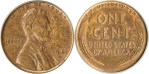
Back on Earth, my brothers and I would read about actual rare coins created in error at the mint. These misshapen coins would be released into the wild to appear like Easter eggs in a strawberry field. They shouldn’t be there but hey, eggs. Key elements of coin metrics include the type of coin, the date minted and the location of the Mint; “D” for Denver; “S” for San Francisco. No mint mark meant Philadelphia obviously, as the “P” is silent. Because so few of these mistakes were produced they became extremely valuable, approaching the stuff of legend.  mint-errorThis penny for example, sold for $210,000 at auction in 2010.
 

We still collect things, you and I, looking for that unique coin or concept. We hold these in memory, anchors to the past, bridges to the future.

The word “Troubadour”.

troubadours

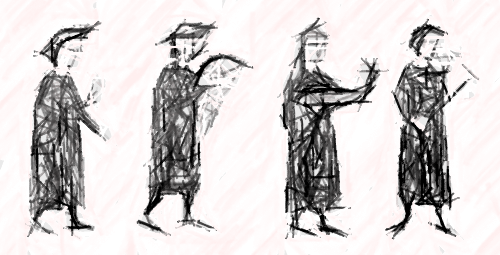
In my mind’s eye I see these medieval minstrels carrying their songs with them, walking through the town square. I see folks looking up from their busy day and smiling, hearing the banjo, guitar, lute and mandolin weaving their lyrical stories like audible histories passed from generation to generation. The word ‘troubadour’ has been around since at least the 12th century, but I wonder if the first music made by the earliest humans did not owe its appearance to groups of impatient musicians who decided to set off down the wooded path. Today our electronics brings the music to us wherever we may be, but there is still something essential about the troubadours coming to your town, riding the notes of the mandolin and the song of the lyre.

The toads that gather under the streetlights on warm evenings.

toad-1

When I do my walkabouts I tend to notice the small things around me.  The world is really built upon such things, all connected like the random scattering of straw upon the earth; forming unseen patterns we sense but cannot see. I walk past the toads congregating under the street lights, they having learned the behaviors of winged insects and their compulsive relationship with light. The toads do not think this through as we might; the light attracts the insects therefore we should go to where the light is. That would be too indirect and reasoned. Rather I suspect the toads move to where the insects are and are not at all concerned with causality. Thus they have a different stimulus, a sensory code written long ago in the web of life on earth. Without the light the insects move wherever they will, and the toads will find another spot, and these words will change as well.  I wonder about that story and if it will speak to who we are and of our place out there in a sea of darkness on the winds of light.

The word “guffaw”.

guffaw

The word “guffaw” is not seen often anymore having given way to laughing, chortling and god forbid, giggling. It is unclear exactly what a guffaw sounds like but the adjective boisterous comes to mind, a laugh produced in an unconstrained way, just prior to lapsing into an alcoholic coma. It’s really too bad that a guffaw is not a kind of bird, because then we could describe that day when a flock of guffaws descended upon us, and then shuffled about in that weird little dance they do. But sadly, and with a sly chortle or two, we accept guffaw into our small but growing list of cast aside words. Welcome guffaw, there are plenty of chairs up front.

Kuching, The Cat City of Sarawak, Malaysia.


One of the many good things about living in Singapore – besides living in Singapore – is that it is a great place from which to visit nearby places in southeast Asia. One such place is the island of Borneo. The southern 75% of the island of Borneo belongs to Indonesia, who call it Kalimantan. The northern part of the island consists of the East Malaysian states of Sarawak and Sabah, as well as the sovereign nation of Brunei. A number of years ago we had the opportunity to spend a week in the city of Kuching, Sarawak, Malaysia.

kuching-cat

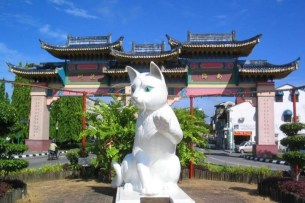
Kuching is sometimes called the Cat City, and its streets and marketplaces are festooned with statues of cats, some rather garish and scary like the one shown here. The reason why Kuching is called The Cat City is not entirely clear, but best guess is that the Malay word for cat is “kucing” so, duh. Another possibility would be that it is named after the pervasive fruit “mata kucing”, but then the city would have statues of fruit all over which would make this accounting far less interesting and exotic, albeit equally garish and scary.

rafflesiaarnflw1

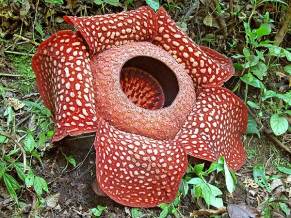
Mountain mists have shrouded the rain forests of Borneo for over 250 million years. These ancient forests support a biodiversity equal to any on earth. We were able to see (and smell) the Rafflesia flower, a form of parasitic plant that emits a rotten meat odor to attract flies for pollination. The Rafflesia are huge and alien, several feet across and looking like they just arrived from Alpha Centauri.

But then perhaps it is we who are the alien species, late to the party and sipping wine over in the corner. On Borneo we are seeing the world as it once was before human beings came down from the trees.

Long ago. Far away.