Random Walk.

I think of mathematics as if it were a real world. You open the door to your house, walk down the path to the road and head off into “Mathlandia” taking any direction you choose. Unfortunately for me, my journey into this world begins and ends just beyond my front door. From there I observe the vast universe of mathematics, impressed with its scope and power. Then I pick up the morning paper and go back inside to see what odd foibles we have been up to whilst I was sleeping.

It is from this lofty perch as math observer that I thought about the concept of
“random walk”. Imagine a drunk as a skunk party goer clinging precariously to a lamppost. It is late and he must get home but seems to have lost his way, if in fact he ever had a way to begin with. Nonetheless he departs the safety of the lamppost and embarks on a series of short staggering journeys which take him hither and yon in a chaotic pattern.
Our good friends at MIT made this little graphic of not one, but seven such wandering souls.

After a series of “N” random lurches of average distance “r” you can approximate how far from the lamppost our brave explorer has gone. And this is where math goes from merely interesting to way cool, bro. This little mental exercise in drunken hijinks has practical application in myriad fields, including gas diffusion, bacterial colony growth, financial market behavior, and even baseball!

Under our seemingly chaotic world a structure exists — awaiting discovery – out there in Mathlandia.  Get out there!

The word “scallywag”

scallywag

This word has an uncertain origin but it does look a bit like a useless lay-about, a person of slightly ill-repute whose crimes are equally petty and minor. Referring to someone as a “scallywag” these days is likely to get you quizzical stares or perhaps a more bellicose response if the target senses a certain negativity in your constant braying. So if you call someone a scallywag, do so in a lighthearted and whimsical way, lest you happen upon a mean-spirited etymologist or reclusive crossword puzzle fanatic, in which case prepare for some seriously superficial banter.

Sleepy Grass (Mimosa Pudica).

Most plants appear to us to remain still or at worst move very slowly as they follow the sun. Plants that move quickly are considered novelties with the best example being the Venus Flytrap, with its gaping mouth and scary looking “teeth”.

In Singapore and many other tropical places we would find a type of plant called “sleepy grass” or the less common scientific name Mimosa Pudica. The kids would always be amazed at such small miracles and would play with them for hours. Well the closing up part; they take 15 minutes or so to open back up and this exceeds a child’s attention span by 11,000 percent. I found this animated GIF file which shows the effect. Hypnotic, no?mimosa_pudica

The exact point of this “sleeping” is not fully understood, since it extracts a fairly large energy penalty on the plant. It may be done to reduce the desirability of the plant to herbivores or perhaps to dislodge voracious ants or caterpillars.

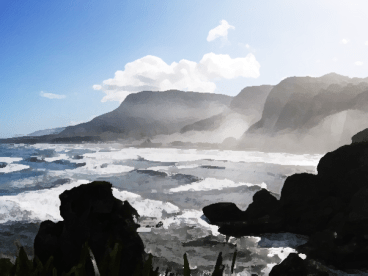
The smell of salt spray from the ocean.


As you grow closer 
you sense its power,

A kind of gravity
that bends the air and light
like a bow stretched taut
across a newborn sky.

You know the sea in pictures, salt-1
A distant frozen horizon,
the eager waves in ragged lines,
Exhausted runners race and lunge
To finally rest
Prone upon the jagged shore.

But reality transcends
Mere words and film;
Assaulting every sense-
Fickle sun uneasy glints
Off a reckless surface;
The sound of waves
Pummel the sand
As gulls wheel and cry above,
Cautious in courting rare refuge,
knowing their time in the sky
Will end now and then.

The wind comes
With ripples and swells,
perhaps jealous of unrelenting tides;
The same air surrounds and holds you;
A mother caressing her child
Lost upon the land
Now found.

But for me 
The rich smell of salt
Most defines the sea,
Primordial, wild and free,
Braced upon the sand
With bleached air all around
We are forever changed, 
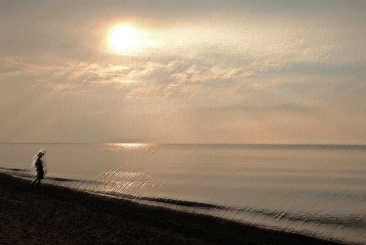
Even in the stillnessperson-standing-on-shore
Of far mountains
And forgotten shores.

We are drawn you and I
To remember the place we began
And will one day surely return,
The salt clings to us as we sleep
And dream of sand and sea
And home.

Hana Highway.


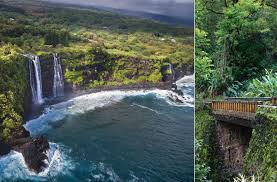
maui-hana-highway-adventureThe turns are relentless, requiring absolute attention lest you, your car, and your passengers take an exciting — albeit short – trip to the Pacific Ocean.  Thus, driving to Hana, Maui from Kahului is not for the faint of heart, but like most memorable trips the overused phrase, “the journey is the destination”, seems to have been invented for Hana.  

hana-3The 50-mile trip can be a physical grind with its over 600 hairpin turns along the cliffs, so the best way to approach it is to block a day and stop frequently.  The scenery is a visual wonder, and history awaits around every curve, full of slack key surprises, hidden paths and secret pools rumored to contain magic.

For me the memory of the blue sky above and bluer ocean below exists like a dream, evoking what we must imagine Heaven to be like.  The Hana Highway turns 90 this year, a grand old journey worth experiencing at least once in your life — to a place that time has remembered and you will never forget.

road2_hana_maui_discoverhawaiitours_685x300


The saying, “slow as molasses in January”.

Imolassesf you asked me to describe the taste of molasses right this minute I would be hard-pressed. Yet as a child this form of sugar was common on pancakes and other, um, things. Yet if you gave me some right now and I tasted it, all the memories would come flooding back — yet the description of the flavor would remain elusive — it is one of those things that tastes only like itself. It is deathly sticky too, and once on your fingers you will be instinctively compelled to seek water and soap, specifically Boraxo, a hand soap designed by shadowy soap scientists capable of removing any substance from your hands, including the first few layers of epidermal material.
glub-1.png

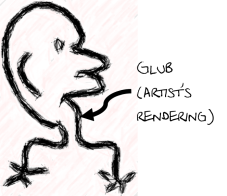
Molasses is thick and as it cools it gets thicker and thicker which gives rise to the phrase “slow as molasses in January”.  I have nominated this as descriptive phrase of the year, along with “I was born at night, just not last night”, and “If it was a snake it woulda bit yah”. Glub, God of Phrases, will cast the tie breaker.

I used to imagine that molasses was pumped directly from the ground and transported across the dry plains of the Serengeti in great metal flasks as tall as a man. Then I woke to the fading sound of heavy hooves on cobblestones and the scent of lilac in the air. A dream?  I think not.

Surface tension.

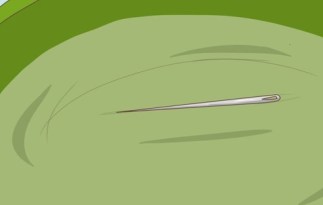
Look, I get it. Most people don’t walk around thinking about surface tension. Yet it exists wherever there is a boundary condition. It enforces shape upon the world and is basically needle-floatscool. I remember this little experiment we would do as kids, betting each other that we could make a steel needle float on water. Place a small strip of Kleenex in a bowl of water. On this floating piece of paper carefully place the needle. The paper soon saturates and falls away yet the needle continues to float all by its lonesome, held up by the force known as surface tension.
water-on-leaf

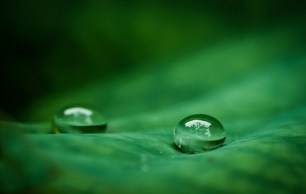
Raindrops on a leaf display this magic as well, as they form flattened spheroids held together by a kind of “skin”. They are flattened because of Earth’s gravity, otherwise they would form spheres. A very important question is whether the water droplets *roll* off the leaf or *slide* off the leaf. You will be happy to know that they in fact *roll*. Those of you in the “slide” camp will just have to plot your revenge. By the way I note in passing that WaterSkins would be a good name for a rock band.

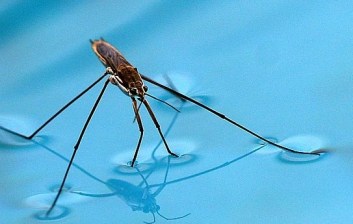
And life itself has found a way, he says, stealing a line from Jurassic Park. Insects water-striderscalled water-striders glide across the surface of streams and lakes, quite literally walking on water. The pads on their legs and feet are perfectly shaped to balance their weight with the force of surface tension. They clearly read ahead in their physics textbook and anticipated the ol’ floating needle trick. I can imagine an awful lot of water-striders met a watery fate until those smart folks back in the evolution lab came up with the perfect foot design.
Call it “surface intention”. Heh.


Baseball.

baseball
Baseball is a story. We want it to be just a game where we catch and throw and hit and run. Grab a bat and ball and glove and maybe a hat creased to look like your favorite player. The field is level and might only be an open pasture where that line of bushes is a home run and the old oak is the foul pole. But baseball grows on you and works its magic because everyone can play everywhere.

A kid in Panama uses a tattered ball wrapped in tape and a cardboard box for a glove. He makes it to America and for 20 years throws one pitch, The Cutter, that no one can hit. Mariano Rivera is one greatest players to every play the game, yet somehow grows to be an even better person.

A shy kid from the hardscrabble plains of Oklahoma is thrust into the limelight of New York at age 19 sustained by pure natural ability. Mickey Mantle earns the harsh lights of fame but it costs him, and everyone who watched him play wonders how good he could have been without the booze and the 24/7 party life.

Pedro Martinez was a small man with an arm so quick no one could hit him for 10 years.

Ernie Banks missed seeing his Cubs win the Series, but somewhere he’s playin’ two.

The Jeter flip. Say Hey Willie Mays and The Catch. Ichiro and The Throw.

Stan The Man. Ty Cobb with spikes up high. Joltin’ Joe DiMaggio, where have you gone? Ted Williams sees the stitches on a curve ball before launching it over the Green Monster. The Babe calls his shot, and Lou Gehrig is the luckiest man alive.

Our world may not be so grandiose. Thousands do not not cheer our every move or live vicariously through us. But out there in the early Spring with the air full of promise and passion, the baseball stories we make, make us.