Pictures of Winter.

I have never been a fan of cold weather.  This is likely a result of my spending a significant portion of my adult life in tropical climates, watching my plastic lawn chairs melt. Yet, given a choice between 100 degrees Fahrenheit and zero degrees Whatever, I prefer the cloying madness of the Venusian summer to the bitter cold Martian winter.

forest-snow

But here on Earth I admit to a certain fondness for pictures of wintry, snow-covered landscapes, where water itself has apparently given up the ghost and joined the world of solid things. Such photographs conjure a world where hard edges are translated to soft curves, as if the land has conspired with gravity to catch you if you fall. In this picture-world I can imagine the harsh sounds of summer muted like a bell wrapped in wool.

As I gaze at such images I can appreciate the simple monochromatic grace without the accompanying wind chill. And I am cheered by the fact that I need not wrap myself in multiple layers of clothing to go outside, covering all exposed surfaces until I resemble a great round flannel ball, giggling like a loon.


Instead I can simply admire the purity and power such scenes convey, out there on the frozen tundra, a windswept surface whose uniformity is marred only by the irregular lumps of certain foolhardy loons who defied Kelvin’s First Law of Winter: Beware The Tundra – Unless We’re Talking Trucks, Then Head On Down That Lonesome Highway Good Buddy.

Pictures of winter suggest a place I can travel to in my mind whilst safely ensconced in the warmth of the Venusian Summer, surrounded by unused antique mukluks and faded copies of Loon Quarterly.

The Anchor.

Windswept and tidal games
anchor-1It seems we move
Under directionless dark guides
Inertial forces in play around us
Unseen and relentless,
A vice-like grip on slipstream currents
Carrying us away like brittle leaves
On dry sand rivers.

The anchor drops and holds
Back remorseless pressure,
Marking a spot upon which we stand
And plan a path of our choosing;
A secret door in time
Firmly fixed with black lock
And golden key.

Down deep the heavy anchor
Persists in light-less certainty;
Ignorant of raging storms above
Doing the thing
That gravity demands;
Embrace the earth
And guide us home.

Empathy.

Whether we believe in the concept or not, we all are endowed with the capability to empathize with another, to understand and relate, to reach a kind of common ground. We find ourselves at times waging an internal war between our self-interest and our realization that the well-being of our fellow humans is equally important because we depend on one another. Empathy can take us outside our skin and imagine what others feel and think. And it is not the case that self-interest is somehow “bad” and empathy is therefore “good”, but that both emotions have a role to play in our shared reality. Taking the time and energy to understand one another seems to me to be a key element in the survival of our species. Empathy provides us the tools to stand together as one.

empathy-2

Hypothesis.

I am mildly perturbed by a recent uptick in the disparagement of science and the scientists that practice the craft. These discussions often involve two components: (1) scientists really don’t know anything and are just guessing; (2) The things they *think* they know are just theories.

Scientists do make guesses and those guesses are called hypotheses. These ideas are put forward with as much knowledge as is known or observed at the time, and are then subject to rigorous and prolonged testing by people that “believe” the hypothesis and by those that do not. This testing process, done properly, gains as much understanding through an unsuccessful test — one that fails to support the hypothesis — as an successful one. In this sense both outcomes are equally valuable in the unbiased pursuit of knowledge, because a negative result can help us avoid the abyss, a place we need not go, unless you are a shadowy *abyss scientist*.

Suppose I form a hypothesis that the moon in the sky is a giant ball of mozzarella cheese.  I further suggest that if we could ever get there we could have pizza uninterrupted for the next 11 billion years.  After going there we discovered, through observation and testing, that the moon was cheese-less and our hypothesis had to be abandon.  If you run out of pizza this weekend, don’t blame me.

Only after a hypothesis has survived the gauntlet of testing does it move gradually into the category of theory. The testing of theories really never stops because each tested theory provides a stepping stone to the next hypothesis, and so on. For example, *gravity* is still a theory even though it behaves precisely as predicted over hundreds of years.  Moon cheese didn’t make the cut.

discovery

This method of systematic discovery seems to “work” in the sense that our modern world is built on the results.  I mean omg, airplanes *fly*.  How is that even POSSIBLE?

We humans have been blessed with the ability to figure things out and I personally find this process of discovery to be one of the many good things about our species. Well, that and baseball.


Clouds.

Those of us who look up at the sky, and that would be pretty much everybody, have grown to expect a broad range of sky-like behavior. The sky has as many moods as can be expressed in words, and don’t get me started on night.

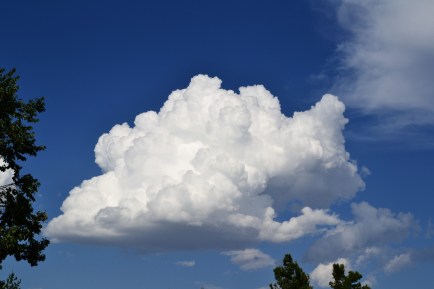
I was talking to my daughter during one of our walks along the banks of the Eno River. She opined that while a deep blue cloudless sky gives a sense of the infinite, she much prefers a blue sky filled with dense white cotton clouds, providing a depth, context and narrative.  Also, as she points out, it’s not “boring”.

cloud1

And I think I get that. Clouds that are heavy and defined put edges on what would otherwise be a featureless canopy. A clear blue sky we may glance at, but fill that same sky with mottled cotton and our imaginations are filled with images of unicorns and spaceships and look! — a profile of your long-departed grandfather, still watching over you.  At this point any mention of “minions” will spoil the mood.

Once, on one of my many early evening walks I saw distant clouds illuminated by a low sun. These clouds were roiling gray-white and filled with bursts of lightning flashing on and off like enormous flickering light bulbs. I was too far away to hear the thunder and feel the rain which I, as mere witness, know is happening out there in the gloaming and the rising wind. I observe the beauty of the storm but do not suffer its consequences, like viewing an oil painting of a great and terrible battle.

What triggers us so, this need to convert the random drifting of water molecules into meaning and memory? Perhaps it is our basic human curiosity trying to make sense of it all and connect the dots of our world. Or maybe, just maybe, we briefly assume the role of Nature’s poets, looking up at the infinite and sensing our place in the universe of things.