Before the advent of electronic toys, computer graphics and 3-D virtual reality games, the lowly and stalwart crayon could be found clutched in the sweaty paws of millions of kids. These colorful waxen tools were how we translated the real world onto paper, with fish and oceans and trees and clouds. And stick figures climbing mountains. And bright yellow sunflowers opening upon a green field. Picasso’s we were not, but we made the world as we saw it and the crayons came in just the right amount of colors (120) to satisfy our nascent yet demanding palette. The tear-off paper covering was genius, exposing the crayon without relinquishing the grip. We used the pencil sharpener to refine the blunt instrument into a surgically precise waxen blade, designed to stay inside the lines at all costs.
Crayola began making crayons way back in 1903, and much to my surprise they are going strong, producing upward of three billion annually. They also sell colored pencils, chalk and my personal favorite, Silly-Putty [tm].
One Christmas I remember getting the 120-crayon box with precisely one crayon for every color they had. I flipped open the box and looked upon them, brilliantly arrayed in tiers like a church choir. And though we didn’t have much back then, on that day I had more than I needed.
(This is a story I wrote some time ago, from my time in Singapore)
The old man pushes an ancient shopping cart along the street in front of my rented terrace house. His body is bent; bony shoulders stooped under the weight of time. He and his cart have seen better days.
He calls out to each home he passes in a cracked and warbling voice, asking us to bring out old newspapers. His mission today, as always, is to deliver his load of paper to the nearby recycling center. I know that given his glacial pace each trip will take more than an hour, cart by laborious cart.
He is a throwback to an earlier Singapore, a Singapore nearly forgotten in this island-state’s headlong rush to the future. Yet there he is defiantly pushing his cart of paper, showing us that he has preserved both his usefulness and his pride. As he shuffles along I can hear the gentle slap of his slippers on the pavement, the squeak and rattle of his rusty pushcart and the tremolo of his voice – a timeless chorus of renewal sung against the backdrop of our recycled history.
One fine equatorial morning I leave the flat early to catch the bus to the University. I am halfway to the bus stop when I see the old man pushing his daily burden of papers up the road in front of me, and it seems to me that he has miscalculated and stacked his cart too high. I watch in dismay as his load slides off onto the street and lands with a series of audible thuds, restoring the sovereign state of gravity.
Something seems to go out of him then, as if the whole thing – the effort, the burden, the journey – has become too great to bear. He sits down at the curb and places his head in his hands, his posture a testament to life’s cruel mercies.
A young girl of no more than 11 or 12 years rides slowly by on her bike. She is wearing a blue middle school uniform common in Singapore. She slows to a stop, dismounts and begins to pick up the scattered papers, placing them quickly and efficiently back into the shopping cart, as if performing a common chore. She gives the cart a quick shake to insure against a repeat catastrophe. She then walks respectfully to the old man, offers her hand and helps him up. He stares down at her and smiles uncertainly as if agreeing to a new and unspoken contract. She pauses to review her handiwork – cart and man – mounts her bike and pedals off to a future at least as bright as the rising sun. She does not look back.
I am the only witness to this muted single-act life play. No more than a minute has passed yet it resonates with a kind of permanence outside the sweep of time. The old man places his hands back upon the cart and resumes his circadian duties, though it seems to me that he stands a little straighter. As do we all.
I cannot say how often such events occur around the world unreported in major media outlets. We have all seen the tricksters, the charlatans, and the self-important and it is easy to assume that those people are the mainstream; that if you roll back the curtain you will discover that deep down we’re all just faking it. Maybe we have become too cynical and suspicious to remember the many little acts that play it forward. Maybe you have seen such things or done such things or been on the receiving end of such things and forgotten them.
But I have not forgotten. I do not believe they are in any way random; rather, they are full of purpose, succinct and compelling – a bunch of imperfect Earthlings trying to get along as best we can. A pebble strikes a glassy pond and ripples roll out fated to touch distant shores. On an obscure Singapore street that morning I saw such a pebble fall.
All over the world life seems to happen when we least expect it, but in actuality life is happening all around us; second by second, deed by deed. It is in these little acts that perhaps we can take a measure of grace, and understand that this thing thought lost is forever found.
Once, while playing a pickup baseball game in the park behind our house, I raced back to snare a long fly ball, turning my head to track it in flight. Unfortunately for me this particular field had some picnic tables in the “outfield”, tables I had forgotten were there. I ran smack into them, and the next thing I knew I was staring up at the sky with the other players looking down upon my lifeless body. They told me that when I hit the tables at full speed I stopped, stood up and then fell over on my back, apparently with the wind knocked out of me. This event was scary, but it didn’t lessen my obsession with baseball.
I immersed myself in the game but it wasn’t until much later that I began to appreciate the finer points, the game within the game, the subtle strategies that can make the difference between winning and losing. As a kid all this was beyond me because it was hard enough to hit a round ball with a round bat or of chase down a long fly ball to left center, picnic tables be damned.
My hero in those days was Mickey Mantle, and since the Mick played center-field, I did too. The Mick was a switch hitter so I was too. At some point the coaches realized that I didn’t have the strong throwing arm or other athletic tools needed to play the outfield, so I got put at first base, the position most favored by tall, clumsy players who can hit.
I think it was around this time that I started to move away from the game, at least as a participant. Playing the infield brings you much closer to the action and it penalizes those people who have a tendency to drift away and think about other things. In the outfield it’s possible to contemplate the workings of the universe between pitches, and you are so far away you might as well be a spectator. Oh look, a squirrel!
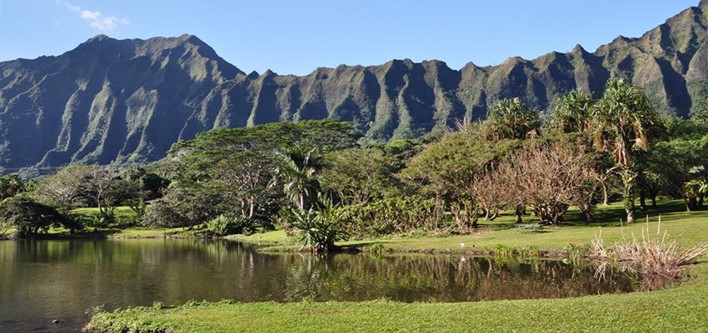
It is expensive to live in Hawaii, but the best things there are free or so the story goes. The mountains, the sea and the ever-present volcanic earth are simply waiting to be experienced. I lived on Oahu from 1968 – 1987 and learned to appreciate and respect the land, especially on the hiking trails balanced on knife blade ridges or meandering into deeply creased valleys.
The Koolau is not a mountain in the classic sense. It is the edge of an ancient volcanic caldera which has been worn away by the effects of wind and water over thousands of years. But we are small and it is large, so it might as well be a mountain.
From the leeward side of Oahu it is possible to climb to the very top of the Koolau Mountains and look down upon the windward side and feel the power of the great gale whipping vertically up the cliffs.
Koolau Range
There are those brave few who will hang-glide off such places, defying gravity suspended below their brightly colored nylon kites. I have always admired them, their bravery in taking that first step into the open air, trusting the wind and their engineering.
Climbing up the Koolau mountains is like passing through a series of open air rooms, each with its own decor. You start by walking among the ferns and bamboo, lush, green and primordial. Higher up will be the majestic ironwood trees with their thick trunks, dark and sturdy as a fortress wall. The wind blows through the ironwoods with a sighing sound that is the tenor against the deep baritone calls of the humpback, singing to us in a symphony we once knew.
Higher up still are the grasses and rough shrubs clinging to the rocky soil like barnacles. Here in the wild wind the air is fierce with a peculiar dry scent that is so compelling as to create a memory all of its own. I remember it to this day, all these years later.
Now that I think on it the best things in Hawaii may defy enumeration. The best things give back far more than than can be measured in the mathematics of memory.
Those of us who have lived in or visited SE Asia will speak of the sights, the sounds and revel in the ancient cultures, at once mysterious yet oddly familiar. But talk of SE Asia inevitably comes round to the food, and this little blurb is no different. Indonesian food, so savory and rich, is as amazing and varied as the country itself. One of my favorite things is Indonesian stir-fried rice, or Nasi Goreng. Although I am not a huge fan of spicy foods, I find the aromatic mix of spices and soy to more than balance the chili, and I have been known to wolf down great quantities whilst keeping a flagon of water nearby. I am not sure how much a flagon is, but I hope it translates to multiple gallons in the irrational English system of measurement.
Try the Nasi Goreng on your next visit to the ol’ kampung (village). Guaranteed to please.
And sometimes, sitting in my chair I can feel the absence stretching out in all directions– like the deaf, defoliated silence just after a train has thundered past the platform, just before the mindless birds begin to chirp again –and the wildflowers that grow beside the tracks wobble wildly on their little stems, then gradually grow still and stand motherless and vertical in the middle of everything.
~ Tony Hoagland
We are nearing the end our little trip into the past and inevitably, the future.
From Burlington we planned to take the ferry across Lake Champlain and then south through New York State, but the ferry service stops on Labor Day in anticipation of winter and ice. So we drove down through the rolling hills of Vermont hugging the lake’s eastern flank until a bridge crossing took us west to New York, then on to Paterson, New Jersey.
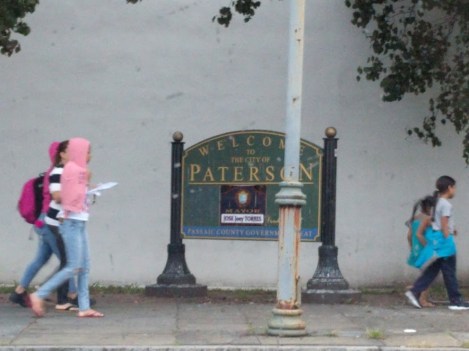
The history of Paterson mimics in some ways the history of America, a mill town created by immigrants from all over the planet and powered by the energy generated from the Great Falls of the Passaic River. Back in the day, this hydroelectric power source was a key element in allowing America to become economically independent from British manufacturing.
My goal in coming to Paterson was far less grand. I wanted to visit the city ever since I saw the movie “Paterson”, a slice-of-life story about a bus driver who also happens to write poetry in his spare moments. I thought that since we were there I might as well attempt to recognize the reality of Paterson from the screen portrayal. The short answer is “no”, the movie depicts a highly sanitized version of the actual city, needing to tell a story absent the chaos of real life. Yet the multicultural nature of Paterson still thrives, with immigrant neighborhoods stitched together like a quilt.
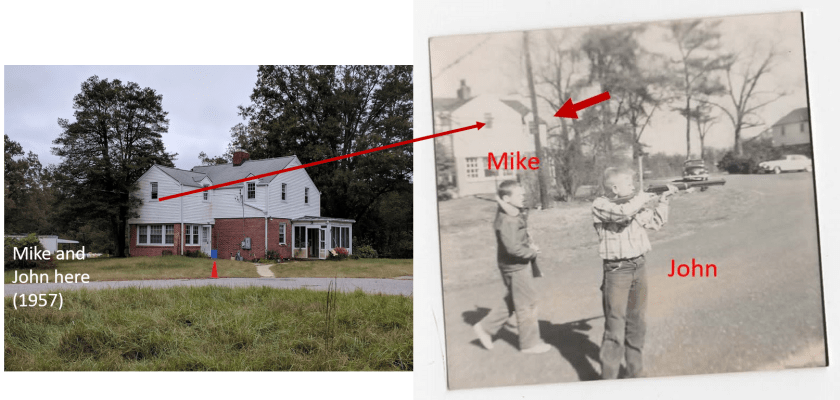
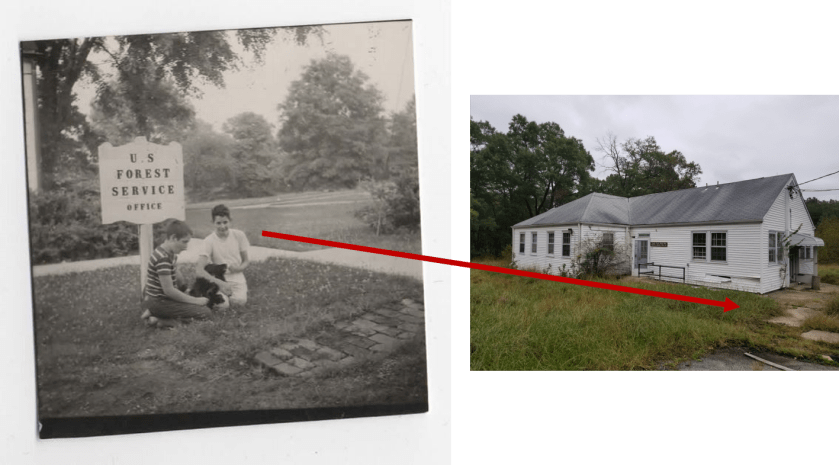
We leave Paterson and head back toward Springfield Va, and it is at this point that Matthew suggests that we stop back in Laurel and see if we can find the government caretakers of the old homestead on Loblolly Pine Drive.
He has located a Department of Agriculture visitor center near Loblolly Pine, so we drive there and plead our case to the nice folks, who seem bit amazed that we have appeared with our connection to this place and to the past. Basically the story they tell us is this: The Forestry Research property has been mostly abandon for many years, and the plan is to demolish the remaining structures and let the entire area revert to its natural state. They tell us that only one person lives up there now and mostly he just takes care of the site, but we are welcome to go and look as long as the gate is open.
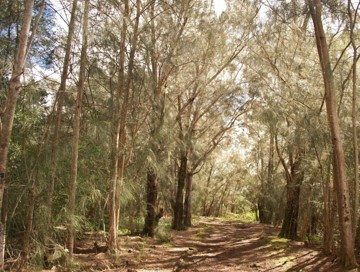
So off we go, through the open gate and up the hill to the research center. It is clear that nature is well on her way in the planned reclamation. The place looks familiar yet much smaller since the forest, long kept at bay, has begun to take back what was rightfully hers.
loblolly pine drive today
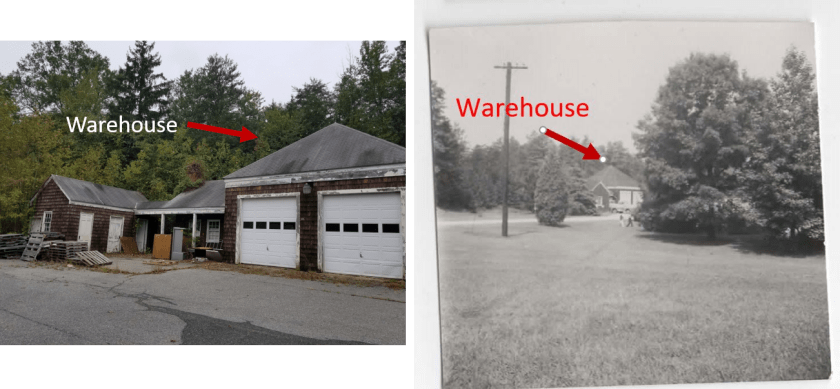
Then and Now photos
Warehouse now and thenThe old house on LoblollyBill and Mike in front of the Research labBill and Mike in front of Zukoff place, now and then
It was a little sad to see the state of the old place up on Loblolly, but of all possible outcomes reversion to the forest is far preferred over yet another golf course, subdivision, or strip mall. A place that studied the forest is preparing to take its last test, and come home. It brings balance, this recycling of the spaces we lived and the times we had, and I am glad we went to see it all again even if the memories seem impossibly distant, like the faded photos in this diary.
I am the last of my tribe and I regret that I didn’t have a chance to share the trip with John and Bill although I did share the pictures we took with Bill in his last days. My kids got to see it though and that is really why I went, to let them know that they are part of the great river, there, in the middle of everything.






 whoisfenton