The public library.

“My library is an archive of longings.”
                                                                      ― Susan Sontag

From that moment long ago when our species discovered we had trouble remembering what we had seen, heard, felt and thought, the need to take notes was born and the library became inevitable.  These recordings may have begun as markings on cave walls or soaring oral histories passed down by tribal elders, but we are driven to capture it all, and in doing so provide a path for others to follow; or avoid.

I have a neighbor who has made it known of his dislike of the very idea of a public library, I guess because it smacks of some form of socialism in his mind and must therefore be inherently anti-market.  I pointed out that he could go to the public library and *read* about socialism and other forms of government, or about capitalism and other economic systems.  It is all so very interesting, I said.   That argument did not seem to go over all that well but I promise I don’t have a smarmy bone in my body.  I note in passing that “Smarmy Bones” would be a great name for a rock band.

I used to take the kids to the library every weekend, and while I perused the magazine racks they would be immersed in desperate dragons, far fables and great deeds.

“Fairy tales are more than true: not because they tell us that dragons exist, but because they tell us that dragons can be beaten.”
                                                                          ― Neil Gaiman, Coraline

Our digital life gives us access to endless new possibilities and problems.  On the one hand all the knowledge of the world becomes available to us; but on the other hand we communicate in 280 character twitter-blocks, enough begin a story but not enough to complete one.  I have seen these long, continued twitter-fragments; an attempt to overcome the limitations of the medium whilst tricking our forever shrinking attention spans to hang in there for the next tweet.
library

As wonderful and scary as the Internet is, the public library remains, to me, one of the high points of human achievement.  Within the walls and amongst the cloistered stacks we call to one another across time and space.  We share the common stories of our lives.  The books here are meant to be checked out and read into the wee hours.  I just couldn’t put it down, we say, and I never wanted it to end.
 

The word “skittish”.

“Hello I am from the Isle of Skit.  I’m skittish!”

OK, bad joke, but the word skittish seems to flit about nervously, preparing to dart off randomly at any moment.  Horses can be famously skittish, dancing left and right as they are wont to do, before suddenly charging directly at you in the pattern of the dreaded Madagascar Attack Horse, a species I invented to be part of this paragraph.  Being skittish should not be confused with insects that invade your home and skitter across the floor, although such images can make one squeamish AND skittish, or ‘squeamittish’.   You can google ‘squeamittish’ and discover that “No results containing all your search terms were found.” Yet, your life will be made whole when google asks helpfully if instead you meant to search for “squattish”, a word Ms Merriam Webster defines as “somewhat squat”.

“Hello I am from the Isle of Squat.  I’m squattish!”


Continental Drift.

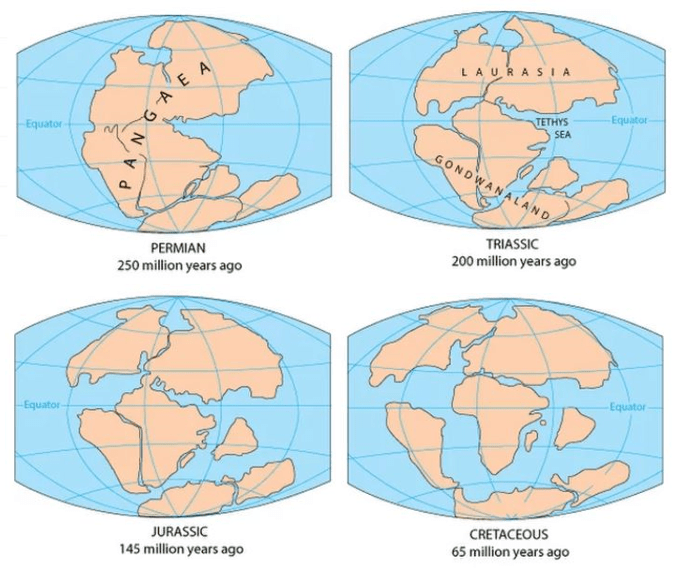
It’s strange to think of continents drifting like great islands floating free, untethered to the earth.  For a very long time this was our way of explaining the gradual shift in the relative position of the continental land masses.  The earliest geologic record seems to indicate that the current arrangement of continents occurred as the single large super-continent split and drifted apart.  This ancient landmass was called Pangea and was made up of segments with names like Laurasia and Gondwana (and I wish Wakanda).  The oceans of the time were called Panthalassa and Palaeo-Tethys.  All I can say is that the God of Names must have had a ball.

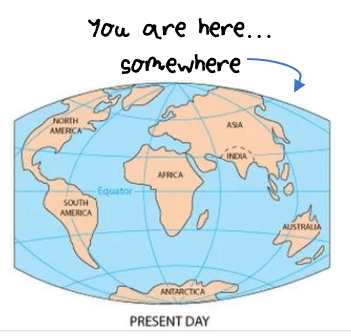
These days you can still see how the continents fit together like puzzle pieces scattered on a brobdingnagian board.  

early earth

today-2

The principles of science require that we test our hypotheses, and when we do we find the notion of continents “drifting”, while as dramatic and fun as a great carnival ride, is not completely accurate.  Instead geologists extended the idea of drifting to include the notion that the Earth’s crust is made up of tectonic plates which are constantly moving in reaction to the stresses of the planet, and perhaps even tidal forces, although that is not certain.  The places where the plates grind together are called rift zones, which is almost as much fun to say as continental drift.