Felt tip pens, and more.

"The moving finger writes; and having writ, moves on."
                    ~ Rubaiyat of Omar Khayyam

Simple things are are easily overlooked, crowded out of our increasingly narrow attention span by the Big News Of The Day.  Today however, I ask that you consider the lowly writing tool; the pen, pencil,  brush, and chisel.  We have been recording our ideas on the nearest flat surface since we crawled out of the ocean and took our first breath of air.  OK maybe not quite that long ago but you catch my drift.
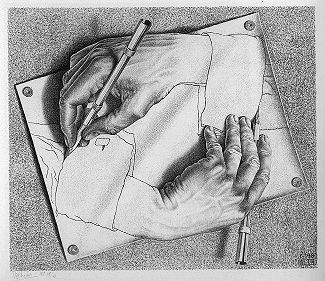
DrawingHands
Drawing Hands:  lithograph by the Dutch artist M. C. Escher first printed in January 1948

I can remember the first time I used a felt tip pen.  The way the ink seemed to magically transfer itself to the paper, clean and crisp with just enough friction to make the lines preternaturally smooth and steady.   The ballpoint pens of the day were quicksilver sleek, exposing my unsteady hand in every loop and curve.  I will also admit to using a fountain pen, drawing in the ink from the deep black inkwell careful to avoid leaks and spills since those stains would be nearly impossible to remove. 

Now of course we rarely have the need to use handheld writing implements; our words are sent with digital clarity and rendered on screens large and small,  When was the last time you had to write in cursive?  Even our signatures are little more than squiggly lines with a flourish at the end.  Walla!

We are curious creatures you and I, full of passion and paradox.  We are moved with a fundamental drive to record our time on earth and to pass that story on to those who follow, which is itself a story according to M.C. Escher. 


The Old Tree.

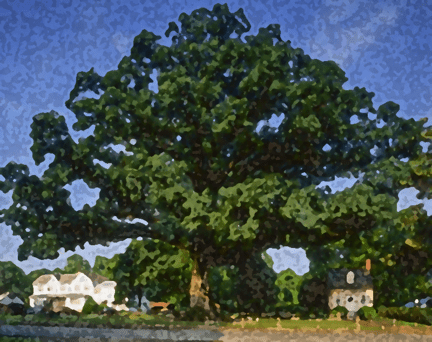
The tree was here before us.  It was a vast and spreading white oak with branches reaching out and up as if in celebration of the earth and air.  It shaded an old farm house over on Homestead Road and stood like a guardian long after the farm was sold and the farmhouse condemned.  I have no way of knowing the age of this spreading oak, but I think it was there before the farmhouse was built and most likely before the the farm existed.  It may have even been there before the road, a young oak in the vast and uninterrupted forest that would later become Chapel Hill.

white-oak

Stephanie and I spoke of this during our weekly walk along the Eno River, a tradition begun several years ago and one we have maintained, weather permitting.  White oaks have a lifespan of several hundred years, and we wondered about the history such a tree has witnessed, the events that unfolded over the centuries of its life.

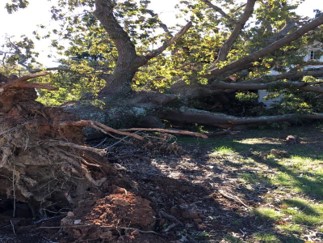
When Tropical Storm Michael raced through the Carolinas recently it brought a period of very heavy winds, and during the night the old oak toppled over, crushing the farmhouse.

oakdown-1oakdown-2

At first this made me sad, to have such an ancient being meet its end so suddenly.  But as I think of it now, perhaps it is fitting that Nature brought down one of her own, and that the oak didn’t fall to the indifference of commerce and yet another shopping mall or townhouse.

acorn

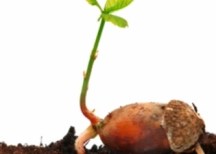
I would like to think that a new oak tree is beginning to grow out on the forest floor, the acorn putting down its tentative roots, beginning the cycle once again.  Imagine what that tree will see in far off time, what tales it will tell, what songs it will sing?

Coincidence.

pie-piThere can sometimes seem to be a certain randomness to events; a kind of chaotic Brownian motion that swirls about, absent direction, order or logic.  And it is definitely true that many occurrences are unconnected to one another; say, two people meeting at a ball game after not seeing each other for many months or years.  What a coincidence we say and we would almost certainly be right, unless one person was secretly stalking the other, but that is the stuff of Hollywood thrillers.

Yet we know from science that there are many events which ARE correlated and causal.  in fact much of science is devoted precisely to figuring out this vast cosmic puzzle.

doninoes

And then there are those events that seem to be connected but are not.  I have had those moments where I am convinced that something terrible is about to befall a friend or family member.  I call them and tell them to be careful, only to find, a few days later that they barely avoided a tree crashing down on the road in front of them.  Did I have a premonition of a future event?  Maybe I did, but to be honest it is far more likely that this premonition was another coincidence.  I have had many more feelings of impending danger, only to discover that nothing bad happened.   False alarm.  It is our nature to *report* the successes and remain silent on the “failures”, so the reported data is skewed toward those events which succeed.  

Finally there are events which are crafted to appear coincidental but ride on top of an underlying deception.  The fact that I was at the scene of the crime with a knife AND a gun is mere happenstance your Honor.  

And don’t get me started on fate and destiny.  Down that road lies a tree crashing down.

The Word: “Outlandish”

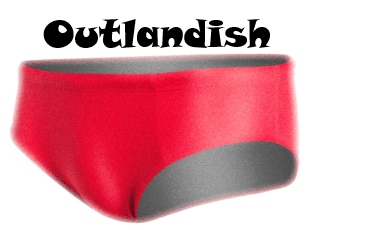
We hear the word “outlandish” and immediately think of extreme behaviors and appearance, like wearing red speedos to a wedding and dancing an Irish jig whilst singing ‘Old Man River’ in a deep baritone.   I know we can all relate to that.

The word itself has seemingly been around for nearly a thousand years and is derived from the Old English word “ūtlendisc“, or foreigner.  I guess that makes a kind of sense because when ancient peoples would encounter one another, it is fairly certain they would speak different languages or dialects, dress differently, have different customs and mores, etc.  

The fact that we are territorial in nature is not a surprise.  We seem to be wizards at making fences and borders and have a finely tuned sense of the “other”, the foreigner.  I wonder if that behavior is learned or genetic or a little of both?

I ask only that you be wary of wearers of red speedos.  They are simply outlandish and not to be trusted.

speedo-2

Kudzu.

If you live is the Southeast USA you will undoubtedly find it strange that this blog, purporting to speak of good things, would ever spare a kind word for this invasive species.  And while I would not include kudzu as a good thing, I will argue here that it is at least an “interesting” thing and one deserving of our understanding, like all things living or not.

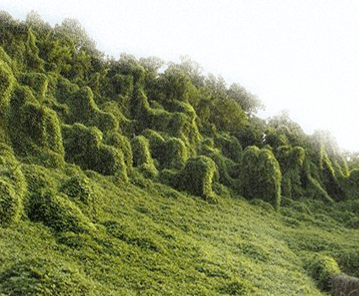
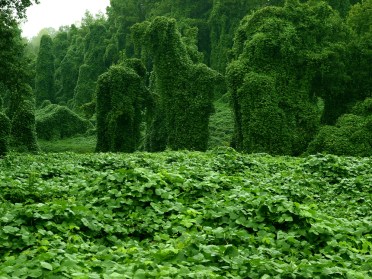
Kudzu was introduced to the USA from Japan over 100 years ago.  At that time it was to be used as a fast growing shade-creating vine and effective ground cover.  How right they were!

kudzu-Picture1

Kudzu is now understood to be a “structural parasite” in that it uses existing objects to climb up and over other plant species to gain access to the sun, thereby starving the plants below.  During the warm days of spring and summer the kudzu is incredibly prolific, growing at nearly 12 inches a day.

Kudzu uses nitrogen in the soil far more efficiently than other plants.  This can create “vine barrens” or forests and fields where kudzu is optimized to out-compete all other species.

kudzu-1

Given its growth patterns, my first thought was what if kudzu could be used for food?  After all people eat the monstrous clam so how much further down the food chain can we go?  Apologies to mollusk lovers everywhere, but by now my guck intolerance is well established.

It turns out that kudzu has been used as cattle feed and and has been found to contain some vague medicinal properties.  Sooner or later someone will bake a delicious kudzu pie, and it is at that point where the vine will face inevitable extinction; such is our propensity for PIE.

Although kudzu represents a nearly perfect example of an invasive species, I still admire it for its ability to survive, and the singular nature of its design.