Tupperware.

It may not have been an accident that I was born one year after Earl Tupper patented the storage design that would later be known as Tupperware[tm].   I say this because Mr Tupper’s infernal invention has been my personal plasticized Iago, a sinister presence ever-ready to question my amateurish handling of leftovers.  By the way, am I the only person who wishes that Earl Tupper was actually called The Earl of Tupper, a position formally held by the Duke of Styrofoam and a loyal subject to the Baroness of PVC?  Yet another opportunity wasted.

Anyway, I believe I own all the Tupperware that currently exists on the planet.  I say this because all of the horizontal surfaces in our house have at least one piece of Tupperware on them, and in many cases contain multiple instances of bowls cleverly concealed INSIDE ONE ANOTHER, like some hellish mockery of those Russian nesting dolls. 

Now, I know some of you feel that you yourself have Tupperware in your home or place of work, but this is clearly the result of a clerical error at the vast and secretive Tupperware complex located deep in the Carpathian Mountains.  Regardless, the Tupperware is mine.

Tupperware inventory sale

At this time, I would like to suggest a major revision to the concept of the Tupperware Party and its ill-fated companion, the Tupperware Jubilee.  I am thinking of naming it The Great Tupperware Recall Event, where participants bring their (my) Tupperware and assemble it into an enormous shimmering mountain visible from space.  I haven’t worked out the next steps but it will be epic.
 

Birch Trees.

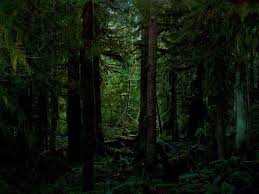
The forest can be a dark place, blocking out the sun, capturing the light high in the canopy where only flying things bear witness.  It is easy to let our imaginations run wild and create any number of horrifying fictions of what entities rest down there on the forest floor, ready to sense our fear and lurch forward with the heavy rasp of cartilage on stone. 

dark forest

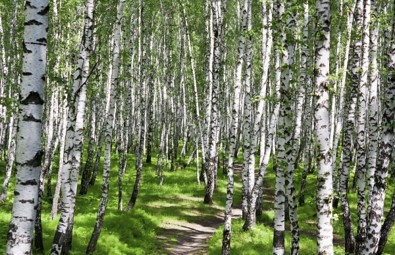
It is into this grim appointment that we come across a stand of birch trees, white and stately and gleaming with an otherworldly glow.   

birch stand

Of all the trees in the spreading wood I find the birch to be one the most beautiful, an oasis of light exposing our fears as fantasy.   The birch stands out like a visitor to the forest, something artificial placed there by forces outside our understanding.

Long ago, after we emerged from the sea, we lived our lives on the grasslands and in the trees of the forest.  I wonder if those memories have followed us, unwitting companions whispering into the quiet air the story of our long and curious journey.  

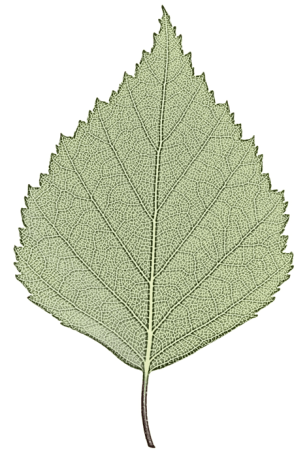
leaf

Highly unlikely events.

A few weeks back I wrote about the idea of coincidence, or unconnected events that seem connected in some mysterious way.  This idea is a lot more interesting than I originally thought, and I want to expand on it here.  Those mathematicians amongst you may wish to avert your eyes since what I am about to say is (1) obvious to you, and (2) way oversimplified.   Before looking at highly unlikely events, let’s look at something which seems unlikely but tums out to be pretty common.

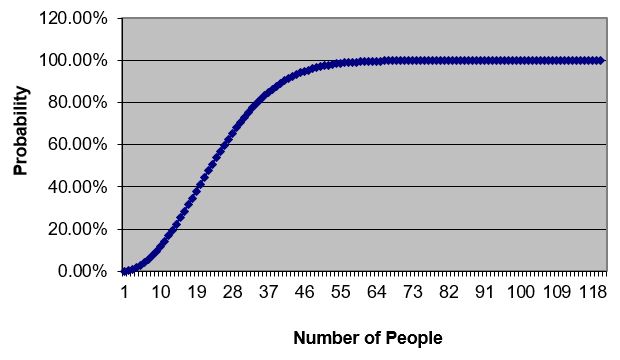
You go to a party and see that there are exactly 23 people in attendance, including you.  What are the odds that any two people in the room have the same birthday?  With 23 people the math says the odds are about 50/50.  That result, borne out by actual experiments, runs counter to our intuition.  Our linear brains would guess it should take around 183 people in the room for this to be true, since that is around 50% of the total number of possible birthdays in one year.  So what is going on here?  You can crank up a spreadsheet and calculate the odds of various sizes of parties (shown below), but what I find more interesting is that our brains don’t seem to handle exponential changes very well.  When faced with an actual event that behaves in an exponential fashion, we are surprised at the result.

birthday

A corollary to this idea is found in Highly Unlikely Events.   The idea is that given enough chances or choices, something unusual or rare is bound to happen.   The best example of this idea is the lottery, you know, that thing we are sure we are going to win this time.  We know that the odds of us winning are astronomical, yet the odds of someone winning are nearly certain.  That is because the number of us’s is very small, and the number of someone’s is very large.   That someone wins is not miraculous but a normal outcome. 

The miracle for me is the way these numbers work.


Very Large Numbers.

You know me, always blathering on about infinity this or infinity that.  But in a way numbers that are Very Large are even more interesting.  Hey, I see you out there rolling your eyes, but bear with me on this.

While doing research on nonce words I discovered that there are lots more such words in play than just “quark”.  Back in the early 20th century the 9-year-old nephew of mathematician Edward Kasner was asked by his uncle to give a name to a very large number, in this case the number “1” followed by 100 zeroes or 10100.  The nephew came up with Googol to describe this number.

Many years later the founders of you favorite Internet search company wanted to name their venture “Googol” but found that word was already in the English lexicon, so they altered it to Google.  The rest is history.

Anyway back to a googol.  How large is this number?  One way to think about it is consider that if the known universe were completely filled with sand, that would constitute “only” around 1096 grains of sand!  So a Googol is a really, really big number.

That same 9-year-old was asked to think about an even larger number, and he thought of the number “1” followed by a googol number of zeroes or 10Googol. He called this unimaginably large number a Googolplex.  And to bring you full circle, the headquarters building of Google in Mountain View California is called, you guessed it, Googleplex.

if you tried to write down in long form the number represented by a googolplex, you would run out of space in the known universe before finishing.  You would also run out of time as it would take longer than the projected heat death of the universe.

Aftermath.

FloodPlain_1024_4

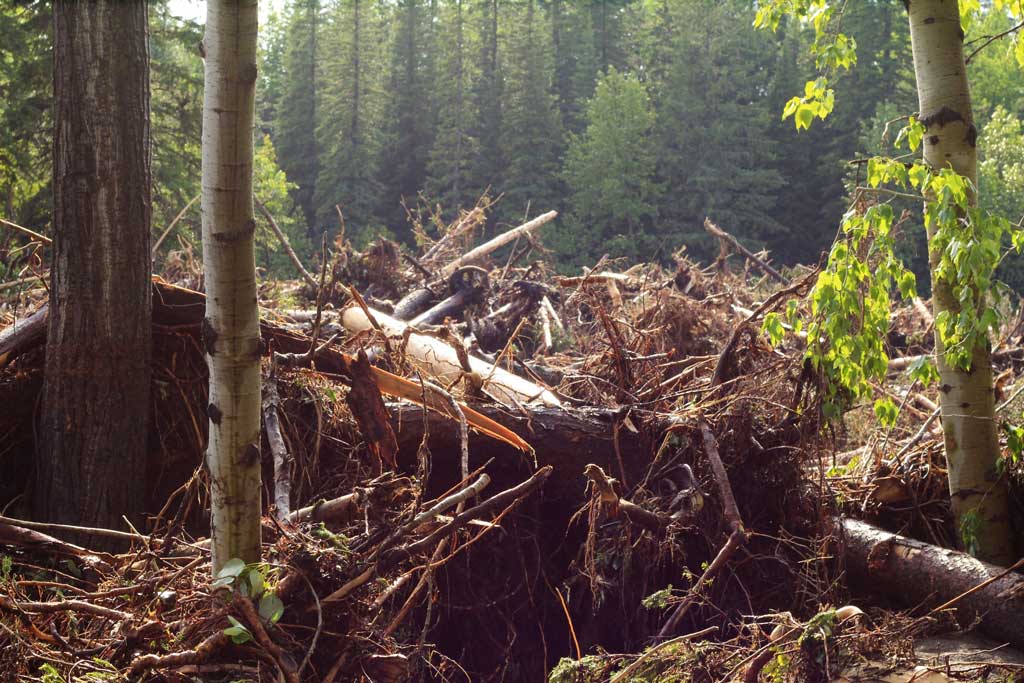
Something happened here,
We pick our way through
Debris cast asunder;
Forces hidden and powerful
Now exposed and naked
Under a sun-bright canvas.

Shadows leave clues
in flattened grass
and trees bent broken,
Not losing the game
Just recycled for return
When least expected.

flood plain1

Not a one-time thing,
The aftermath
Makes the earth
Each time forgotten
Surprising no one
Only those who watch
And listen.

Nonce Words.

While researching the word “curmudgeon” the other day I came across a concept I had not seen before:  nonce words.  a nonce word is one that is made up to be used for a singular purpose, for example testing children on sentence and word structure.

crils

In this case the nonce word “cril” doesn’t mean anything and is just a teaching mechanism for how you make something plural in English.

Some nonce words claw their way into the language by happenstance and usage.  There is this amazing story from the world of particle physics with the unlikely pairing of Irish writer James Joyce and physicist and Nobel Laureate Murray Gell-Mann.  The story goes that Gell-Mann, in search of a name to give the basic building block of all things, came across this line from Joyce’s “Finnegan’s Wake”:

Three quarks for Muster Mark!

Sure he has not got much of a bark

And sure any he has it’s all beside the mark.

Gell-Mann was thinking of naming his new most elementary of all particles a “quork”, but changed it to “quark” based on his reading of Joyce.  Quark stuck and is now an established part of the language and is no longer a nonce word.  Of course when Joyce wrote Finnegan’s Wake this was the furthest thing from his mind, although given the impenetrable nature of this work, I wonder for whom Joyce was writing.                              

Particle physicists, apparently.

The word: Curmudgeon.

A curmudgeon is a person, usually an older member of the male gender who, by virtue of having experienced the ups and downs of life, feels compelled to impart said knowledge to all who will listen and many who will not.  Curmudgeons can be a tad surly and mean and must be approached with care as their ideas and opinions are delivered with a regal stubbornness certain to overwhelm the unwary. 

The origin of the word is not completely known, but it has been around since at least the 1600’s.  White-coated etymologists deep in their narrow warrens have come up with many theories,  include the idea that curmudgeon might have been borrowed and re-spelled from the Gaelic word muigean or “disagreeable person”.  Another researcher postulates that it is derived from the alternative spelling cornmudgin, or “corn-merchant”, but this interpretation has yet to gain traction.

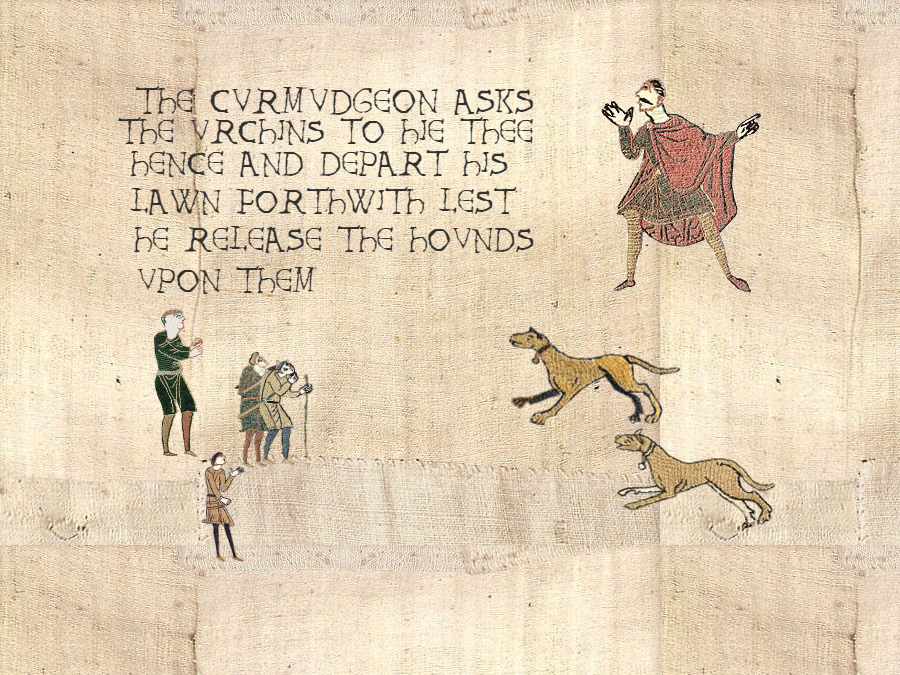
Regardless of word origin, curmudgeons have been around for hundreds of years as shown in this ancient scroll I discovered in my investigations:

TheGloriousTaleOfBayeux


Nutmeg.

Image result for eggnog and nutmegThe scent of some spices, like cinnamon and cloves, can invoke strong memories of a time gone by.  As a child I can remember sprinkling nutmeg on my eggnog and toasting the members of my family seated around the Christmas table, imagining myself so very adult and wicked.  Today, when I think of Christmas I remember that eggnog, and nutmeg that made it special.  I started to wonder where nutmeg came from and I found that  the garden of good intentions is sometimes strewn with the residue of avarice and greed.history of nutmeg

The history of nutmeg provides a glimpse into human nature and our propensity to seek power, influence and control.  The nutmeg tree was originally only found in the Banda Islands of Indonesia, sometimes referred to the Spice Islands.  It was believed to be quite rare and thus something of great value, like a first edition Superman comic.  The wealthy classes of Europe sought out nutmeg and attempted to corner the market, a little like some folks have periodically tried to do with silver and gold and yes, oil.   Wars were fought over this seemingly precious, yet innocent, spice.  People died in its name.  It wasn’t until someone realized that the nutmeg tree would grow quite well in other locales that the supply increased, the conflicts diminished and the Spice Wars ended.

If it could speak to us, I think the nutmeg tree would be the first of many living things to tell Homo sapiens to chill out; take some time to smell the roses, gaze upon the distant stars, and drink the eggnog.  Not necessarily at the same time though; don’t want to overdo it.

The word (phrase): Topsy-turvy.

It is said that the average English speaker has an active vocabulary of around 20,000 words and a passive vocabulary of around 40,000 words.  The active vocabulary consists of words a person uses in everyday speech or writing; the passive vocabulary consists of words a speaker or writer recognizes when seen in context.

Into this chaotic and cluttered world shuffles the ancient phrase “Topsy-turvy”.  This unkempt fellow is not normally found in regular speech today, but if you lived 450 years ago you might have come across the following text,

“They say that… they see the houses turne topsy turuye, and men to walke with theyr heeles vpwarde.” 

Richard Eden wrote that in his work, “The decades of the newe worlde”, written in 1555.  To which I say, “veryr coole”.

So topsy-turvy refers to things that are upside down or otherwise in disarray.  It goes without saying that my favorite synonym for this phrase is higgledy-piggledy, which has no discernible meaning but is fun to say out loud in elevators.  Try it!  You will be the life of the party, at least for a minute or two.

tt


Barbershop mirrors.

Infinity is a funny little guy, popping up like a weed in all these unexpected places.

infinity mirror

Most of us have have likely found ourselves standing or sitting between two  mirrors and seeing our image repeated “forever”, as the reflected image reflects itself which in turn is reflected and so on.  And on.  And on.  This is known as an “infinity mirror”, or barbershop mirrors.  My buddy Bill and I, back when we worked for the Corps of Engineers, would sometimes encounter these infinite loops caused by the irrational world of government bureaucracy.  At such times we would look at each other and gleefully cackle, “Barbershop Mirrors”!

In the Arts there is this type of painting or drawing called a droste image which is an image that contains within it a smaller replica of itself, and so on and so on. The effect is named for a Dutch brand of cocoa first sold in 1904.  The advertisement,  designed by Jan Missetis, is shown here with a nurse holding a can of “Droste’s Cacao”, which itself contains a smaller image of the can.  Why a nurse I can only imagine.

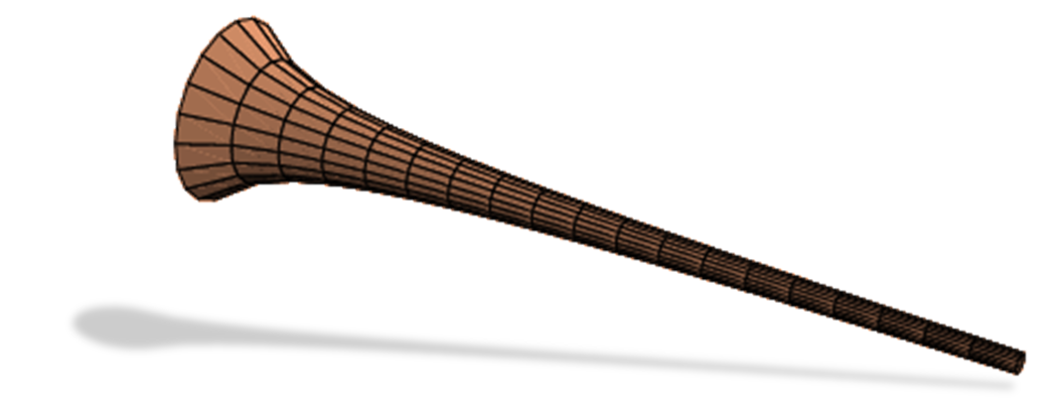
Back to barbershop mirrors.  Real images in real mirrors don’t actually go off to infinity because mirrors are not perfect and some light is lost each time the image is reflected.  Mathematics contains no such constraints, so the principles of geometric optics applied to the infinity mirror describe a perfect mathematical surface with the wonderful name of Gabriel’s Horn.  In theory, the surface of Gabriel’s Horn is infinite in area, but encloses a finite volume.   Consider our minds officially blown.

horn1
Graph of Gabriel’s Horn

The name Gabriel refers to the Archangel Gabriel who, it is said, blows his horn to announce Judgement Day.  The Infinite announces the Finite, which has to be one of the coolest things ever.  Who said mathematics was boring?