Perigee.

Yesterday we experienced another one of those events designed to make us feel small, stuck as we are on this beautiful globe as it whirls through the cold vacuum of space.  Yikes, lighten up Mr Spaceman.  Every once in a while the earth, moon and sun line up in such a way as to cast shadows upon one another.  In this most recent Total Lunar Eclipse, the earth cast its shadow upon the moon, and due to our atmosphere refracting the sun’s light, it produced this “sunset” effect on the moon.
little moon
Photo by Fenton

That is a picture I took of our moon, standing out on the tarmac just past the witching hour freezing my buns off.  The fact that this image looks like it might be *anything*, like a marble or a slice of pepperoni, is a result of my not being able to force the iPhone camera to take a picture of the night sky.  Could be user error, just sayin’. 

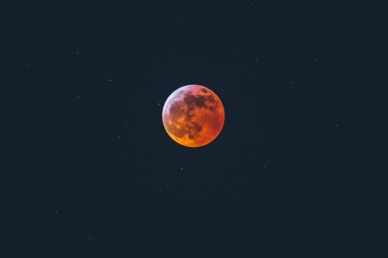
The actual image laid down on my analog visual system was spectacular and you’ll just have to trust me on that — or — you can search the internet and find actual pictures taken by real photographers that look like this;
blood-moon-jan 2019
Photo by Dave Wegiel

This is called a blood moon by Captain Obvious and a super blood moon by Herman, God of Heavenly Bodies.  The ‘super’ comes from the fact that the moon was at its closest proximity to earth — its perigee — and thus appeared slightly larger than normal, like the T-rex in your side mirror.  Oh wait, that’s CLOSER.  Dadgum optics <grumble>.

NASA estimates there will be 85 total lunar eclipses this century so there will another sooner or later.  Sky watchers who missed this week’s show will have to wait quite some time before the next total lunar eclipse; on May 26, 2021.  Mark your calendars!


Wednesday.

We all understand that time is linear, yet our lunar nature insists on clocks and calendars, even naming the months and days after the gods.  These cyclical notions have become so ingrained in our collective psyche that if we try to consider linear time our circadian brains curl into a fetal position and must be coaxed back to normalcy with cookies and milk.

Back when I first learned computer programming, in between woolly mammoth hunts, I would devise these complex code fragments to figure out how many days elapsed between two dates, or if you started on date A and added 1075 days, what would the new date be?  In other words I was doing crude “calendar math”.  Internally computers store our MM/DD/YYYY style date in a form called the Julian Date, which is a measure of linear time. Day zero starts on January 1, 4713 BC,   Jan 2, 4713 BC is day one, Jan 3 is day two and so on.  Once our normal dates are converted to Julian Dates, then regular math can be used to do calendar arithmetic.  Two routines are needed:

1) Convert our normal date to the corresponding Julian Date

2) Convert a Julian Date back to our normal date

3) Walla! 

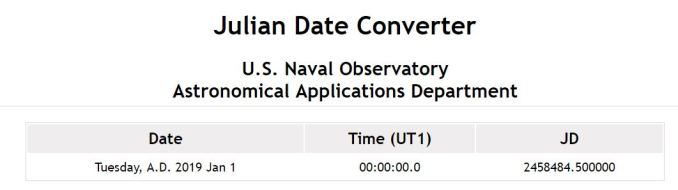
For example, today is Jan 1, 2019, or the Julian date of 2458484, as shown below.  Because the Julian date is just a number, the fractional part of days can be represented as a decimal fraction to the right of the decimal point.

julian date converter

woden
Woden (or maybe Gandalf, who knows?)

Which brings me back cyclically (see what I did there?) to Wednesday.  Odin of Norse Mythology was king of the gods.  In the Anglo-Saxon version of the myth he was also known as Woden, and the mid-week day became known in Old English Wōdnesdæg or Woden’s-day.  Woden’s son was Thor from the Marvel Comic Universe and sure enough Thorsday follows Woden’s-day.

Today, Wednesday is sometimes called “hump-day” (old english: Hmupdae) because it represents the peak of the work-week followed by a blissful slide into the weekend, also known as Sæterdæġ, after Saturn.

And round and round we go…