Since I spent the last entry on certain types of motion (motility), it is only fair that I spend some blogspace on beings that spend all or part of their lives fixed in place with no ability to move on their own. These are called sessile organisms and have the characteristic of sessility. ScrabbleMasters™ take note in case you find yourself saddled with a whole herd of “S’s”. I guess you could try “psssst” and fight off the inevitable challenges and cries of outrage, resulting in the rarely practiced form of the game called CombatScrabble™.
Anyway, back to sessile organisms. Most of these animals are found in a marine environment — examples are sponges, corals and anemones. Another sessile animal is the barnacle, although in their larval stage barnacles do in fact move until they latch onto a solid surface, whereupon they spend the rest of their lives fixed in place. These sessile creatures are very efficient since they don’t waste energy chasing down their food, relying instead on the movement of water to bring food to them, the zoological equivalent of Amazon Prime™.
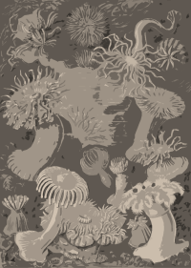
Given their reliance on water currents, most of these sessile animals exhibit radial symmetry, to respond to food coming at them from any direction. Also, I like the words “radial symmetry”, which might be a good name for a rock band.
 whoisfenton