Recently whilst walking with my daughter out at Eno River State Park, the topic of frogs came up — and not for the first time. Frogs are a big deal amirite?
Anyway, we collectively wondered where these little guys go in the winter months to then suddenly appear in such large numbers in early Spring? I mean we are not considering something horrendous like FrogSpores[tm] are we? I am guessing that they burrow under the mud or earth to avoid freezing and then go into hibernation with slowed respiration and other metabolic activity. At least that is how some warm-blooded (ectothermic) creatures hibernate, so I speculate something similar occurs in cold-blooded (endothermic) animals.
It turns out that this is true as far as it goes, but some of our little tree frog buddies have a surprise waiting, oh yes they do. Tree frogs are not very good diggers so in the winter months they must lodge themselves deep into logs or in crevices of branches and hunker down. If the air temperature around them drops below freezing, ice crystals begin to form on their skin and then this incredible biochemical transformation begins.
The frog’s liver begins to replace the body’s water with glucose which allows the cells of the frog to freeze without damaging the surrounding tissue. They then proceed to go into a state of extreme hibernation; their heart stops beating and they stop breathing. Essentially they are frozen solid and ‘die’. But as air temperatures rise, the frog’s internal systems come back “on line” and the frog slowly revives.
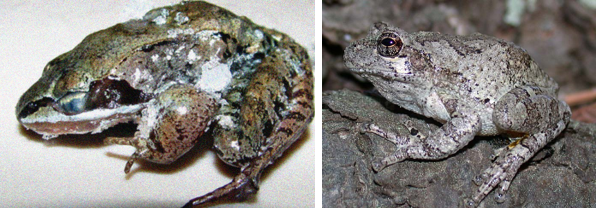
It would be cool if these cadaver frogs would shout “BOO!” as they wake, but that would be too much to ask.
Imagine the changes which have occurred over the millenia to develop this adaptation. Life does indeed ‘find a way’.
And Frog Spores *might* be a good name for a rock band, albeit a pretty strange one.

 whoisfenton