If you ever had the pleasure of visiting an ancient rainforest and entering the darkened world under the canopy, you have experienced one of the seven billion wonders of the world, because who can believe there are only 7 or 8 of those? I believe we formed in such places a very long time ago, so it is not surprising to feel that sense of home there amongst the liana vines and towering mahogany monoliths.
I had a chance to visit such a place whilst living in SE Asia many years ago; Taman Negara in the state of Pahang, Malaysia. The expansion of humanity has diminished the number and size of tertiary rainforests, but Malaysia has taken active measures to preserve this amazing resource, including sponsoring eco-tours to spread the word.

Unbeknownst to me at the time, there is this very interesting phenomena found in certain forest canopies around the world, adding to the curious nature of trees.
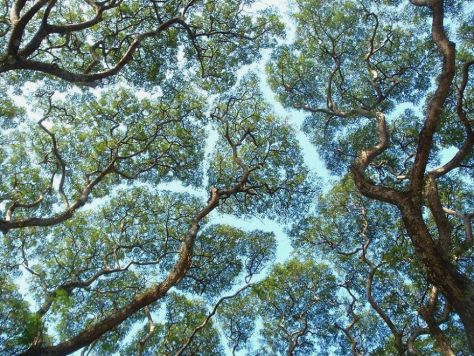
This cool pattern is called crown shyness or canopy disengagement, where the leaves spreading from each limb seem to avoid touching one another creating these gaps and lines in the canopy. This has been noted and studied by botanists for nearly 100 years yet the exact cause is not clear.
Three hypotheses prevail:
1. Friction hypothesis – In windy conditions, the branches of adjacent tree limbs form gaps to avoid striking and damaging nearby leaves, thus limiting damaging to the overall tree.
2. Allelopathy hypothesis – Allelopathy is the well know capability of plants to communicate with one another through the production of compounds called allelochemicals. These chemical signals can be protective in nature or aggressive, giving rise to the Madagascar Attack Plant, a species I invented for this very sentence. All weak attempts at humor aside, allelochemicals are used by plants to, for example, signal the presence of plant pests and thus limit the spread of insect borne diseases.
3. Photoreceptors hypothesis – Leaves have photoreceptors which allow the tree or plant to follow the sun, or equally to avoid shade. This idea speculates that leaves and branches position themselves to receive optimal sun, and to not grow on top of one another.
The causes and mechanisms of Crown shyness remain elusive. I am told that seeking and revealing the secrets behind the world somehow diminishes the magic and majesty of it all. I feel quite the opposite. Experiencing Taman Negara and understanding how it works may provide clues on how to help it survive the ravages of fate and time.
And of us.

 whoisfenton