The Word: Taproot.

Trees and other plants use an underground system of roots that pulls nutrients and water from the soil, but also provides structural integrity. The fibrous root ball of some trees may extend horizontally the same distance as the tree is tall, so don’t plant trees to close to your house lest they slowly come to visit you.
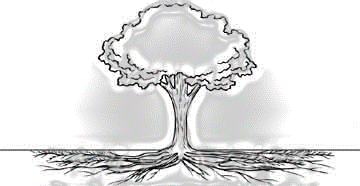
Fibrous roots

Other types of trees and plants grow from a central vertical root, called a taproot.

Taproot with secondary branching roots

There is something solidly real and obvious about the taproot, a large anchor holding the tree down, and one that can seek water in the dark depths during times of drought. Taproots can go way down too, with the wild fig tree sending a root down 400 feet. Seriously, 400 feet? By the way, the wild fig is like the Great White of the botanical world, with these terrifying aerial root systems that reach out to neighboring trees and slowly strangle them, leaving withered husks where once an innocent tree stood.

While doing what I laughably refer to as research on this topic, I came across another category of taproot, the storage root, which itself is an edible part of the plant. Examples of storage roots include carrots, beets, radishes and turnips! So all this time you have been eating taproots! Ew!

I had assumed that the onion is also a taproot, but nooooo. It is a bulb, or a part of the plant’s stem growing at or just below the surface. The humble potato? Sorry that’s a tuber. Why can’t anything be simple?

Anyway, the word taproot is just very cool, all by its lonesome.

Obsidian.

This dark mirror agrees
In subtle contract
Give back the light
A planet’s story
inscribed within.

Born in mountain kiln
Children of the earth;
crafted in pressure and fire,
Impossibly smooth
Like waves on glass.

Ancient and brittle
Jagged shards
Become tools
Extend mind and hand
Edges cut and flay;
War without warriors.

Katydids.

Spring and summer nights are punctuated with a symphony of squeaks, squawks and cries, all performed in benediction to the need to procreate. Get your mind out of the gutter dear reader. Sheesh.

I had assumed that this racket was caused by crickets, however the real culprit was the erstwhile katydid, sometimes known as the bush cricket. These bright green insects use protective mimicry to look like leaves on trees.

Scientists have discovered that green is not the only color in some species; bright pink can be found as well as orange, tan, brown, or yellow .

Talk about making yourself a target. Please come eat me, he says.

One night last week as I was headed out the door on my evening constitutional, I noticed a <green> katydid on the window frame. I didn’t want him to fly inside, so I made to brush him away from the house. Unfortunately he/she decided at that moment to FLY DIRECTLY AT MY FACE! I immediately went into a series of arm-flailing, face-batting contortions, a move so ridiculous that it is recorded in the Guiness Book of Laughable Behavior. He veered off at the last second leaving me to scream “Get it off me!” in a high-pitched warbling bleat. He flew away, chuckling no doubt at having reduced a human being to a whimpering gnome.

The next morning I notice that an orb spider has snared a katydid in its web, where it will be committed to the food chain. I wonder if it is *my* katydid, and if I have somehow played a role in its demise. Down that path lies madness and I shall consider it no further. Now excuse me while I scurry back to the lawn.

Typos.

The typographical error, or typo (tipoh if you are me), is a willing accomplice in my continued destruction of general conversation.  To be fair, my typos have the potential to increase the number of valid words in the universe, if only we would get over those pesky spelling rules.  And try as I might to deflect blame, shadowy keyboard scientists have determined that the problem is not with their invention.

typo

Typos have been around so long that they have their own mythos and taxonomy.  One might say they have been typecast.  Sorry.

Consider TypoSquatting.  Years ago some clever individuals realized that web site searches might be slightly misspelled,  like Gooogle instead of Google, so they would grab the domain gooogle.com and effectively hijack the space to nab unsuspecting typophiles.  Once harvested these netizens may be subject to some bad squatter mojo, which is coincidentally a great name for a rock band.

Then there are intentional typos; misspellings that have become so common they are used in a sardonic or sarcastic manner.  The word ‘teh’ instead of ‘the’ for example.

The fat finger typo has been around since fingers first encountered keys.  Spell checkers have inserted their own way-too-smart heuristics into the fray, sometimes correcting actual intent into something entirely new and unwanted.  Cellphones are wicked smaht, with advanced predictive algorithms designed to help tiny keys fend off a phalanx of lumbering warrior thumbs.

The Atomic Typo.   The sneakiest of the bunch, the atomic typo exposes letters rearranged so that both words are correctly spelled but have no visible connection.  The seminal example is the use of unclear instead of nuclear, hence ATOMIC.  Is that clever or what?  No, not clever.

buy buy for now.

typo1