You might have heard the saying “Isn’t this a fine kettle of fish?” which sounds like something weirdly familiar, but is very cool even if unknown. It might be fun to say it on a crowded elevator, once anyway.
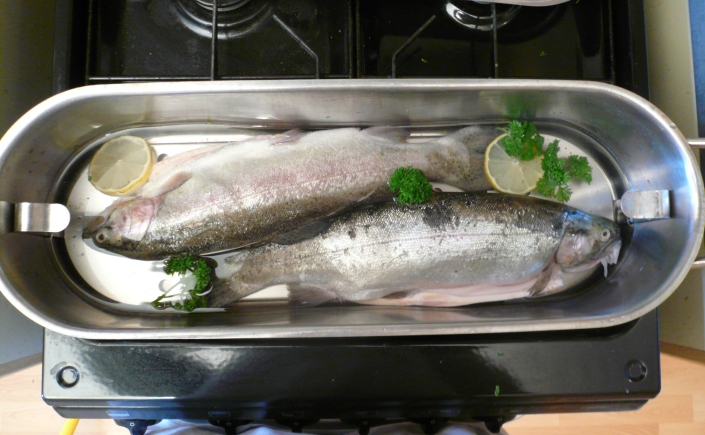
The phrase means a situation or process which is totally messed up or jumbled beyond immediate repair. The use of “kettle” here likely refers to the elongated english saucepan designed to cook or poach an entire fish, like so.
Yum!
How such a cooking pan has come to mean a completely muddled up state of affairs is not entirely clear, but the first reference to “kettle of fish” is from mid-1700’s in England. Speculation is that after the feast the kettle would contain the rather chaotic remains of the unfortunate marine beastie, although this origin story is by no means certain. Over the decades the phrase was made into a generic “thing” referring to a less-than-ideal state of affairs.
And while we’re at it, why are we so afraid of a “can of worms”? If you open the proverbial can of worms they just slowly crawl out and make an awful mess on that kitchen countertop you JUST cleaned. Now a can of BEES, well that would be a whole other kettle of fish.
My father loved trains. On our infrequent trips I can remember him seeking out train museums or other historical transportation venues. I don’t recall actually taking a trip ON a train, opting instead for the trusty ’51 Plymouth. He especially loved the vintage steam locomotives, the ones you would see in old black and white movies, heavy and loud and announcing their presence in a cloud of steam and grinding of wheels, steel on steel.
The steam whistle was deafening, actuated by the same super-heated steam that drove the great wheels. Modern trains use air horns to the same effect, namely to warn those near that this enormous machine cannot stop quickly.
These steam-powered trains were marvels of engineering, because while it is easy to imagine heat –> water –> steam –> pressure –> moving wheels, it is another thing altogether to actually build one.
Steam engine
My brothers and I had a stretch where we were serious HO Model Train Enthusiasts. “HO” was the type of train reproduced at 1:87 scale. We would lay out the tracks in the bedroom, attach the transformer, place the scale model trains on the tracks; caboose always taking up the rear. Crank up the juice and away they go! We had small tunnels, train stations, little fake trees and shrubs. We would build a little city around the train tracks, which is how it actually happened out here in the big world, scale 1:1.
Model town
I think we played for years with these trains, and I can imagine Pop watching us from the doorway, happy to have made this connection, he to us and now back again.


 whoisfenton