Uneven lies the surface Taking us to places We need to be; The hum and hiss Of flying air A background noise Urging us along Insistent In time and space.
Beneath the clamor a rhythm Washing over the rattle and roar, The syncopation of jazz, The long cool water Of the southern blues, The single thread of a violin Soaring on notes written Before the line was made Between A and B.
We are creatures of cadence You and I, Our beating hearts Measure collective moments Feeling the patterns In road songs For the journey That never ends.
Most of the Nature shows on TV make the mistake — in my humble opinion — of characterizing animal behavior in human terms. We say animals are ‘nervous’ or ‘afraid’; they ‘seek companionship’ or ‘want to be comforted’. We say these things about animal behavior even though we really have little to no idea what is motivating them or what’s going on inside their heads. (especially those CATS, amirite?) Our worldview forces us to translate behaviors into familiar terms.
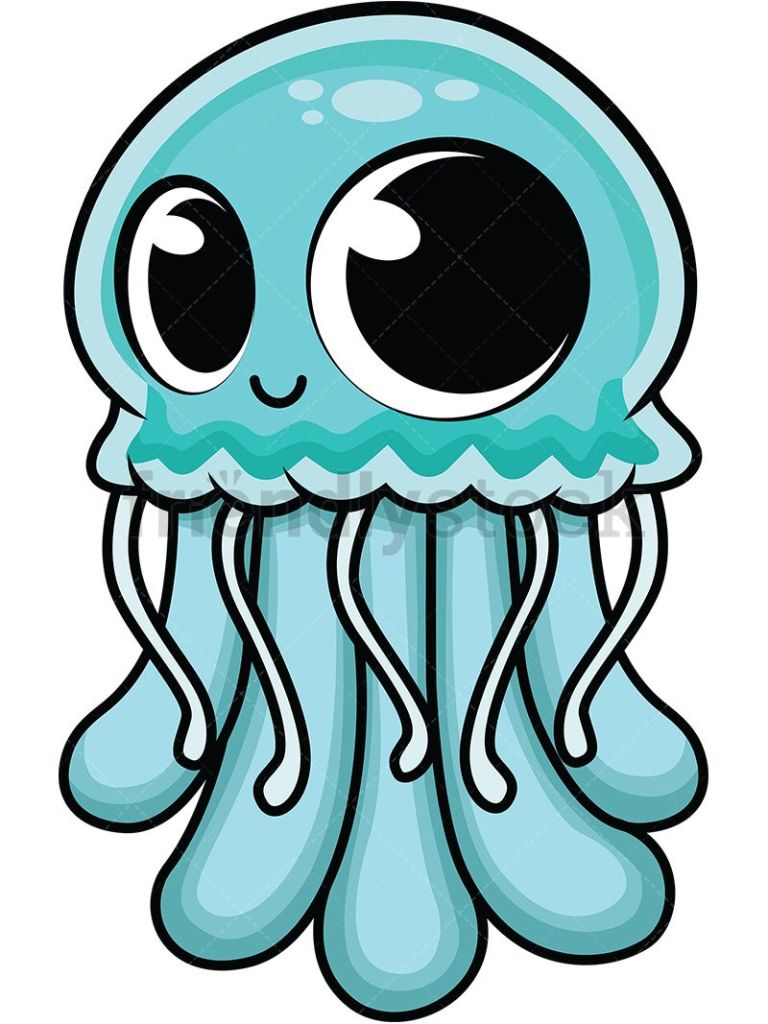
“Cute JellyFish”
A long time ago Matthew asked me how a jellyfish could possibly survive if it doesn’t have a brain. But the jellyfish does have a cluster of nerve cells that create phyisical responses to stimuli like light, pressure, heat, salinity, and these are the inputs it needs to survive and thrive in a harsh and unforgiving ocean (there I go giving human traits to an OCEAN for goodness sakes). Because the jellyfish is so different from us, we have an easier time imagining it as a kind of living machine programmed to react to its environment. We would never place human characteristics on it as we would ‘higher’ animals, those seemingly more in line with our own physical makeup.
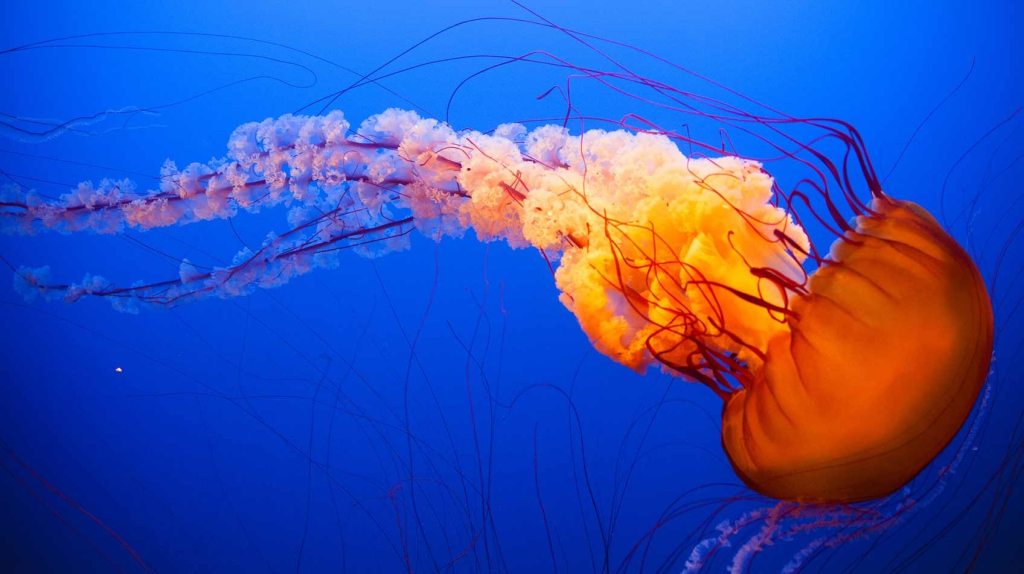
“Less Cute JellyFish”
I guess what I’m wondering is this: What if the problem boils down to one of complexity? What if we are some kind of really advanced jellyfish, with enormous clusters of nerve cells allowing us to respond to the Universe in complex ways? And what if the beings above us on the evolutionary ladder interpret our behavior in their terms?
Several years ago we had an opportunity to observe North Carolina’s calm, measured reaction to a 12-inch snowfall. The responses ran the gamut from abject fear to screaming panic. We southerners like the way nature handles things and prefer to let old Mr Sun work his environmental magic on the snow. It snows, it melts, dun.
My kids were at an age were they responded with kid-like glee, marveling at our area being so suddenly and completely transformed. But they did come up with the inevitable question: Why is snow white?
Not a bad question when you realize that ice is not white and a close examination of a snow proves it’s composed of only small ice crystals and not cotton, vanilla ice cream or whiteout, that ancient substance used to correct errors in the days of typewriters.
SnowFlake
The answer to the mystery is really found in the corollary: Why is anythingwhite? We remember that our so-called white light is really composed of a number of different frequencies of radiation (the spectrum), or so I’m told by Mr. Roy G. Biv (Red-Orange-Yellow-Green-Blue-Indigo-Violet). Materials interact with light in such a way as to reflect back to us all frequencies that are not absorbed. It is these reflected frequencies that give things their color as interpreted by our onboard optical apparatus. If all the incoming frequencies are reflected back to us, we see the object as white; if all frequencies are absorbed, it is black. So, somehow snow is bouncing the entire spectrum right back at us. How?
Ice is not completely transparent; it is translucent. As light passes through the crystals of a snowflake, its direction is slightly altered. The new path is further redirected by the next snowflake and so on, until the light eventually comes back to us (although on different paths, otherwise we would have a mirror effect). The color of all the frequencies in the visible spectrum combined in equal measure is white, so this is the color we see in snow, while it is not the color we see in the individual ice crystals that form snow.
Helpful Wikipedia Diagram
Ipso Facto, E Pluribus Unum, Habeas Corpus. Ain’t science grand?
On a recent walk at Eno River State Park, my daughter noticed a cast off plastic soda bottle floating on the otherwise pristine waters of the Eno. She asked why is it that some folks feel free to litter in this way, and that perhaps we should attach a social stigma to such misbehaviors as they do in Japan. She opined that maybe we should institute shunning as a method to control our darkest instincts.
The word “shun” is one of those words that looks misspelled. The longer you gaze upon its make-believe simplicity, the worse it looks. That can’t be right you say to yourself, the very same self that generates typos with such willful contempt that entire *languages* weep. Continue to stare at those four little letters and eventually you will be convinced that shun is a chinese word meaning “small, three-wheeled cart used in the Yuan Dynasty by members of the nobility”. Trust me, it’s inevitable.
But no, shunning is something akin to shaming, applying social rejection to penalize folks for misbehavior. The earliest use of the word was around 900 A.D, from the Middle English “shunen” or Old English “scunian”, meaning to avoid or fear.
Regardless, I plan to hale a shun to take me and the missus to the opera at the palace.
I came upon a word I hadn’t seen before: Contronym. Simply stated a contronym is a word that is its own antonym. Here are some of these words: Oversight, sanction, left, dust, seed, stone, trim, etc. The meaning of these words can be one thing or the opposite thing depending on context. You can seed a lawn, or seed a lemon (meaning un-seed I guess). Trimming a Christmas tree is quite the opposite of trimming a hedge. 4 people left the party, how many are left?
What is the opposite of a contronym? I guess just a word with no other meanings. My head hurts.
Between the stars above and the sturdy earth is a sea of air which will hopefully come as no surprise to you. Our little ships (us) are subject to its whimsical nature and I was reminded of this during my first walk of 2020. The weather has been unseasonably warm and I was tempted to try a tee shirt in January, thumbing my nose at the winter solstice. But no, at my age there is no reason to tempt fate so I opted for my trusty hoodie.
Almost immediately I see danger on the horizon, a horizon which seems to be getting closer by the minute.
The white below the dark is a sheet of rain, yet I am an optimist at heart. I make it to the cross street and turn left, moving parallel to the storm. I had this weird idea that I would somehow skirt the edges and avoid the worst. I mean I am so small and the storm so large, surely I would not attract the storm god’s attention?
I feel the wind coming up behind me, pushing me along, and then this whooshing sound of rain hitting the trees and I know without turning around that I am in for it. I pull my hood up and brace myself and here it comes; wind and rain in sheets letting me how it is out here in the world.
Being ‘in the elements’ is a raw, primal feeling. There is no shelter save what you can carry. All your senses are engaged; indeed this is why we need “senses” at all. The January rain is cold and unforgiving and my choices are to hunker down or keep on moving. I am resigned to be wet and cold so I keep on truckin’.
Drenching aside, my daily walk grounds me; takes me out of myself and into the shared experience and our place in the world. I have a number of paths I regularly follow but in truth the journey is never the same, a book of infinite pages. I may not know the name of the lizard I find along the way but I know he wasn’t there yesterday. And so the tapestry changes and I expect will again. As I walk I am making these new internal routes, unique to me. You might call them memories.


 whoisfenton