Broken Stones: A Fable

Broken Stones is a work of fiction. Any events, places, individuals, or companies depicted in Broken Stones are either products of the author’s imagination or are used fictitiously.

Mentira Valley’s long season of bad karma and general misfortune ended with a barely perceptible turn of the wheel of fate.  Repairs were underway to restore the broken and cracked cobblestone roads.  New shops and houses could be seen in various stages of construction.  Even the persistent drought relented under a blanket of gentle and serendipitous rain.  This newborn confidence had been sparked by rumors of gold in the rough slopes above the valley, followed by the inevitable appearance of hard-eyed men looking to profit from gleaming opportunity.  When the truth was discovered – the golden rocks were in fact common pyrite – the hollow men silently withdrew in search of more favorable prospects.  A lesser place might then have succumbed to the cold grasp of entropy, but Mentira’s strength was based on more than the mere possibility of mineral riches.  The siren call of wealth, once exposed, allowed the residents of Mentira to recognize their valley as an unusual and spectacular setting and simply a fine place to live and work.

Yet not everyone is equally able to catch the rising tide.  Consider Rabio.  One might search the world over and never gaze upon a more somber and cheerless visage.  Rabio occupied a small earthen-colored home along an unremarkable stretch of cobblestone road near the edge of town.  He was meticulous about his daily chores, fixated on the myriad of minor acts that form the incidentals of life.  Utterly opposed to disorder, he maintained his bungalow in a state of such brutal cleanliness that every exposed surface was left with a faint but undeniable chemical presence, like sterile gauze on skin. Rabio would spend hours organizing his meager possessions into an uninspired Cartesian array of straight lines and right angles.   

Rabio’s one saving grace, the thing that kept him from dropping entirely off the visible human spectrum, was his ability to create small but finely detailed models from match sticks.  He was exceedingly clever with his hands and could render minute recreations of almost any real-world object.  His neighbors would often remark upon the precision of these tiny forms and the patience required to make them.  Perhaps motivated by such praise, Rabio was known to suddenly and awkwardly reward the surprised admirer with the model in question.  Whenever he shared his creations in this way, he felt oddly invigorated; a connection with things and people external to his limited existence.

But for reasons known only to Rabio himself, even these nascent social efforts were becoming increasingly rare, like the flickering scenes from another life.  More and more often Rabio would sit stiffly on his hard flat couch and stare longingly outside, wishing for something to do; something manifest and grand.  The days stretched into weeks and the weeks to months and still Rabio would sit and measure his fate, occupying the space behind his window; lifeless as the cobblestones littering in the street. The little matchstick figures grew faded with age and welcomed no new members to their world. 

Rabio would have been surprised to know that his neighbors actually liked him and found his odd mannerisms endearing. It hurt them to see him imprisoned in his austere sanctuary, so they set about thinking of ways to reverse his decline. 

Caught up in the new confidence sweeping Mentira, they approached Rabio one day and said, “Why don’t we build a castle on the highest hill in the village?  Mentira is now growing, and we need such a symbol.  It would be the first to catch the dawn and the last to see the sunset.  Your ability to make such wonderful small things will surely scale to the large and prominent.” 

Rabio’s first thought was to reject this outrageous idea out of hand.  But the more he considered it the more tempted he was, remembering the toy blocks from his childhood and the fortresses he made.  When he built things others could envy it mattered not that the blocks were too large or his hands too small.

Afraid to expose these fragile hopes he said, “I would like to do this thing but I’m afraid I don’t have enough stones – and I would need a lot of stones.”

Collectively they agreed that, if they could find the needed stones, they would all work together and help create the first Castle Mentira.  They talked into the night and hit upon plan, a solution that was literally right in front of them.  As Mentira’s roads were replaced there would be no shortage of worn and broken cobblestones there for the taking.  Mentira’s recent dismal past would itself provide the source material for this new symbol of strength and rebirth. 

Rabio was ecstatic.  He saw this castle as a way to enliven his dreary life and finally build his dream.  He told his neighbors that in return for their help and kindness they could come to his castle freely and make use of all the wonderful facilities.  At the time his neighbors thought nothing of this strange statement; they assumed that Rabio was just vocalizing the enthusiasm they all felt.  It was only later that they realized he had meant exactly what he said, but by then it was too late to alter the fateful path.  Rabio, you see, had begun to imagine the as-yet unborn castle as his own future home, unique and beautiful with gleaming ramparts and soaring turrets.

The neighbors cleaned off their old carts and wheelbarrows and set about the grueling work of collecting cobblestones near their homes and moving them to the hilltop, trading one form of dust for another.  Once the work began, each became immersed with the project and began to offer ideas on the basic design, the size of the courtyard, the height of the windows, and the color of the walls.  They would meet and argue and meet some more.  Though not even one of them had built an actual castle before, the undertaking became a common and shared goal, a goal that consisted of more than just stone and wood and glass.

But it quickly became apparent that real castles built of stone and wood and glass are wholly different from tiny castles made of matchsticks.  Hearing this, Rabio began reminding them that they were merely the helpers, not the builders, and that they were merely assisting him in building his castle.  Rabio was insistent on this and became quite angry when neighbors failed to understand these simple and obvious facts.  With each such argument his neighbors began to see him more clearly and understood that perhaps Rabio had not come upon his lonely life by accident.  Perhaps lonely lives seek out their predestined vessels.

As is often the case in the world that men and women have made, the most terrible disputes occurred over the smallest of decisions.  Like vile spores these arguments grew and flourished in the fertile soil of suspicion and doubt.  Questions of leadership and authority were raised along with their cousins, power and influence.  Ownership and credit were asserted, blame cast, and the whole construction effort seemed weighted down by the monstrous anchor of self-indulgence.

Nearly a year after beginning and despite the inherent hostility and growing acrimony, the day came in late autumn that Castle Mentira was done, and a grand opening planned.  Although barely on speaking terms, Rabio and his neighbors put aside their differences and prepared a feast fit for a king.  As the last rays of the sun angled against the polished leaded windows, the great oaken doors swung open and all the Mentira Valley folks walked slowly between the carved lions. Once inside they marveled at the great hall, gazed up at the soaring arches and touched the ancient stone made new. 

One by one they approached Rabio and his neighbors and said, “You and your friends have created a wonderful gathering place.  The sturdy walls are fit, the roof does not leak, and all within are warm and dry and safe”.

In the spring when the flowers bloomed word continued to spread about the amazing place high in the hills above the valley.  Even the hard-eyed men came again to set their blank gaze upon the castle – an opportunity lost – but soon departed when they were told that such symbols cannot be for sale.

Yet, in what should have been his moment of triumph, Rabio could not stop the growing resentment within.  He saw his neighbors as mere accessories to his goals, and he utterly lacked the capacity to forgive.  As he watched the popularity of the castle grow, he became increasingly angry and introverted.  He refused to come to the castle, preferring instead his gloomy little house with its four drab walls.  Day by depressing day he would turn away from the town and toward the gathering darkness within. 

“This was my idea”, he thought, “All should know me and envy my castle in the sky.”

In his mind he saw his neighbors, his former friends conspiring to ruin his vision and take away what was rightfully his.  They had taken it from him and twisted it into something he was loath to contemplate.  Whenever Rabio glanced at the castle, instead of seeing the soaring arches and leaded glass windows, he saw a monument to a stolen dream.  Rabio’s bitterness grew until hatred, suspicion and jealousy overwhelmed his mind.  He began to plot revenge against those he believed had wronged him.  He would crush all of them, all the blackguards and thieves that were at this moment (he knew) plotting to humiliate him further.

He began to travel about the valley and whisper to all who would listen that his neighbors were insidious and evil and had planned all along to steal his ideas. 

“The castle”, he would say, “is cursed with the bad luck of thieves.  Take care if you choose to visit”.

He invented fantastic schemes and weird tales which he pawned off to the townspeople as actual events.  He planted the twin seeds of fear and doubt which would sometimes take root and grow into monstrous deceptions, infecting the unwary.  Rabio eventually became unable to recognize real events from those he had fabricated.  His utter and complete conviction in his fantasies made him seem, for a time, quite believable.   

When the real castle on the hill became, to him, compromised beyond repair, Rabio built in his mind the perfect substitute – a house of lies.  This house did not keep off the rain or warm the body or revitalize the spirit.  Living in such a monument of deception brought him no inner happiness.  Requiring no stones, he had constructed this bleak house lie by crafty lie, a sham structure empty save the indistinct and counterfeit shadows of myth.  

Inevitably, as the truths emerged to cancel each lie one by one, the house of lies collapsed in upon itself like the frail thing it was, leaving no mark on the barren ground.     

Someday you will pass a small earthen-colored home on an unremarkable stretch of road. You might wonder at the shrunken figure crouched within, staring out his small window at dreams unknown.  Around his feet will lay small objects, twisted and misshapen, grotesque soliloquies to deception.  Matchsticks without form or function, cast aside in a whispered cry of regret and madness by the last resident of the house of lies.
Pop.

The Growing Season

It begins with touch. His hands press down firming the soil, compacting it just enough, giving through touch the promise of life to come. Throughout the long winter the man has planned his garden with care, considering the needs of each plant as it develops from seed to seedling. The gardener knows that each will respond in unique ways to light and heat, water and fertilizer, and each will be challenged by pests large and small seeking to claim the crop as their own. We are vulnerable the plants say, take care of us and let us grow. And in return we will sustain you when the daylight fades and the long night begins.

Dear Pop • Forty years is a long time to wait to hear from your youngest but I will argue in matters of the heart the statute of limitations need not apply.  I started to write to you to let you know how things turned out; the places we went, the things we did, the wonders we saw.  How we succeeded and how we failed.  I thought I would give you a kind of diary, and maybe I will do that a bit later.

But for now I want to talk to you about the growing season. And let me set your mind at ease right from the start; I ended up actually liking vegetables despite all those hot summers slaving away in the garden.

Potatoes are like icebergs; the real part is below the surface. If the leafy plant is too lush, too green, or too large, the tubers below will suffer; punished for the sin of vanity. Before the last frost of spring the man and his sons would plant the cut seed potato with the ‘eyes’ down, appropriate for a vegetable whose future lay below. The man would plant them deep because if the tubers came into contact with sunlight they might develop solanine, a bitter, toxic alkaloid that imparts a greenish tinge. It occurs to me now that this could be the botanical source of the vampire legends. The little still forming bumps on the underground stems are called stolons, a great word for Scrabble and crossword puzzles. The tops of the potato plant die just after first frost, and, using a pitchfork we turn the earth to expose the prize, now fat and white and dense, like a piece of living granite.

Dear Pop • On hot summer days your three boys would go down to the spring, a natural up-welling with water as cold as a mountain pass in February. We would bend down and drink from this pool like the two-legged animals we were. Through the water we would see frogs swimming on the bottom but thought nothing of it, as if sharing this natural thing was not just normal, but a requirement of simpler times. I guess we were lucky not to grow a third eye in our forehead or come down with some sort of horrendous intestinal parasite. These days our water comes neatly wrapped in clear plastic bottles but it seems oddly tasteless, endlessly filtered through many layers of commerce. Perhaps we need the frogs to make it real.

The humble yam occupies a spot in the food kingdom much higher than its poor name implies. The man would prepare elaborate mounds into which the nascent yams would go, taking great care in mixing in the right amount and type of fertilizer. Yet the yam yield always seemed less than bountiful. Next year, the man would say, next year.

Dear Pop • Our dog Suzy (who we nicknamed “Tooler” for some reason) would deliver a batch of puppies on demand twice a year or so and we kids would be tasked to sell them by the side of the road. We built makeshift pens of chicken wire, stood up our “Puppies for Sale” sign and waited for the cars to stop. And waited and waited; traffic patterns around the back roads of Laurel, Maryland were unaware of the metropolis to come. Not only would you not recognize the old Laurel place today Pop, I doubt you could even find it amongst the endless malls of the Baltimore-Washington Metroplex. Anyway, I remember once that a guy got out and asked how much for the gray one? They are all $5 mister. He then proceeded to pick the puppy up by the ears, saying that if the dog doesn’t cry out it will be a fine dog. It didn’t make a sound and thus was traded for five dollars, proving that a good set of ears may not take you a long way but at least you’ll be the first to go.

Snap beans were fated to be canned and subsequently eaten all winter long. The man plants both the type that grow on low bushes and the kind that climb on poles, much preferred by those assigned as harvester droids. String beans have this tough, well, string that runs down the length of the bean and should be stripped off before snapping the beans into three equal parts. I can remember entering a kind of bean snapping Zen state as I transformed a basket of newly picked beans into a bucket of snapped, ready to cook beans. Glancing around I would sometimes eat the raw bean, feeling wicked and primal.

Dear Pop • In Maryland I remember the winter months most clearly. After any snow we would be found on the hill out back of the house, a hill which ended at the pond. These landmarks required the power of capital letters: The Hill, The Pond. Oh how we rode our sleds down The Hill, Pop! Remember? We’d hit those jumps one, two, three and if there was still someone on-board at the bottom, The Pond, hopefully frozen, awaited them and across they would go. But the real adventure was always reserved for the toboggan, a creaky, impossible-to-control screaming ride of death which could carry four stalwart souls down The Hill and over the jumps. On the way we would always lose at least one passenger, a snow covered laughing lump not at all displeased over being so rudely ejected. I seem to recall that the fourth rider was sometimes you, Pop, which ranks as one of the coolest things ever. It is your laughter I hear over the decades now, a memory not stilled with time.

One of the man’s favorites was squash; summer squash, acorn squash, zucchini — and for some reason eggplant although I never could figure out why. Eggplant to this day remains on my “do not consume” list. I never bought into the concept of acorn squash, but learned to like and even request summer squash. Although squash appears hardy in fact it remains quite fragile and susceptible to many insect pests. Kind of like us.

Dear Pop • I close my eyes and I am “Weed”. Your older sons bestow this name upon me because I am “always popping up where I don’t belong”. It becomes a part of my persona to the extent that I have a license plate made for my Schwinn bike (“WEEDER”, it proclaims). This nickname is an obvious source of embarrassment for me, but strangely it also affords a kind of perverse recognition, much preferred over the stealthy silence of anonymity.

Your three boys are playing American football on a field of grass awash with the light of a phosphorescent blue sky. The youngest is hesitant to join in. He hopes to be seen as an unlikely equal in his brothers’ eyes, yet he feels he cannot compete with them; they are too tall and swift. But they insist he play because he is their brother and this is a matter of blood and kin. In a flash of insight and compassion, they conspire to allow him to run untouched to score. As he raises his arms in triumphant, he realizes he is free of the inconstant gift of the Weeder; what his brothers have given, they have magically taken away and left in its place, family.

The North American cantaloupe holds the promise of a wonderful surprise, covered as it is by a reticulated skin covering. In Australia and New Zealand it is usually called rockmelon due to this skin. So cool Down Under. Why couldn’t we think of a name like that? Yet, cantaloupe is preferred over the laughable “musk melon”.

Dear Pop • Behind our house there were seven large oak trees, stately and majestic, to all appearances as old as the earth itself. This spare wood resonated with an ancient wisdom in a language that I, at six, once knew. Hurricane Hazel made landfall on Maryland’s Eastern Shore. Eventually the eye would pass directly over Washington DC, my trees, and I. You did not know this but as the storm approached I snuck outside to watch, fear overcome by curiosity. The winds grew and grew until the giant oaks themselves were bent and twisted like blades of grass. For the first time I realized that big and small depended on how you saw a thing, and on what was standing near. The trees, the storm, the boy – all locked in the timeless beauty of scale. The storm passed; the trees and I survived only slightly worse for wear. And though I’ve been away many years, I believe the oaks remain, as big as the memory that binds them — and as small.

No garden would be complete without the watermelon, the funny old uncle of the food kingdom. The man watches as his youngest son sits on the ground under a spreading Elm tree, tap, tap, tapping the outside of several large oblong watermelons. He is listening for the properly pitched hollow sound which indicates perfect ripeness. He chooses and begins to cut open his victim. Watermelons are full of black seeds (no seedless in those days) but it is no problem at all as the boy devises a spontaneous game of long-distance seed spitting. Next spring small watermelon vines will sprout on the site of this carnage, the boy an impromptu participant in the food chain.

Dear Pop • You and Mom had three kids before I came along, and as destructive as the War was I know it paled in comparison to losing your only daughter to that terrible accident. Someone was supposed to have said back then that it was good that I happened when I did; I could help fill the void left by Margaret’s passing. In retrospect this is surely a responsibility too heavy; too high; too steep; a mountain peak clouded in infinite sorrow. We who remain should never be asked to climb such a thing; cannot be asked to climb such a thing.

The war came as wars always do to take you from each other, a war that you would never speak of. I think that you were made hollow by what you saw and did, emptied in some terrible way. Then the death of your daughter took the rest – but you moved forward regardless.

The personal war of attrition fought by you and Mom resulted in many notable moments spanning the years of our youth. These were not glorious, history-producing battles of bravery and sacrifice; just grim, failed signposts announcing to our peers that we were somehow different; that we had failed. You would think that exposure to the sun would weaken the power of the demons of a desperate family. But visibility can breed contempt and a bitter truth. No words, no memory, no dreams will lessen the sadness, helplessness and betrayal I feel when I remember the bad times. Both of you entered that place of pain where you used us, your own children, as weapons against one another. You made us choose sides. I will never know the lowest point you felt you reached — when you hit the rocky depths — but that was the worst of times me. Today this is our burden to carry and this mountain we have no choice but to climb.

Yet, I know that you and Mom loved each other along the way. I believe that you must have walked a quiet path hand in hand and looked at one another with eyes filled with promise, potential and passion. The future must have seemed unlimited to you then; a thing of gleaming hope. It saddens me now that I missed the early years of your relationship and that I can only remember the bad times, the tearing down, the anger, pain and suffering that your lives, and ours, became. But I still believe those first happy times had to have existed and were as real — in truth I hope more real — than the other parts I was there to witness, before life came to take it all away.

At the top of the food chain was sweet corn. If the corn crop was good the entire season was deemed a success; a failed or substandard corn yield could never be balanced by a stellar showing of lesser vegetables; a result disallowed by the arcane mathematics of harvest. At the end of the season, when the skies turned gray with scuttled clouds and tassels tinted dark brown, we would shuck the ears and sample the crop. The man would say that there is nothing better than fresh sweet corn and, sweeping though that statement may be, such new corn surely ranks high on our list of Good Things. His preparation of the corn rows was meticulous, pushing several seeds into the soil; taking care not to space them too closely or too far apart. That each seed could create such abundance was a mystery to me then, and though I have come to understand the mechanics, the miracle remains. Mystery just tastes better. Sometimes the man would show us kids how to plant the seeds, sharing with us his love of gardening. And it was in those times that three brothers in an otherwise dysfunctional household witnessed a larger miracle.

Dear Pop • I am the last one left at home, living in the strange place you and Mom made together. Mom’s behavior, always odd when it comes to you, becomes increasingly bizarre and frightening. A college sophomore; I am poised to enter life yet I am afflicted with that malaise which strikes people of a certain young age. Uncertainty is my closest friend; always ready to impart his tentative and formless advice.

Even your stubborn stoicism could not hide the fact that something was wrong. Yet when you collapsed in the bathroom and again in the driveway as Mom and I tried to get you to the hospital I still couldn’t completely understand. Leukemia they said–very advanced. Your personal physician shows up at the hospital in tears, having completely missed the diagnosis. My brothers come back home to help and we play cards into the wee hours, waiting. Two days later you are seemingly stable and we go visit you. I watch as Mom approaches your bedside. I am terrified because I have no idea what she may do. But she reaches out and gently takes your hand and looks directly at you. I cannot look away as a single tear slides down your cheek. In that single frozen moment I see the trace of two lifetimes; of what happened to you both. And what did not. On your death bed I witnessed, for the first and last time, an act of tenderness between you two. To this day I do not know whether to laugh or to cry.

Cry, I think.

What have I learned over the years? What did you teach me? You passed your introverted ways to me and that has been a mixed blessing. I am pretty good one-on-one and speaking to large audiences, but I fail totally at parties and small talk. I am better at looking inside my skin than out at the world even when the view inside ain’t pretty. I have learned that life’s mysteries still astound; gates are slow to open and quick to close whether we pass through them or not; the smallest things can be the most important. Observe. Don’t drink. Don’t smoke. Love. Learn. Be patient. Pay attention. Tame the demons and celebrate the child; not the other way round. Learn to cherish those who came before; and those who will follow.

And above all; remember your father’s garden.

The man pauses in his labors and looks to the sky where the clouds are becoming heavy and dark.  He is thinking about his other crop, his family and his three boys. He knows he has not prepared so well for this longer and far more important growing season, a season that will span generations. He wonders what legacy he will leave to his boys and if his failures in marriage will hold them back as an anchor to a ship, sails billowing, straining to leave the harbor. He looks at the furrows so meticulously parallel holding the promise of the seeds within. He has done what he has done in the only way he knew. He stoops down to the soil hands pressed down, getting back to the thing he loves, the thing he knows. Some mysteries must be lived. 

Deep in the dark earth the seeds await.  Out in the air, it begins to rain. 


Mom.

Surface Intentions

My mother spread her presents at the feet
of those poor saints hewn of heartwood.
Mute, unmoving, and amazed, they stood
behind the pews, so straight and complete.

They neglected to thank her, too,
for her fervently offered gift.
The little dark her candles lift
was all of her faith they knew

Still my Mother gave, in a paper roll
these flowers with their fragile blooms,
which she took from a bowl in our modest rooms,
in the sight and longing of my soul.

                                       ~Rainer Maria Rilke

The boy would stand and watch the clothes washer perform its mysterious mission, fascinated by the furious water and the inner workings of the machine.  It was an old-fashioned wringer washer, a vintage last seen standing next to the dodo bird and waiting for Time’s wrecking ball.  I would patiently wait for the wash cycle to complete so I could feed the wet clothes into two counter-rotating cylinders which would “wring” out the water.  With practice I could make the clothes proceed continuously from basin through the wringers to the waiting laundry basket below; pants, shirts, socks and underwear stuck together like a flat textile ribbon. For a “dryer” we used the Spring wind filled with honeysuckle promise.  I remember Mom and I outside hanging out the clothes, the raw smell of wet sheets; clothespins scattered about like the bones of some forgotten beast.

Once I dropped a thermometer on the kitchen floor and watched as the mercury scattered silvery balls across the linoleum surface. How did each little ball know when to stop expanding?  Why did they become so large and no larger?  If I combined the little balls into a bigger puddle it became wider but no deeper.  Spilled water did not behave in this way; liquid adhesion corrupting purity like a student over-thinking a math problem.  There exists an effect where surfaces meet, surface tension, which seeks to reduce the total surface area of the fluid. Forces in balance result in a puddle of uniform depth.  THIS deep but no deeper.

The US Forest Service Research Center out on Maryland 197 is isolated, home only to the researchers and their families.  If God had been given an 8th day, she might have perfected this place for three boys to romp – here among the forests, streams, and back roads of the compound.  It seemed my early years were were spent outside in the sun, sometimes with my brothers but equally by myself.  My hobbies were tied to the land and included searching for and catching snakes.  As summer grew hot and the days long I would go on my ‘snake rounds’; checking all the places I knew they would hide.  I learned to stay away from those snakes with slit pupils, signifying danger, although getting close enough to see their eyes was incredibly stupid.  I once told my classmates I wanted to be a Herpetologist when I grew up and they looked at me blankly, as if I had not spoken at all.  

My fascination only increased the day a six-foot black snake dropped on my brother from the branches of an oak tree, wrapped around his neck and tried to bring him down like a water buffalo.  I brought a garter snake to 2nd grade one day for Show’n’Tell, but it died shortly after lunch.  I cried uncontrollably over this loss because garter snakes are supposed to only “play” dead as protective mimicry, not BE dead.  Once you cry in school over your dead snake you have established your reputation as Class Weirdo.

I would keep my snakes in the window wells of our house, not at all worried that my misuse of window wells would bring down swift vengeance from the gods of building design.  Locusts; how cool would that be?

Around the lakes and ponds near our house water bugs would skate across the surface, performing what seemed to us to be a magic trick without equal.  If we thought about it at all, we assumed that they just had some knowledge lacking in lesser insects; yet the truth was far more beautiful and elegant than we could have ever imagined.  The curved pads on their feet depress the water just enough to balance their weight against the tension of the water.

Liquid cannot exist in a perfect vacuum. Surface tension is not a property of a liquid alone, but a property of the liquid’s interface with another medium. The top surface of a pond, for example, is an interface between the pond water and the air above. The forces push and pull until an uneasy truce is reached.

My family moved from Maryland to New Jersey as I entered the 7th grade, and it was there that I began my on-again off-again relationship with school.  It was not the work I found hard but the requirement to interact with a new set of non-reptilian creatures.  My thoughts were consumed with fear of being different and, equally, the fear of being the same.  I started well enough, but the combination of puberty and the worsening home situation slowly brought me down, like a balloon with a slow leak.  Increasingly driven by fear and doubt, I decided that it was best to locate myself precisely in the middle, because the middle was where the invisible people stay, hunkered down against the social wind.  I succeeded in getting straight C’s for the first two years of high school, with the exception of Algebra which I simply did not get. Yet what I lacked in academic achievement I balanced with a certain animal cunning.  When my name was announced at assembly as a National Merit Scholar, I slouched in my seat whilst my juvenile delinquent pals snickered.  I never received the award; fading from view; seeking my lowest point — down in the window well of my soul.

Baseball becomes my savior, a result of endless hours playing with my brothers and then on organized teams.  I was never athletic, but had unusual hand-eye coordination.  My ability to hit offset my lack of foot speed and laughably weak throwing arm.  My teams played on dusty sandlots in front of a few tired spectators, but the players in the field didn’t care.  We were playing ball, man; get your glove.  Heaven for me would be standing forever under a dazzling sun waiting to judge the arc of the ball off the bat, tracking it against the sheltered sky.

If a tube is sufficiently narrow and the liquid adhesion to its walls sufficiently strong, liquid will be drawn into the tube entirely by the hidden tension between the inner surface of the tube and the liquid itself.

One of my father’s colleagues lived not far from us in a crisp white house.  His wife was a thin, tired looked woman with a quiet manner and kind eyes.  I noticed on our infrequent visits that she would often place a protective hand on my shoulder.  I thought nothing of this gesture at the time but much later was told that my father had asked her to take care of me for a six month period; a time whilst Mom was away at the sanatorium.  I imagine that being asked to raise an 18-month old child for such an extended period created an inevitable bond; a bond I was too young to remember, but one she was too old to forget.  To this day I do not know what happened at our house to send Mom to that terrible and misbegotten place, but I do know the world goes round on the kindness of strangers.

Mom was diagnosed schizophrenic, an illness which meant “we’re not sure what’s wrong with you”.  I imagined her head filled with bursts of color and sound which would build to a kind of rage.  Her angry and sudden actions against Pop were terrifying to us and incredibly draining to him.  He would try and read the paper only to have it snatched from his hands.  She would stand inches from him — perfectly still — smiling and crying simultaneously.  Once I heard him say, anger visceral on his face, that she had killed my sister Margaret with neglect, using words as the cruelest of weapons.  At these times we prayed he would explode and leave because if he stayed he would start telling us how crazy she was.  Once he told our visiting friends this very thing and I remember feeling the brutal shame of failure as a great palpable weight. I wanted to tell them we were just playing a game in our house; none of it real—the crazy Mom game ha-ha!  Let’s go play ball guys, ride down to the field and hit it deep and far into the high grass, brown and dry and brittle.   Hit it so far it would never be found.

Mom was second generation Irish and maintained a lilting brogue her whole life.  “If it t’were a snake it woulda bit ya”! “, she would say when we couldn’t find something under our noses.  The poorest of the poor Irish immigrants, the Shanty occupied Shanty Town, a place of fear and indignity, a vortex of unending poverty.

If a liquid is contained, then besides the liquid/air interface at its top surface, there is also an interface between the liquid and the walls of the container. Where the two surfaces meet, their geometry must be such that all forces balance forming a contact angle.

Horace and Geneva had two sons; my father Richard and Uncle Charles.  Both would eventually go to the Naval Academy and serve with honor in WWII. Upper crust Episcopalian, Geneva must have felt that Richard had married well beneath him when he fell in love with Mary Dunphy, a poor Irish Catholic from Providence Rhode Island. And while I was too young to know this sad history, I imagine the pressure between Mary and Geneva must have been palpable, especially when Pop was away at war.  Even armed with the knowledge that this separation between economic and social classes is capricious and arbitrary, it is nevertheless very real; a surface glimmering and terrible and one that separates, divides and destroys.  While Pop was away at war I wonder if Mom was as well, struggling to breathe in the toxic atmosphere of misery.

My two brothers and I grew up and made it out of there, leaving that house as soon we legally could.  I hung around the longest, moving from Jersey to West Virginia and staying right up to Pop’s death.  A very strange thing happened after Pop died.  Mom became “normal”; apparently suffering all those years from a chemical imbalance.  She would take her pills and become, for the first time, Mom. Irony can be a terrible thing.

Many years later I am living in Hawaii, working for the Army Corps of Engineers.  My brother Bill calls and tells me that Mom has been diagnosed with cancer.  The three boys who ran around those Maryland woods decide to bring her to Hawaii for the trip of a lifetime.  We have a wonderful time on Oahu and the Big Island of Hawai’i; a chance to share something for the first time that we had spent our lives missing.  When she leaves Hawaii I don’t say goodbye. I say see you soon.  Three months later I fly back to West Virginia; this time to say goodbye.

Sometimes I look at old photographs of Mom and Pop, yellowing monograms of long ago.  I think of these people as waiting patiently, greeting us as we emerge from the shadows of time.  Look at Mom I think, see how young she looks here! It is tempting to say that those times were somehow better, purer; but I myself have grown too old to judge the past. In these photos I have no perspective but sweet memory and who can trust such an aging and whimsical thing?   But I know something has been captured in the frame and something certainly has been lost.  My mother and my father look back at me; so happy, so young and so free; and so they shall remain.

A fine spring morning is upon us and my mother stands across the clothesline, a twinkle in her green eyes.  Between us the damp sheets billow in the whispering wind.  Now you see me; now you don’t.  I know we are about to begin our private game she and I.   I will run and she will chase me.  I do not wish to be caught yet hope so very much to be caught, held in the arms of my mother, now and forever.  Here in the shimmering air of winter’s leaving we run to keep the forces in balance, forces in the world and in ourselves that we sense but cannot see.  I hear her laugh, my mom, this Irish lady nearly lost yet finally found.

I will catch you, Mike! I will catch you!

And we run.

Lizard in Winter.

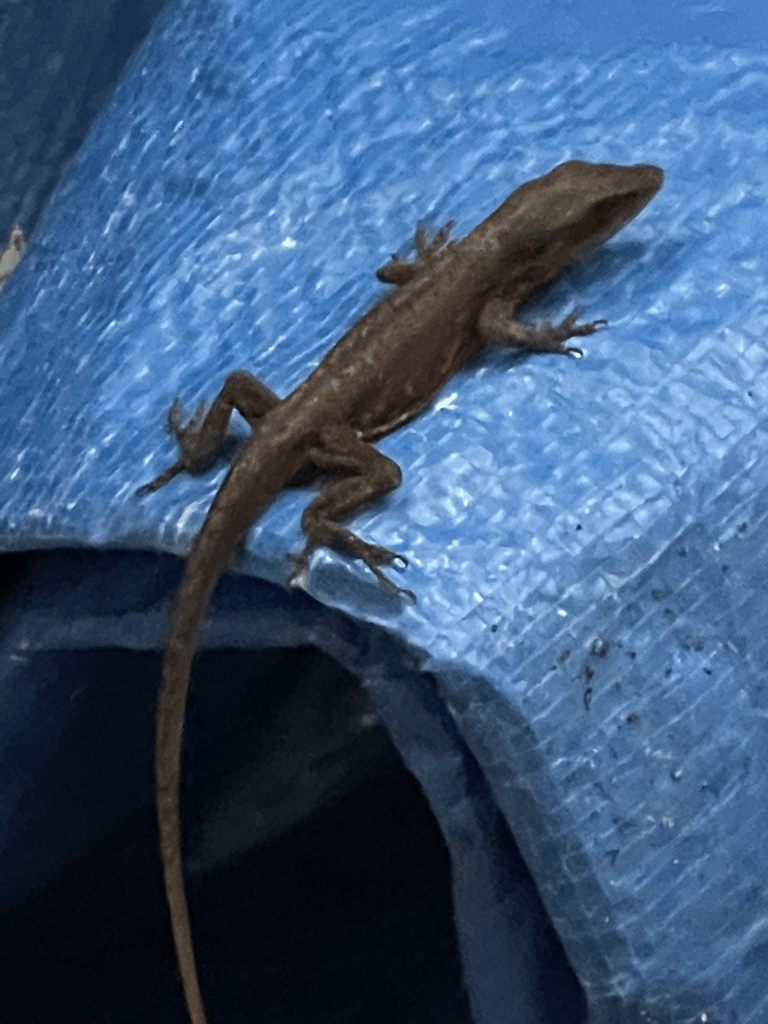
One day last December I was out in the garage looking for something, exactly what I cannot recall. There upon a blue tarp sat a solitary lizard, poised to leap away as they often do. The garage is pretty cold, maybe 45 degrees or so and thus an unlikely habitat for the cold-blooded reptile. When it didn’t immediately scurry away I wondered if the cold weather had caused its internal engine to slow and stop.

Being a simple person of obvious intent, I just walked up and *poked* it with my finger. It just sat there — no leaping up and screeching like some freakish tiny alien. Poke, poke. Nuttin’. I made a point to come back later and remove the poor little dude from the artificial conditions under which he had clearly perished.

The Winter Lizard

The next day I go out and he is GONE. Not on the floor upside down; not wrapped in some spider’s deadly embrace; but nowhere. Vanished. Gonzo.

I subsequently read about iguanas in Florida temporarily freezing in a cold snap and falling out of trees, cold and lifeless as stones. But mirabile dictu these lizards regain life as the temperature warms, none the worse for having been frozen. I would be remiss if I failed to note that Falling Iguanas is a great name for a rock band.

So this “dying” is the reptiles way of surviving when air temperatures refuse to cooperate, a cool adaptation <the editor apologizes>.

I hope I see my winter lizard in the spring, waking like the flowers and trees to become one with the great world.

Huge Snowball Battle.

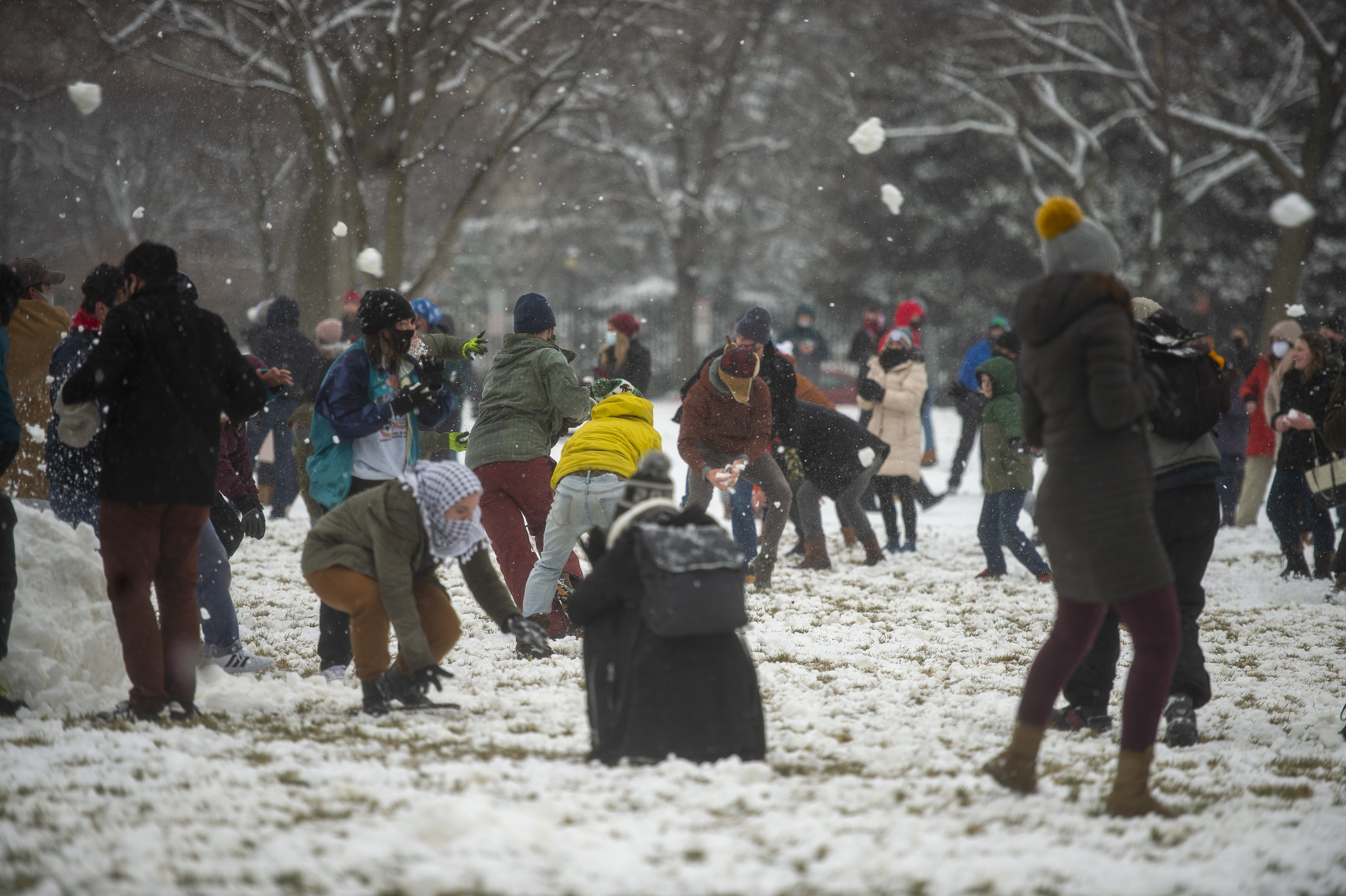
You can imagine that 2020 was a tough year for those of us trying to find those parts of life that are positive, hopeful and interesting. It would be easy to shake our puny fists skyward and decry the complete lack of spontaneous kumbaya singing in the neighborhood. But then, just when all is lost and we are about to succumb to the snarling beasts of despair, a little magic occurs on the mall in Washington D.C. In the midst of a sudden and fairly intense snowstorm, a large and impromptu snowball battle ensued. Total strangers began hurling snowballs at each other in the largest outbreak of inner children in recent memory. Human beings putting down their differences for a moment to engage in play, for no other reason than to have a bit of fun.

Imagine that.

Humans participate in a large-scale snowball fight on the National Mall in Washington, D.C., U.S., on Sunday, Jan. 31, 2021. Photographer: Bonnie Cash/Bloomberg via Getty Images

Natural Phenomena Like Sunlight and Birdcalls.

The riddles whispered
By the far sea
And empty shell
Reveal primal words
In secret song.

The heron’s mad glance
Offers subtle hints;
Sly knowledge
In scribbled pages
Of an ancient book.

The slow round turtle
And winter lizard
Care little for us;
Our ponderous clouds
Dapple the sun
In streaks of gray.

Sunlight and birdcalls
embrace no such ego;
The stitches on the loom
Enfold the world
Like wings.