While on our walks in the warm days of spring and summer, my daughter and I will often see earthworms attempting to make their way across the sidewalk. This tricky maneuver often ends badly for the worm, so in an act of kindness my daughter will remove the struggling beings and place them in the grass.
But nature is a cruel temptress, and we discovered that some of the worms she saved were not the standard European night-crawlers, but an invasive species called the Asian Jumping Worm.
As Cornell University notes: “Asian jumping worms devour organic matter more rapidly than their European counterparts, stripping the forest of the layer critical for seedlings and wildflowers. Jumping worms grow twice as fast, reproduce more quickly, and can infest soils at high densities. In areas of heavy infestation, native plants, soil invertebrates, salamanders, birds, and other animals may decline. These invasive worms can severely damage the roots of plants in nurseries, gardens, forests, and turf.”
In other words, the opposite of the normal earthworm. In researching these worms I also found that they are asexual (parthenogenetic) and mature in just 60 days, so each year they can have two hatches. The eggs are brown and small and look like seeds and lay dormant during the winter, waking when the air temperature reaches 50F.
I mean these babies sound like perfectly adapted killing machines, and are just another example of Nature keeping things interesting out here in the great world. Apparently we need more sidewalks.
For those that read this rambling journal you may know that Pulling A Fenton (PAF) means taking the smallest and simplest act and allowing it to spawn a grotesque and towering monument to stupidity.
I love rice and make a big pot periodically, way more than can be reasonably consumed by two people. The plan is then to divide the cooked rice into two roughly equal piles and place them into two plastic freezer bags. One bag goes into the frig and the other into the freezer to be taken out and thawed at a later date. This advanced riceology technique has worked well for years.
The other day I noticed that the first bag was nearly empty — time to take the frozen bag out of the freezer. Our freezer trays are really a series of metal grills which slide in and out on railings. On this day I go to take out the bag of frozen rice and it’s stuck, having sagged into and through the grill and then frozen around it. So it takes some work to free it from its icy entrapment, just need to tug the bag free and, uh-oh, the top of the bag tears off cleanly in my hands.
This angers me so I attack the remaining frozen lump and FREE it, aha! But in my zeal I manage to pull the freezer tray off its railing and watch in dismay as the other frozen food items slide out onto the floor. So I put the frozen lump of rice to the side, take out the freezer tray, pick the various items off the floor, place the now empty tray back onto its rails, and finally place the food items back onto the tray. I close the freezer door and turn menacingly to the frozen rice in its torn plastic bag, as if it is to blame somehow. I have succeeded in turning a simple act into a screaming avalanche of terror, like Everest without oxygen or Sherpa guides.
I managed to get the recalcitrant riceberg (heh) into another freezer bag for thawing without bringing down the entire house, so I’ll take that as a win.
I am a huge fan of Mochi in general, and I used to make Hawaiian butter mochi by hand. Usually my hands are perfectly adapted to destroy promising recipes, so when something goes right it is cause for celebration. This entry in Good Stuff is not a recipe per se, just a listing of preparatory activities that seem somewhat ancient in retrospect, like cave drawings from the earliest humans.
You start with a coconut picked from the ground under a Samoan coconut tree, a type of tree short enough to reach without having to climb high up in the air, like those tall swaying symbols you see in Hawaiian commercials.
dwarf coconut palm
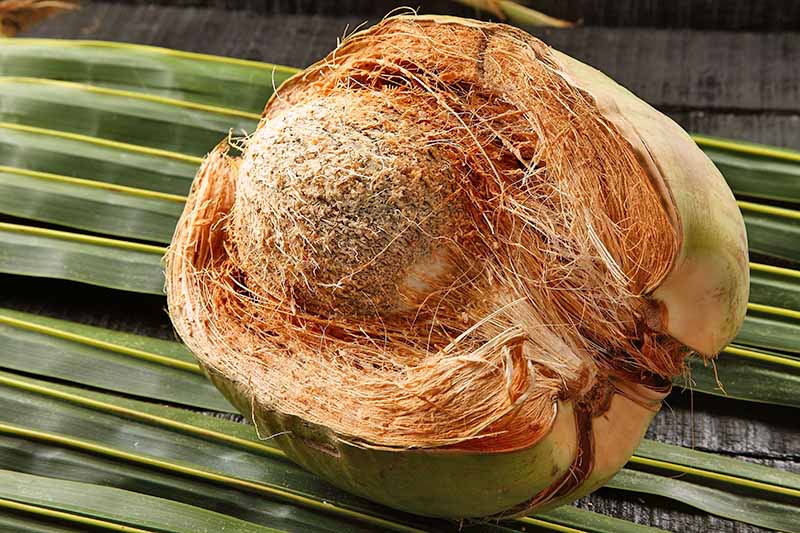
Once these babies fall to the ground the outer husk turns brown, and is ready to be peeled off to expose the actual coconut inside.
Peeling off the husk
I would do the peeling by using a pick axe with the flat part embedded in the ground and the pointy part facing up. Then I would force the coconut onto the pointy end and, using my weight, begin to pry off the husk. I have seen videos of coconut crabs in the south pacific with claws so strong that they could open a coconut. That is not me as my claws are puny. Once done I have the familiar nut you see in the store.
Walla!
Now you want to open the nut. I would rotate the nut on my hands until the “eyes” were pointing left and then, using the dull side of a machete, give the nut a few firm whacks around the perimeter. The nut splits neatly open thusly:
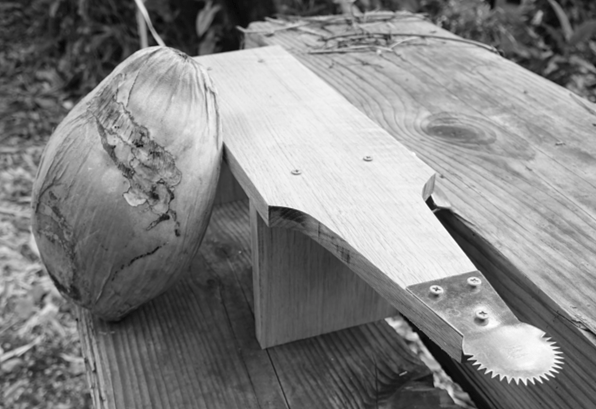
Now some folks want to preserve the “juice” but I am not seeking that for mochi. This juice is just old water and I have never been a fan despite it being promoted as a health drink. What I am seeking is the white meat, which I will now scrape out into a bowl. For this I used a cool scraper nailed to the end of a board:
This is more fancy than the one I used. It has a bench for sitting!
You sit on the board to hold the scraper in place, then proceed to use the tines to scrap the meat out into the bowl beneath. Once you have the grated raw “meat” you can move to the next step which in squeezing out the “milk” from the grated coconut. Yes, all this work was to get a bowl of grated coconut meat!
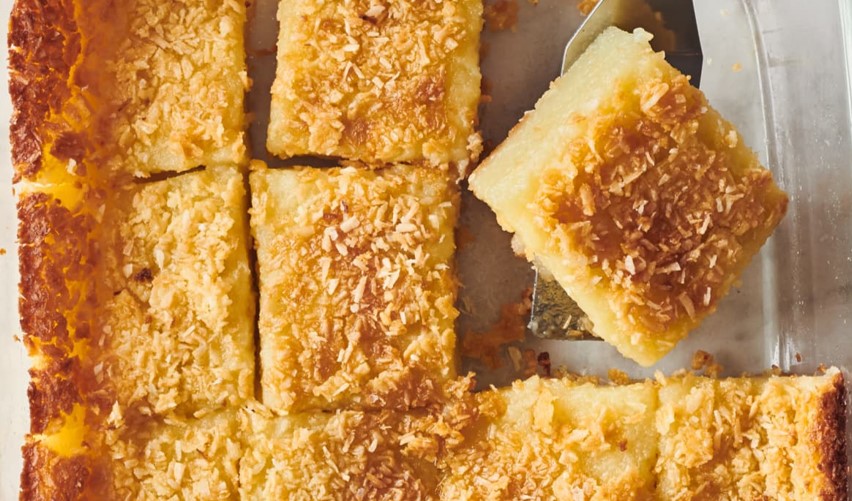
The rest of this article is really just using the painfully extracted coconut milk for Sweet Butter Mochi, replete with Asuki beans. This Mochi is baked and has a thin crust on top and is so good it “Brok da mout” in Hawaiian pidgin English.
Google “Sweet Hawaiian Butter Mochi” for various recipes
I am unsure if this activity — producing a dessert from raw ingredients — made the result taste better, but it’s as close as I have come to farming since I worked in my father’s garden as a child; long ago, far away.
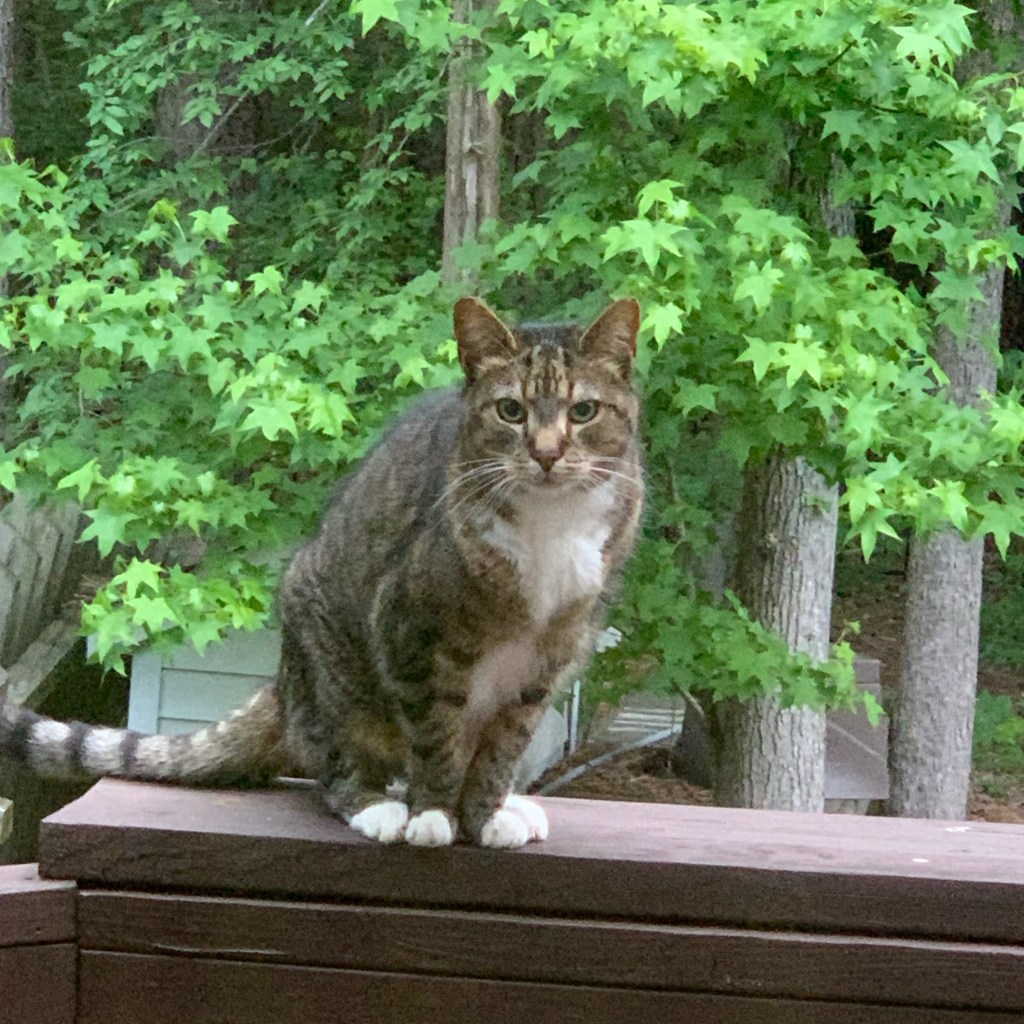
We got him as a rescue some 17 years ago. A mixed breed striped cat, selected for his distinctive facial markings, white feet and, insofar as we could tell, a strong character — although with cats such declarations can be tricky.
The Tinkster
My daughter named him Tinky which is a strange name for a male cat and one that might have caused some gender identity problems were he able to grasp that we humans assign names to cats and other objects in our world. I called him The Tinkster or simply Mr Kitty which may or may not have been an improvement.
Tinky joined us to be a companion for the roly poly Kody, a puppy so named because of his tiny bear-like appearance. We anticipated years of them joyfully romping together in the back yard, a bond between species. As Kody grew larger and larger this romping devolved into chasing and other forms of predator-prey behavior where Tinky would barely escape with his nine lives through the slats of the perimeter fence, leaving an oft frustrated but ever-eager Kody glaring at him from the other side.
Yet, a truce of sorts formed over the years whereby the Tinkster would stand his ground when faced with the aggressive posturing from the much larger dog. A carefully timed whack across the snout would send Kody stumbling away from this suddenly fearsome adversary.
It was clear early on that The Tinkster would be a mostly outdoor cat and that he needed this freedom. Anything that contained walls was to him simply a cage, included our house. If brought inside he would spend the next 7000 years seeking a way out, yowling to be set free. I never saw Tinky catch or kill small animals or birds in the woods. I am sure this must have occurred but there was never any obvious signs, not one in 17 years. I know he had some fights with other cats because both ears were torn with almost identical cuts, battle scars for the mythology of Tinky lore.
After Kody died Tinky was left alone. It took a little while but he soon realized that he had the run of the deck, the yard, and all areas within the fence and beyond. His realm at last. The closest he would come to the inside was the sun room equipped with a pet door, and only then because food and water were regularly provided by his large, but slow moving, servants. Over the last few years a family of raccoons also discovered the pet door and the food within, leading to some amusing confrontations between wild animals and a wild animal wannabee. Tinky almost never attacked them as they came for his food, nor did he run away, perhaps accepting a strange hierarchy of domestication.
A year or so ago Tinky began to slow down and lose weight. He was diagnosed with stage 1 kidney disease and put on a special diet to slow its inevitable progress. His journeys into the woods became shorter and shorter, his steps increasingly measured. This last week it became clear that there would be no magical cure and that Father Time had come knocking.
My daughter and I stayed with him in a quiet room at the animal clinic, and we were there as he left our world. Tinky was an outdoor cat and we thought it fitting that his final resting place would be out there where he lived his life. We dug a deep hole in the hard earth under the tall pines, cutting away the roots and moving loose soil with our bare hands.
Tinky lived his life by his own rules, as cats often do. Our memories, and these words, will keep him with us long after his passing. I like to think of him with Kody still, running and chasing, out there in the deep woods. No more cages for you Mr Kitty.
Open window breeze
Soothes like a cool cloth
Over fevered summer brow;
A silent symphony of
Of bright leaves
And pastel birds.

The quick passing dawn
Becomes the too-bright day
Filled with clattering noise;
An interruption unwelcome,
Like a smooth country road
Becoming rough cobblestones
Beneath our wheels.

As our kind seeks control
To bring straight lines
And hard edges to the world,
Consider for just one moment;
We have earned the quiet;
A stillness in time to remember,
Or think nothing at all.
On the surface a horizon
Casts sly glances your way;
The same in every direction
Receding at your touch
Like magnetic forces
And perfect points.

Water knows this shape
Wanting to conserve itself
Time and space balanced
In that momentary fall
When gravity insists
And Earth prevails.

Funny little mathematics
Sets the rules in motion
and travels a line
infinite yet bound;
Symbols like notes
In the music
Of the mind.
While working on this writing, I was forced to change the subject by the arrival of a small but noticeable guest. A tiny inchworm, much smaller than an inch, had entered the human realm of keyboard and mousepad.
How the little being arrived into my world I can only guess. Maybe I brushed past a leaf on my daily walk and he hitched a ride, or perhaps on the silken strands they spin to escape predators. Feather light and nearly invisible, I can only imagine where the inchworm fits on the food chain.
These little guys are determined yet cautious, testing the next step with their front legs whilst anchored to safety with their back. They instinctively sway back and forth because this strategy maximizes their chances of finding the next step.
The inchworm is not a worm at all but a caterpillar of the family Geometridae. In other countries the inchworm is called a spanworm, which I find quite cool as names go. After spending most of its life finding and eating leaves the Geometrid caterpillar morphs into the Geometrid moth. Worldwide there is an astonishing 35000 species of Geometers. They must be doing something right.
Geometer
But what to do about my tiny not-yet-a-moth intruder? I want to take him back to his world, yet he will not go upon my finger sensing something large and strange. I finally coax him onto a piece of paper and bring him to the front hedge. I place him on a leaf and wish him the best. It’s a hard world out there little geometer guy.
Did this encounter have any meaning in the larger context? It seems so introspective that I wonder why I have taken the time to record it. I guess it’s because life on the planet is so complex — as is our relation to it Would I have taken equal time and care to capture a cockroach and place it back in its habitat? Very likely not as we humans see roaches in some way as competitors to our way of life; pests to be eliminated.
But the fragile inchworm is merely a fellow traveler along the ribbon of time and space. Our forbearance calls out in the wind and is answered.
“Oubliette” is a French term derived from the verb “Oublier” which literally translates to “to forget”. The term describes a dungeon with an opening only at the top. The victim, once thrown into the oubliette, was considered forgotten by the outside world and remained so presumably forever.
Down you go.
That seems like such a direct method of handling ones enemies: toss ’em in a hole and forget ’em. As a child I had my own version of this although mine was more horizontal in nature. My brothers and I practiced the extraordinarily stupid ideas of “dare” and “double-dare”, ostensibly as a way of establishing a masculine pecking order or some weird bravery index.
Once, after a heavy rain, we were out wandering the wet and soggy Maryland countryside looking for mischief or other marginal adventures. We noticed a culvert under the road which was partially filled with rushing water and we thought it would be fun to crawl through this small tunnel and emerge wet on the other side of the road. Ah, the simple joys of youth.
“The Horizontal Oubliette”
it was a short journey of around 20 meters and of course I, the youngest, was the last go. At about the halfway point I noticed the light at the end getting smaller and smaller rather than larger and larger as I crawled toward it. My brothers thought it would be the coolest thing ever to block the far side and have the rushing water back up in the tunnel with me inside! As the water rose and the darkness closed in menacingly I assumed that this was basically it, game over — a forgotten boy under a road. They eventually pulled the blockage aside and the water gushed out carrying me along. I told them I “enjoyed the ride” so they would feel bad at having missed out.
This experience either cured me of claustrophobia or gave it to me, not sure.
Jordan Pond is an oligotrophic tarn in Acadia National Park near the town of Bar Harbor, Maine.
And wondered, what the heck is a tarn?
The great and powerful Internet Oracle rose from his cloistered warren and spake to me thusly: “0111000001111010100011111…” oh wait that is his *native* language. <translation begins…>
Another name for a tarn is a corrie loch, from the Scottish Gaelic coire, or “pot,” and loch, “lake.” A tarn is usually found in higher elevations and is clear, cold and relatively deep. A mere on the other hand is a wide shallow lake, like a small sea.
For those of you still interested, an oligotrophic tarn in the quote above refers to a deep water lake with low levels of nutrients like nitrates, iron and phosphate. An oligotroph is an organism that has adapted to live and grow in such environs.







 whoisfenton