The word “Troubadour”.

troubadours

In my mind’s eye I see these medieval minstrels carrying their songs with them, walking through the town square. I see folks looking up from their busy day and smiling, hearing the banjo, guitar, lute and mandolin weaving their lyrical stories like audible histories passed from generation to generation. The word ‘troubadour’ has been around since at least the 12th century, but I wonder if the first music made by the earliest humans did not owe its appearance to groups of impatient musicians who decided to set off down the wooded path. Today our electronics brings the music to us wherever we may be, but there is still something essential about the troubadours coming to your town, riding the notes of the mandolin and the song of the lyre.

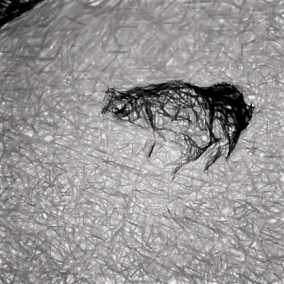
The toads that gather under the streetlights on warm evenings.

toad-1

When I do my walkabouts I tend to notice the small things around me.  The world is really built upon such things, all connected like the random scattering of straw upon the earth; forming unseen patterns we sense but cannot see. I walk past the toads congregating under the street lights, they having learned the behaviors of winged insects and their compulsive relationship with light. The toads do not think this through as we might; the light attracts the insects therefore we should go to where the light is. That would be too indirect and reasoned. Rather I suspect the toads move to where the insects are and are not at all concerned with causality. Thus they have a different stimulus, a sensory code written long ago in the web of life on earth. Without the light the insects move wherever they will, and the toads will find another spot, and these words will change as well.  I wonder about that story and if it will speak to who we are and of our place out there in a sea of darkness on the winds of light.

The word “guffaw”.

guffaw

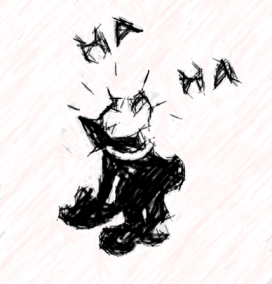
The word “guffaw” is not seen often anymore having given way to laughing, chortling and god forbid, giggling. It is unclear exactly what a guffaw sounds like but the adjective boisterous comes to mind, a laugh produced in an unconstrained way, just prior to lapsing into an alcoholic coma. It’s really too bad that a guffaw is not a kind of bird, because then we could describe that day when a flock of guffaws descended upon us, and then shuffled about in that weird little dance they do. But sadly, and with a sly chortle or two, we accept guffaw into our small but growing list of cast aside words. Welcome guffaw, there are plenty of chairs up front.

Kuching, The Cat City of Sarawak, Malaysia.


One of the many good things about living in Singapore – besides living in Singapore – is that it is a great place from which to visit nearby places in southeast Asia. One such place is the island of Borneo. The southern 75% of the island of Borneo belongs to Indonesia, who call it Kalimantan. The northern part of the island consists of the East Malaysian states of Sarawak and Sabah, as well as the sovereign nation of Brunei. A number of years ago we had the opportunity to spend a week in the city of Kuching, Sarawak, Malaysia.
kuching-cat

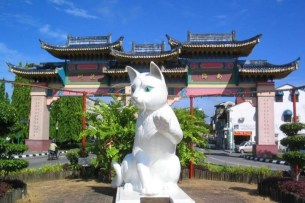
Kuching is sometimes called the Cat City, and its streets and marketplaces are festooned with statues of cats, some rather garish and scary like the one shown here. The reason why Kuching is called The Cat City is not entirely clear, but best guess is that the Malay word for cat is “kucing” so, duh. Another possibility would be that it is named after the pervasive fruit “mata kucing”, but then the city would have statues of fruit all over which would make this accounting far less interesting and exotic, albeit equally garish and scary.
rafflesiaarnflw1

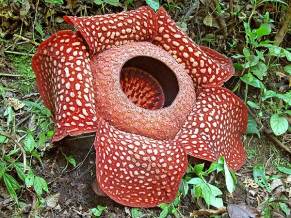
Mountain mists have shrouded the rain forests of Borneo for over 250 million years. These ancient forests support a biodiversity equal to any on earth. We were able to see (and smell) the Rafflesia flower, a form of parasitic plant that emits a rotten meat odor to attract flies for pollination. The Rafflesia are huge and alien, several feet across and looking like they just arrived from Alpha Centauri.

But then perhaps it is we who are the alien species, late to the party and sipping wine over in the corner. On Borneo we are seeing the world as it once was before human beings came down from the trees.

Long ago. Far away.
Makoli.

picture1

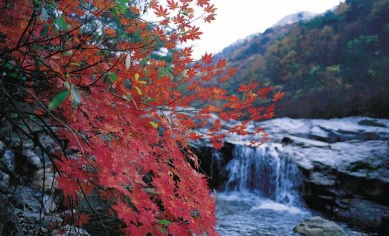
The geography of South Korea is blessed with some of the best hiking trails anywhere, with dozens of craggy yet accessible mountain peaks. I had the opportunity long ago to hike the trails of Songnisan National Park, about 2 hours southeast of Seoul. We started a bit late in the day so by the time we parked the car and hiked up the mountain to marvel at the views, the sun was beginning to set. On the trail down we made a youthful decision to stop off at one refreshment huts adjacent to the trail, yes right there in the forest on the mountain.

makoli

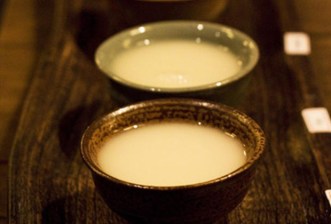
My Korean friends convinced me to try a local beverage called makoli, an alcoholic drink which appears to be a bowl of milk, but is actually a fairly potent form of rice-based moonshine. So we sat on rocks and talked for a bit and then realized two unfortunate things. One, it was becoming quite dark and we still had to maneuver down a fairly steep trail to get back to the car; and two, the makoli had begun to have some rather distinct effects on out ability to reason and, well, maneuver. My memory becomes a bit vague at this point — either a result of my brain cells leaping to their death into a foaming sea of makoli, or my singular attempt to forget the stumbling avalanche of terror which likely followed. I remember going down in a heap a couple of times and the sound of distant giggling.

If you get to Korea in your travels I can recommend taking a day to hike Songnisan. And if someone offers you a bowl of milk along the way, I suggest waiting until you reach a flat spot, preferably one with cushions.

Baobab tree.

baobab-tree-3

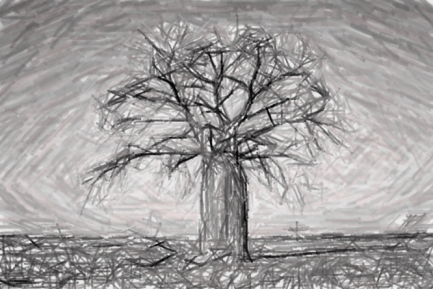
Nature has a pattern of producing forms of nearly infinite variety. One of the most compelling and unusual is the baobab tree found on the arid plains of eastern Africa and Madagascar. The baobab is sometimes called The Upside Down tree because its branches resemble the root systems of other trees, as if had been planted by some early farmer who failed to follow instructions.

The wood of the baobab is quite soft and water saturated, allowing the tree to survive in the desert during long periods of drought. Lacking traditional rings, the age of the baobab has until recently only been estimated through the traditions and folklore passed down from the native peoples who live amongst these ancient beings. Carbon dating techniques now place the baobab’s life expectancy at one thousand years, give or take a century.

When a baobab dies the thick trunk collapses in on itself, the resultant wood particles blown away on the desert wind. Thus, the tribes of East Africa believe that the baobab does not die, it just disappears. These strange trees have been out there for centuries, silent gatekeepers holding witness to the slow ebb of life in the desert.

I have never seen a live baobab nor stood next to one, but that would be something to do one day — to listen to their stories out there in the cathedral of dry sand and subtle wind. Perhaps they might want to know why we race hither and yon, building and rebuilding the world?  And why we insist on doing so upside down?

SPAM™ Musubi.

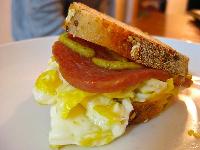
In 1937 Hormel created a material called the Space Protective Aluminum Mosaic (S.P.A.M) which was designed to act as a heat shield for the spaceships of the far future.  Given that those were decades off, they opted to also produce a food-like version called SPAM™. It spam-and-eggs_lwas and is marketed in small metal tins which you opened with an attached key. Inside would be the actual SPAM surround by a gelatinous substance, giving it the appearance of a mystery organ extracted from a large square animal.
As a kid I would relish a fried SPAM sandwich on toast covered with scrambled eggs, thereby assuring a lifetime supply of sodium, cholesterol and fat. Yum.spam-muisubi

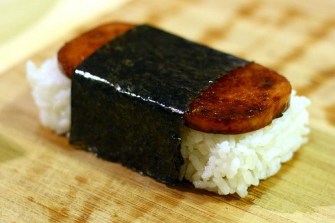
Hawaii consumes more SPAM per capita than any other state, likely a holdover from the years following WWII.  There was a  requirement then to feed a large number of soldiers on an island surround by several thousand miles of ocean, and SPAM has a shelf life of at least 80 years, although the science is still evolving. My own Hawaiian favorite is SPAM Musubi shown here – Spam on rice held together by a plucky band of seaweed. Heat shield or no heat shield, it don’t get no better than that.

Beanbag chairs.

I remember my mom working away at her pedal powered singer sewing machine, stitching together three sides of a small canvas sack. Before closing it she would fill it with dry chick peas. Behold the beanbag, the simplest toy since the “ball” and the “rope”. We kids would rush off to throw these things around, toss ‘em to each other and basically let gravity etch her parabolic curves. Beanbag nirvana.

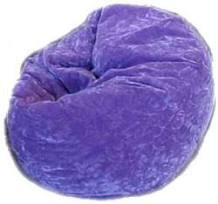
Fast forwardbeanbagchair a number of years and someone thought to apply this concept to furniture in the form of beanbag chairs. A purple one is pictured here, looking much like the mutant concord grape from which it evolved. These things were excruciatingly popular back in the 60’s and 70’s, when young folks found it necessary to “crash at your pad man, just till I get my head on straight”. Sure dude, just don’t hurl on my beanbag – that is like real Corinthian leather.
The concept of the beanbag chair seems so logical – plop yourself down on one of these bad boys and let it mold into the shape of your backside. I expect these chairs have always been more popular with younger, limber people. Old folks like me are pretty good at plopping down, but require significant algorithmic assistance at the standing up part. I imagine myself today rocking back and forth until I reach my tipping point, rolling off the beanbag onto the floor and then creakily rising to my feet, beaming like a loon.

Their time has passed, but I’ll bet a lot of folks still have them safely tucked away, back in the attic behind the Silly Putty and the walkie-talkies.

Snow geese lifting off as one from a blue lake.

geese-in-flight

I remember seeing this image on a nature channel some years back when I watched TV. It was the sudden and majestic lifting off of snow geese from a crystal clear mountain lake. I imagined the white, the blue, the coordinated timing to be an exhortation of life.

Each year the snow geese come from the Arctic north, flying upwards of 8000 feet to winter over in the lakes and ponds of North America.  They have been making this pilgrimage for over 35,000 years; measuring the days with the simplicity of a sunrise, giving the people of long ago a way to mark the seasons. These early people revered the birds and lived in harmony with them. They came represent the beauty of nature, a vision of wildness, perhaps a glimpse of an earthly paradise. The humble human; the soaring bird; all part of the great living engine of Earth.

People migrate too but now our journeys take place mostly in our hearts and minds. We taste the bitter winds of fate, tackle the valleys of despair, climb the mountains of joy. And somehow we figure it out. Even in our darkest hour when it seems that misery and cynicism fill the world, we figure it out — and lift off as one.