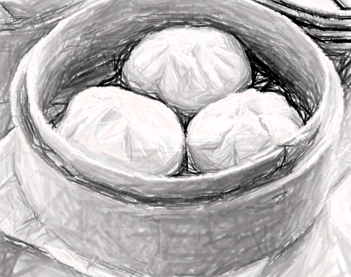
Bao.

It has been many years since I had char siu bao, all the way back to my decades in Hawaii.  “Bao” is basically a chinese dumpling with meat or vegetables inside.  Char siu bao is a steamed bao with pork inside.  “Broke da mout” as they say in Hawaii.

Bao

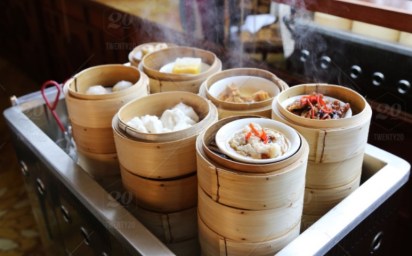
Much further back in time I remember a going to a dim sum restaurant in Hong Kong, where they had these giant carts filled with baskets of steamed bao of all kinds.  I think I referred to this place as Dim Yum after that, much to the dismay of my chinese friends.  I also remember the place being very loud, the combination of animated talking and the clatter of dishes building to a cacophony of sound and sustenance. 

dimsum

Pixar produced an award-winning animated short film called Bao, where a steamed bun comes to life, briefly.  Very cool.

Food can be a time machine, reminding us that the past is not so distant as we imagined.  I was in Raleigh the other day having char siu bao, bringing back memories of long ago, far away. 

String instruments.

The Strings remain
An unlikely union
Of taut twine 
And teasing bow, 
Sound soaring
Like notes on wings.
Everlasting hollow wood
Releases its gift;
A complex geometry
Tracing audible curves;
An inner symphony
Of echoes on air.
Plaintive and pure
Artisans of music;
The teacher is taught
Let songbirds sing
And memories fly
All the way home.


Migration.

The birds arrive one day by the thousands, hang around for a while and then are gone, seemingly overnight.  Each year like clockwork, butterflies descend like a cloud into the trees of California.  Examples of migratory behavior are everywhere and though we have come to understand what is happening, the why and how have proved more elusive.
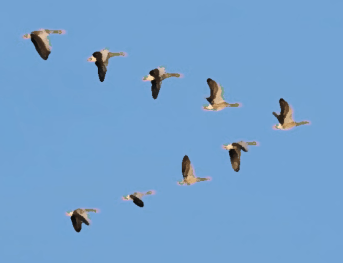
birds-1

As recently as the 19th century these mass appearances were a mystery.  Birds for example were thought to burrow under the mud in winter; some suggested that they might even change from one species to another to survive the cold.  One rather famous fellow hypothesized that birds flew to the moon!

It wasn’t until a hunter in England shot and killed a stork, a stork with an african arrow piercing its neck, that migratory patterns began to be understood. The mysteries of nature are thus revealed, although to be clear I was hoping for the Moon Stork.

And we have found that it is not just birds but insects, bats, sea turtles, salmon and a whole host of other beings that make these perilous journeys, placing their trust in instinctive certainty.  These species live out their life cycles in multiple places, going to or away from some environmental imperative to optimize survival and longevity.

How do they accomplish this without access to the internet, GPS and geosynchronous satellites?  Apparently migration uses a number of different mechanisms and some species use them in combination, hedging their bets.  Earth’s magnetic field is a favorite – some animals have tiny particles of magnetite embedded in their bodies and cells.  Dolphins seem to read the contours of the ocean floor while migratory birds depend on the sun, its angle in the sky and the time of year.

Might we, through our deeds and desires, disrupt the very signals upon which survival depends?  Living in harmony with others is not our strength, but I am forever hopeful.

And so they come and go, come and go, riding the physics of the earth.


Hibernation.

Recently whilst walking with my daughter out at Eno River State Park, the topic of frogs came up — and not for the first time.  Frogs are a big deal amirite?

Anyway, we collectively wondered where these little guys go in the winter months to then suddenly appear in such large numbers in early Spring?  I mean we are not considering something horrendous like FrogSpores[tm] are we?  I am guessing that they burrow under the mud or earth to avoid freezing and then go into hibernation with slowed respiration and other metabolic activity.  At least that is how some warm-blooded (ectothermic) creatures hibernate, so I speculate something similar occurs in cold-blooded (endothermic) animals.

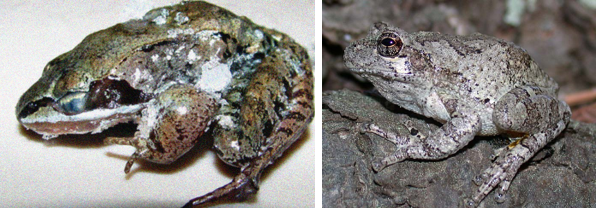
It turns out that this is true as far as it goes, but some of our little tree frog buddies have a surprise waiting, oh yes they do.  Tree frogs are not very good diggers so in the winter months they must lodge themselves deep into logs or in crevices of branches and hunker down.  If the air temperature around them drops below freezing, ice crystals begin to form on their skin and then this incredible biochemical transformation begins. 

The frog’s liver begins to replace the body’s water with glucose which allows the cells of the frog to freeze without damaging the surrounding tissue.  They then proceed to go into a state of extreme hibernation; their heart stops beating and they stop breathing.  Essentially they are frozen solid and ‘die’.  But as air temperatures rise, the frog’s internal systems come back “on line” and the frog slowly revives. 

frog before and after

It would be cool if these cadaver frogs would shout “BOO!” as they wake, but that would be too much to ask.

Imagine the changes which have occurred over the millenia to develop this adaptation.  Life does indeed ‘find a way’.

And Frog Spores *might* be a good name for a rock band, albeit a pretty strange one.


Bali.

Because I have lived in many parts of the world I am sometimes asked what was my favorite location.  My basic answer is every place is amazing IF you pay attention to the small things that are going on around you.  I have written of some of these places in my other blog, BLAB,

Still, there are some locales that stand out in memory, combining physical beauty, culture, and tradition in unique and startling ways.  I have been fortunate to visit one such place, the island of Bali in the Indonesian archipelago.   The culture of Bali is based around a Balinese offshoot of the Hindu religion, making it quite unique amongst the largely Muslim population of the other islands that make up Indonesia proper.  And by “proper” I mean the over 17,500 ISLANDS of the archipelago.

bali

The people of Bali are artisans by nature and make the most beautiful works in wood and stone and cloth.


bali-2


I remember once traveling about the island and stopping off at a batik shop pretty far off the beaten track.  We had our son with us and I guess he was around 2-3 years old, an age when they race around like water bugs.  While we shopped he somehow darted away from us and we had a moment of panic when he was nowhere to be found.  Then WE were racing around like water bugs.

The owner of the shop kindly took us to the small kampung (village) behind the shop and showed us our son, playing with the other Balinese children without a care in  the world.  He was an outdoor kid and brown as a nut, tanned to nearly the same color as the other kids.

The Balinese thought nothing of “borrowing” this slightly unusual looking little kid for a moment of play.  Watching them there under the equatorial sun I was struck yet again by how similar we are, while we try so hard to be different.


Bowling.

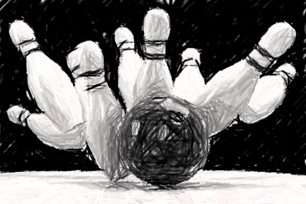
bowling

I can remember being in a bowling *league* back when I was growing up and bowling was one of the preeminent social activities of the day.  I would spend every spare (no pun intended) moment in the bowling alleys of Laurel Maryland, Princeton West Virginia and Pemberton New Jersey.  The alley in Laurel was where I learned ten-pin bowling and the far more obscure *duckpins*, the little squat pins which were hard as heck to knock down, when you did the sound lacked the rattling finality of ten-pins.  Duckpins reluctantly go down with a whimper.

My high school actually had a gym class devoted to bowling where we were taught the proper way to grip the ball, release the ball, how to throw a ‘hook’ into the ‘pocket’, etc.  I love the arcane language of bowling, a sport whose rules are only slightly less obscure than *cricket*, a game which consists of men running around a field and doing random things described as “full toss”, “googly” and “leg before wicket”, all of which sound vaguely sexual.  Don’t get me started on cricket.

Bowling has been around in one form or another for millennia but the type I am describing took off with the advent of the automatic pin setting machines invented by Brunswick.  Prior to that the pins were cleared and set by nimble young men called “pinsetters”.  Even then automation was changing the landscape, asking armies of pinspotters to seek gainful employment elsewhere, perhaps chasing down errant shots at a golf driving range.  Speaking of mysterious language, golf, who knew?

I remember being on a bowling team somewhere,  and since I was a novice bowler with a high handicap I would occasionally be asked to score poorly.  This team request was done quietly as if we all understood the secret mathematics of victory.  Once, it all came down to me NOT making a spare in the 10th frame (ed note: more arcane bowling lingo).  Faced with the need to miss the pins I hit them quite by accident, in any normal time a mark of success.  However judging from the sea of scowls my team was not happy with me that day.  I found it all very strange and disturbing, this need to manipulate the handicap system in order to “win”.

I should have just spun up a googly.


Flying colors.

I find the notion of anything flying to be very cool, since I myself do not fly.  But the notion of flying colors is especially groovy because well, colors duh.

Being triumphant or successful means that we came through “with flying colors”, a homage to ships returning from a great sea battle.  Flags raised and unfurled meant a successful campaign or mission; flags lowered (“struck”) implying a loss or failure, accompanied by much wailing and gnashing of teeth.

Of course we can also show our “true colors” and feel free to sing along with Cyndi Lauper.

…So don’t be afraid to let them show
Your true colors
True colors are beautiful
Like a rainbow…

I remember once walking out the main gate of the Army base I worked at in Hawaii.  It was the end of a long day (“pau hana time”), and I think they play the bugle call “retreat” around 5pm.  It is tradition to ‘face the colors’ – the flag –  to show respect.  Anyway there I am walking along, lost in thought, oblivious to the goings on around me, when I become aware of an angry voice yelling at me.

“You’re supposed to salute the flag!”, he yells, “not keep on walking”.

I slowly come to a halt and turn toward him with what I hope was a face devoid of expression as if he had not spoken at all.  I am not a person who seeks confrontation.  I had apparently violated a code of conduct and he was there to provide a lesson in the optics of patriotism to this poor schlub (me).  I say optics because I have always believed that a patriot is characterized by so much more than respect to a flag, in the same way that attending church does not necessarily make one a Christian/believer, although such symbols might coincide with acts.

Instead, by your deeds you shall be known, with flying colors I hope.


Driftwood.

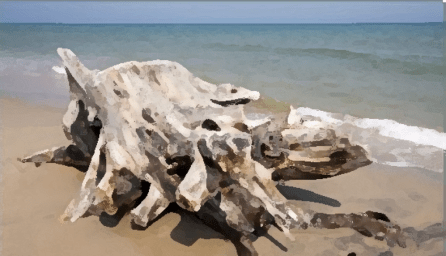
driftw

We admire
The rough-hewn look
Forever shaped
By wind and rain
And sea and sand;
Every piece unique
Like a signature from Earth;
Nature’s lesson of renewal
Teaching us how one thing
Might become another,
Given time and circumstance;
The name itself
Requires nothing further;
It simply says what it is
And translates the world
To art.

Sessile.

Since I spent the last entry on certain types of motion (motility), it is only fair that I spend some blogspace on beings that spend all or part of their lives fixed in place with no ability to move on their own.  These are called sessile organisms and have the characteristic of sessility.  ScrabbleMasters™ take note in case you find yourself saddled with a whole herd of “S’s”.  I guess you could try “psssst” and fight off the inevitable challenges and cries of outrage, resulting in the rarely practiced form of the game called CombatScrabble™.

Anyway, back to sessile organisms.  Most of these animals are found in a marine environment — examples are sponges, corals and anemones.  Another sessile animal is the barnacle, although in their larval stage barnacles do in fact move until they latch onto a solid surface, whereupon they spend the rest of their lives fixed in place.  These sessile creatures are very efficient since they don’t waste energy chasing down their food, relying instead on the movement of water to bring food to them, the zoological equivalent of Amazon Prime™.

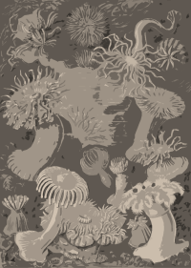
radial1

Given their reliance on water currents, most of these sessile animals exhibit radial symmetry, to respond to food coming at them from any direction.  Also, I like the words “radial symmetry”, which might be a good name for a rock band.


Lumber, Trundle, etc.

I always associate lumbering with large ungainly animals like rhinos or hippos.  As they lumber toward you they kick up clouds of dust and the ground shakes beneath your feet.  Lumbering animals might seem clumsy, but I have always thought of them as very determined and their straight line destination inevitable.

Smaller animals might be said to trundle along, equally ungainly but not so substantial and fearsome as those beasts that lumber.  Raccoons and hedgehogs trundle as they careen along in their clever ways, operating just below our sight lines, little tricksters that they are.  Some objects like a suitcase trundle by rolling along on their little wheels, in fact the noun form of trundle is wheel.

If it’s nice outside we can take the long way round and go for an amble.   There we are bopping along with seemingly not a care in the world.  Nothing on the schedule today, perfect time for an amble.  Amble comes from the latin word ambulare, meaning to walk about.

Add an “sh”  and we become zombies lurching  along in a shambling walk.  Unless we are those real scary zombies that can run real fast, a situation which is totally unfair and breaks all the laws of zombie physics.

I can imagine Yeats wrestling with all these forms of motility before finally arriving at;

“And what rough beast, its hour come round at last,
Slouches towards Bethlehem to be born?”

“Ambling” towards Bethlehem just doesn’t carry the same sense of dread as slouching, does it?