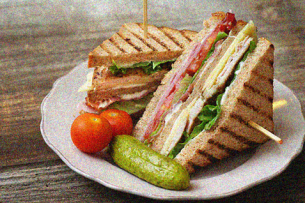
 I am not sure why I find the combination of elements which go into the classic Club
Sandwich so perfect, but there it is. Maybe it’s the toothpick which holds it together or the side dill pickle, but when I see one of these puppies on the menu the result is predestined. My traitorous eyes may roam over other selections, but those feeble attempts at rebellion are doomed to fail. In the end, whilst my head may be screaming salad, my heart is with the Club. There can be only one.
Category: Uncategorized
Skipping a flat stone across a pond.
I would guess a good percentage of human beings have skipped a stone across a glassy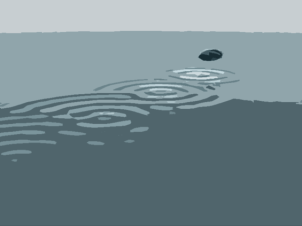
pond, or at least attempted to do so. It’s odd how this shared activity connects so many of us across age, gender, wealth, religion and culture. We are excellent fence builders, finding every conceivable way to highlight our differences and take pride in our apparent uniqueness. But the things that make us unique are not our visible characteristics; rather it is in the way we think and express ourselves in word and image and song. For example, MY expression in song is very unique and quite unforgettable, try though you might <insert grinning emoji here>. Once in a while we come across a thing of such commonality that we amaze ourselves with just how pure and simple our mutual humanity can be. Find a stone. Throw a stone. Count the skips. Welcome to the world.
Old Barn.
Weather beaten and frayed
Rusty hinges cry against the wind;
Many years spent
staring down the sun
And keeping the rain’s tin hammers 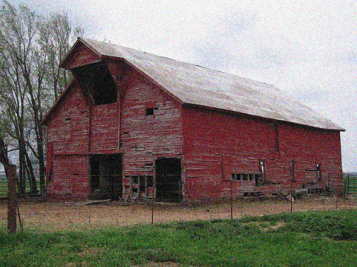
From having their way.
Light filters past motes
That hang like fireflies,
The quiet song of the loft
Brings a smile to weary eyes
And the dry smell of hay
Clings to clothes and memories.
Stubborn old walls resolute;
Watched folk and their beasts
Pull food from the land
And rest a night too short
Before the rhythm rises
And the floorboards shake
With the drumbeat of the world.
Nothing built lasts on Time’s wheel
But that old barn never asks
To be more than what it is;
Out there in the still dark air
Holding back the tide
‘Till morning comes.
Fractals.
Sometimes I think my understanding of the world is ten miles wide and one-inch-deep, but I still find stuff very cool within the limits of my paramecium sized brain. One such concept is fractal geometry and the concept of perimeter.
At some point we all studied perimeter and calculated how far around it was for certain shapes like a circle, a square or a triangle.
But those objects are theoretical shapes described by a set of rules. They help us model, predict and extend our understanding of what is called “the real world”. What about “real” objects? How far around is, say, the island of Oahu in Hawaii? One could walk around it I suppose and measure each step, and that will give us an approximation of the perimeter. The closer and closer we get the more accurate is our measurement, but we realized we can’t know the exact perimeter like we would the perimeter of a geometric circle calculated by formula. For a real object like Oahu we only have an increasingly fine estimate.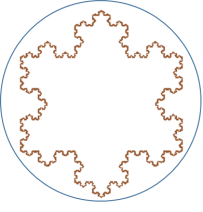
The object here is what is called a Koch snowflake, and is an example of a fractal. You can imagine that as you fly in closer to this image, each of the little “knobs” becomes a replica of the larger image, and this continues no matter how close you zoom in. The perimeter of this object become greater and greater, but the area remains entirely constrained within the circle. Eventually the perimeter of this fractal becomes infinite whilst the area remains finite, or bound.
The real world does not consist of perfect cones, circles and spheres; it is messy and chaotic, rough rather than smooth. The “edge” of an island is elusive depending on how close you get to the surface. The study of fractals has opened up new ways to think about chaotic events and to understand how they may behave.
The Smithsonian.
Each year nearly 30 million people visit the Smithsonian museum complex in Washington DC. My first visit was over 60 years ago when my family and I lived in Laurel Maryland. That era predated the I-495 beltway because it also predated the existence of the Interstate Highway System, then little more than a gleam in the eyes of slide rule wielding transportation engineers. A trip from the little rural town of Laurel into DC was a full day trip down the Baltimore-Washington Parkway, and on warm summer days we would pack up the Plymouth and head due south. Driving into the city we would motor past the Washington Monument, which I would call the Washington Mommyment to the delight of my parents and eye-rolling mortification of my brothers. Then we would park the car on a street near the mall and simply walk out to see one of the great wonders of the world. A different time, then.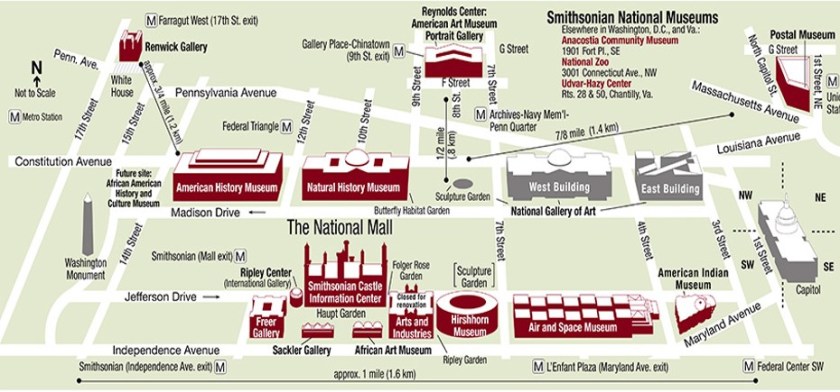
I have visited Laurel more recently and find it difficult to navigate through a landscape devoid of known landmarks. The cities of Baltimore and Washington have grown together to form the Metroplex, absorbing all the intervening spaces. Once rural, Laurel is now one of many suburbs. Such change is alarming, especially if you spent years away, like seeing your neighbor’s children magically grown to adulthood when you meet again after many years.
My daughter and I visited my son in Springfield Virginia recently, and during that visit we took the Metro in to see the Smithsonian and the surrounding government complex. Even after the intervening decades the place has a timeless quality about it. As we walked past 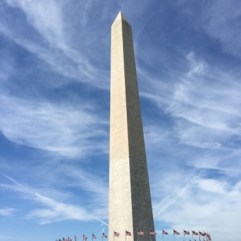 the White House I told my kids that they could become the President of United States. My daughter asks, “Is it nice inside?”– a question so unexpected I cannot reply, or if I did the answer is lost in history. We walked up to the Washington Mommyment, which my daughter calls The Obelisk. The monument starts out reasonable when you are far away, but as you get closer and closer it swells to occupy all physical reality. I find it strangely disorienting to be standing next to objects so large. We thought we might head over to the Lincoln Memorial, but man that looks far away, and I really wanted to see the Museum of Natural History.
As we enter this museum (body scanners!) I get flashbacks from 1956, seeing myself there as a small child; filled with the same sense of wonder. So much to learn and so little time.
Here is where I decide things are going so well that I might as well “pull a Fenton”. I go to throw away my gum, which by this point has lost all its flavor and become a stiff little ball of incipient badness. It somehow gets stuck between my thumb and forefinger and the more I try to dislodge it the stickier and more recalcitrant it becomes. Like the Blob in the movie it slowly captures each finger in turn until my palm is smeared with this nasty goo and I sense it may be attempting to control my thoughts. I notice that I have been standing in front of the trashcan for far too long, so I excuse myself and head off to the restroom. Finding a restroom proves more challenging than I thought, perhaps distracted by The Material and its mind controlling powers. There! A restroom thanks be! Bolting inside I head for the sink, turn on the water but what’s this? The gum hardens even further in water and I am momentarily struck by the irony of a stick of gum with the staying power of dinosaurs and an apparent half-life of millions of years. I wonder if one day there will be a bronze statue in the rotunda of a hunched and tattered homunculus entitled, “Dumb Guy”. By the time I rub the stuff off me, my hands are as red and raw as a Maine lobsterman hauling in his catch.
I never told the kids this so it will be our little secret, ok? (oh, wait…)
Anyway, the good news is that for all our collective difficulties, carnivorous gum included, the institutes and museums of the Smithsonian are there and waiting, a record of who we are, where we have been and all the places we’ve yet to go.
Get out there.
Seeing vultures by the side of the road.
As kids in Maryland my brothers and I would spend the bulk of the day outside, roaming the woods, not so much looking for trouble as pushing the boundaries of the acceptable. One of the games we would play would be to lay down still in a grassy area to see if we could coax a circling vulture into believing we were dinner. I do not recall this ploy ever working, and I am not sure what we would have done if it had. I imagine three screaming dots on the horizon. The vulture’s fearsome aspect was the very thing we found so interesting I guess, like going to horror movies and glancing away at the scary parts.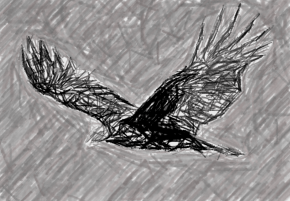
Here in North Carolina I will see clusters of vultures on the ground at the side of the road. I know what it is they are doing; no coaxing or boyish trickery is in play here. They are
merely performing their duties as described in The Book Of Things. It may be incorrect to think of vultures being good, but they are clearly necessary and perhaps — in the way of all creatures great and small — endowed with a form of grace.
One of the first summer jobs I had as a teen was that of janitor at a small business. I would arrive just as the staff were going home, me with my mop, broom and pail. I would clean in silence room by room, erasing the detritus of living beings so that industry could continue unimpeded by dirt and debris. There is an honesty in that, this cleaning up as we go, making way for the new sun.
Popovers.
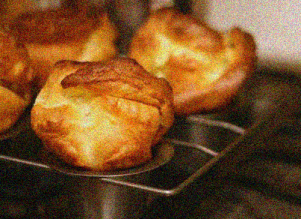
One of things Pop used to make for us were popovers (no relation). Simple to prepare and
to us, a wee bit magical. He knew the “trick” and they always came out perfectly, crusty on the outside with a soft buttery interior. I have tried to make them but they don’t quite seem the same. It might be recipe or the oven, but I wonder if it’s just whimsical memory
having its way.
Skin diving off Three Tables on the north shore of Oahu.
I moved to Hawaii a long time ago to attend the University of Hawaii at Manoa. So many great memories, but one of the strongest is the ocean and my time in and around it. You cannot miss the blue water that surrounds you for thousands of miles in every direction. Some folks who move to Hawaii suffer from Rock Fever, the sense of being trapped on a small circle of land. I pointed out at the time that even folks who live on the Mainland rarely venture beyond a 40-50 mile radius of their home and thereby are living on a virtual “rock”.
In the winter months the north shore of Oahu is subjected to huge waves generated by storms in the north pacific, and these are the best times for surfers. For me though the best water was in the summer when those same rough seas would turn glassy and calm, perfect for recreational diving.
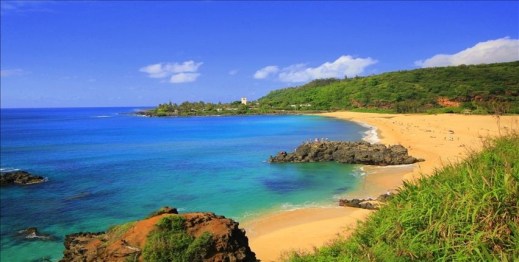
One of my favorite dive sites was Three Tables, so named because of the three flat lava outcroppings which would be just visible at low tide. Out beyond the tables the bottom sloped away gradually.
We used to swim out a few hundred yards until the water was around 40-50 feet deep where, surrounded by crystal clear water, it felt like swimming in an enormous bathtub. I would dive down and clear my ears of the pressure (a squeaky sound!) and revel in the silence, isolation, and best of all, the third dimension. I liked to flip over and swim looking back up at the distant surface, imagining being the aquatic creature I once was. Diving deep at Three Tables, I believe our cells carry these memories still, from that time long ago before we struggled into the sun and the wind, up there on the other side of the world.
Sliding turtles sunning themselves and well, just turtles.
There is something oddly majestic about the turtle, often depicted in our fables as ancient and wise. There is this story I heard once of a scientist describing to a class how the earth orbits the sun which in turn orbits the galactic center. At this point in the lecture, the scientist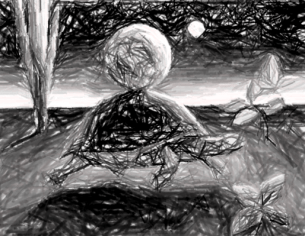 is interrupted by an elderly woman.
“This is nonsense”, she proclaimed, “everyone knows that the Earth is supported on the back of the Great Turtle.”
The scientist asked, “And on what does this Turtle stand?”
She replied, “Why another turtle of course! It’s turtles all the way down.”
I am reminded of this  when I see sliding turtles sunning themselves on rocks in the Eno
River over in Durham. They are still and watchful, the river’s sentinels, ready to dive into the water at the first sign of threat. They are otherwise silent and utter no warning cries, but I know if I was a river dweller and saw these guys dive for cover I might suspect something was up.
We had to take our cat Tinky to the vet recently, and while we waited I noticed a large fish tank in the lobby. In it were myriad colorful fish peering out at the air dwellers in their 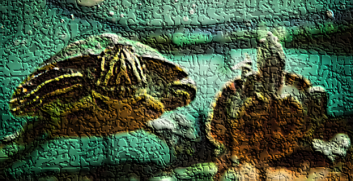 funny “clothes”. What made this aquarium stand out were these two cute little turtles who would take a breath and dive down, their short legs going a mile a minute. But this idyllic picture soon turned dark, as I noticed the turtles were intent on chasing the fish and biting their fins. Indeed, on closer inspection the slower fish seemed a bit tattered, while the rest scattered like banshees before the tiny amphibious onslaught. We may have wanted the turtles to behave themselves and remain adorable, but they clearly had other plans.
Growing up in Maryland, we three kids would head off to school in the morning, walking a long dirt road out to the school bus. We would take this same road home in the afternoon, the late day sun glinting through the trees. One day we came upon a large snapping turtle laying her eggs in the sandy soil next to the stream, a tributary of the Patuxent River. We 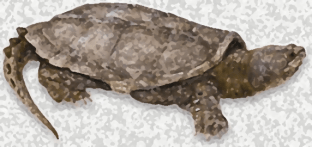 raced home and convinced Pop to get the truck and bring the turtle home. I am sure he rolled his eyes, but in thinking that this is one of those life lessons, agreed. We put it in the dog pen, sans dogs, and bent down to look at it. Our turtle, we thought, we got ourselves a snapper! Pop pushed a broom handle through the wire mesh and the turtle promptly bit it in half causing us to take a step back, admiration mixed with fear, supplicants before such a powerful being. The next morning the turtle pen was empty, save a trench dug under the wire. We looked all over but never found it. It may have just gone home to the river, but I want to believe it went back to holding up the world, taking its place in the infinity of turtles, all the way down.
Stalactites.
Deep down where sound is lost
And no one knows they grow
These icicles cold but not ice;
Tiny rivers flow over time
Watery clocks whisper
Of the still air and darkness.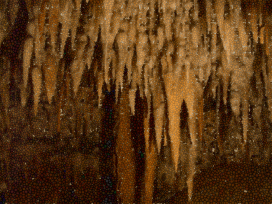
Life still abides below
Blind rustlings and beings
Without one unneeded sense;
The wet touch and dry taste
Guided by the Earth
Pulled by insistent tides.
If stalactites knew
They might be jealous
Of the green land above
Taking all the Sun’s gifts
To cover the earth with life
And us.
But they also know their part
These roots of stone;
Living not life but process,
Sun falls to Earth
To feed the soil
And water the depths,
Refilling gaps and spaces
Under our feet
And ask nothing in return.
 whoisfenton