On a recent walk at Eno River State Park, my daughter noticed a cast off plastic soda bottle floating on the otherwise pristine waters of the Eno. She asked why is it that some folks feel free to litter in this way, and that perhaps we should attach a social stigma to such misbehaviors as they do in Japan. She opined that maybe we should institute shunning as a method to control our darkest instincts.
The word “shun” is one of those words that looks misspelled. The longer you gaze upon its make-believe simplicity, the worse it looks. That can’t be right you say to yourself, the very same self that generates typos with such willful contempt that entire *languages* weep. Continue to stare at those four little letters and eventually you will be convinced that shun is a chinese word meaning “small, three-wheeled cart used in the Yuan Dynasty by members of the nobility”. Trust me, it’s inevitable.
But no, shunning is something akin to shaming, applying social rejection to penalize folks for misbehavior. The earliest use of the word was around 900 A.D, from the Middle English “shunen” or Old English “scunian”, meaning to avoid or fear.
Regardless, I plan to hale a shun to take me and the missus to the opera at the palace.
I came upon a word I hadn’t seen before: Contronym. Simply stated a contronym is a word that is its own antonym. Here are some of these words: Oversight, sanction, left, dust, seed, stone, trim, etc. The meaning of these words can be one thing or the opposite thing depending on context. You can seed a lawn, or seed a lemon (meaning un-seed I guess). Trimming a Christmas tree is quite the opposite of trimming a hedge. 4 people left the party, how many are left?
What is the opposite of a contronym? I guess just a word with no other meanings. My head hurts.
Between the stars above and the sturdy earth is a sea of air which will hopefully come as no surprise to you. Our little ships (us) are subject to its whimsical nature and I was reminded of this during my first walk of 2020. The weather has been unseasonably warm and I was tempted to try a tee shirt in January, thumbing my nose at the winter solstice. But no, at my age there is no reason to tempt fate so I opted for my trusty hoodie.
Almost immediately I see danger on the horizon, a horizon which seems to be getting closer by the minute.
The white below the dark is a sheet of rain, yet I am an optimist at heart. I make it to the cross street and turn left, moving parallel to the storm. I had this weird idea that I would somehow skirt the edges and avoid the worst. I mean I am so small and the storm so large, surely I would not attract the storm god’s attention?
I feel the wind coming up behind me, pushing me along, and then this whooshing sound of rain hitting the trees and I know without turning around that I am in for it. I pull my hood up and brace myself and here it comes; wind and rain in sheets letting me how it is out here in the world.
Being ‘in the elements’ is a raw, primal feeling. There is no shelter save what you can carry. All your senses are engaged; indeed this is why we need “senses” at all. The January rain is cold and unforgiving and my choices are to hunker down or keep on moving. I am resigned to be wet and cold so I keep on truckin’.
Drenching aside, my daily walk grounds me; takes me out of myself and into the shared experience and our place in the world. I have a number of paths I regularly follow but in truth the journey is never the same, a book of infinite pages. I may not know the name of the lizard I find along the way but I know he wasn’t there yesterday. And so the tapestry changes and I expect will again. As I walk I am making these new internal routes, unique to me. You might call them memories.
Mired in the midst of the holiday season we sometimes mark the moment in reflection, circadian beings that we are. But first we must deal with the feast; tables piled high with pheasant and grouse with large flagons of mead ready to slack the thirst of the mighty warriors who risked life and limb to…..to……oh wait that was the Middle Ages. Nevermind.
Turkey is the traditional centerpiece of the Thanksgiving and Christmas tables. Before you begin to roast the bird you must remove the little bag of, well, things which can then be used to make gravy. Generally speaking one should never eat organs unless it’s the zombie apocalypse and you are, well, a zombie. Nevertheless as a child I developed a taste for turkey liver, which sounds like a ceremonial dish served in an ancient rite of passage around a Serengeti campfire. As a point of grammatical order, the words “child”, “turkey” and “liver” should never appear in the same sentence, unless surrounded by protective quotes.
Anyway the next step is to pack the turkey carcass with a mass of bread and seasonings called collectively, stuffing, which will cook along with the bird. So popular is stuffing that dozens of recipes exist and it is possible to buy it premade to be prepared outside the bird. I was going to list some of the various kinds of stuffing but there are quite literally hundreds. In Hawaii, I used to have stuffing made with taro, the root vegetable used to make poi.
Stuffing is great and my favorite part of the feast. Surprisingly my taste for the turkey itself has lessened over the years, unless it’s part of a turkey club sandwich then lemme at it, and bring on the mead.
I didn’t start to play the game of golf until I was nearly 40 and living in Japan. Colleagues at Camp Zama introduced me to the game at the Zama Golf Course, and during the next three years I played various courses on military bases throughout Japan. I never took lessons, relying on the grip it and rip it style of the committed duffer. Mark Twain once famously said that golf, “Spoils a good walk”. I can assure you that I spoiled many good walks in my time in Japan.
Camp Zama Golf Course, Kanagawa Prefecture, Japan
On work days we would go out at sunrise and walk the empty, closed course, pulling our little bag carriers behind us. We would practicing our shots in first light without weekend pressure. The greens would be covered with early morning dew, and our putts would spawn rooster tails as they rolled along with the muted hiss of water droplets in their wake. Funny, the things you remember, the things you forget.
Over the next few years I played courses in Singapore and Malaysia, down in the equatorial heat. Once in Malaysia I hit a perfect drive right down the middle but when I walked to where the ball should be, it was not to be found. Apparently a large monitor lizard ate it and ran away.
Rare species of golf-ball eating monitor lizard
Another time I was lining up a shot and realized I was standing in a fire-ant nest. Time to flee on foot whilst frantically batting my pants legs.
The rules of golf harken back to an earlier era, where, while your immediate opponent was another person, you are really playing against the course itself. Golf requires that you remain attentive at all times and remember all the details of the game in progress. I was very poor at this part of the game, the etiquette as it is called.
I knew these rules yet would become easily distracted by clouds, trees, squirrels, birds, those pesky monitor lizards and fire ants. Once, while playing in a foursome I spotted a nice ball marker on the ground and picked it up only to be told that the marker was actually marking the ball location of one of my playing partners. Duh. I sensed a not insignificant rolling of eyes. I had a habit of committing these silly breaches of golf etiquette, to the point where my playing partners would collectively release a critical mass of eye-rolling (Ew).
These days my lower back precludes me from playing golf, but I often have very detailed dreams of playing. In these dreams the course is a mashup of various courses I played and I can even picture a large and ornate clubhouse. I remember hitting shots, some bad some good, but then I am always losing my golf bag and clubs somewhere out on the course. I must walk back to find my clubs whilst the other members of the foursome continue on. I wander aimlessly amongst the greens and fairways, being able (for the first time) to enjoy my walk.
Most of us recognize the common chalkboard from school, even that terrible screeching sound it might make upon occasion. It turns out that sound, and other sounds we would call unpleasant have their basis in science, in particular the nature of the human auditory system. The ear and its ancillary nerve structure is designed to amplify sounds with frequencies of 2000-4000 hertz, and this amplification seems to give rise to this negative sensation. The reasons why this is so are not fully understood but might be related to the fight or flight response to imminent danger to ourselves or others.
Anyway, where was I? Oh yes the chalkboard in the office or classroom. Many of these boards have been replaced by “magic” markers and whiteboards. Yet there is something time-honored about a teacher using a blackboard as the visual aid of the day. In the world of mathematics, professors often prefer chalk against the blackboard. Indeed watching a skilled mathematician construct a complex proof is nothing short of a work of art, and there is a need to stand and admire the beauty composed in symbols and logic.
Blackboard of February 27, 2017, a linear algebra review class.
I had a math teacher who liked to show off by holding a piece of chalk in each hand and writing his proofs as mirror images of each other, left hand moving left, right hand moving right. I mention this parlor trick because this same professor would roam around the lecture hall and stop speaking mid-sentence as he gazed out the window. He would pause for an unnaturally long time, so long in fact that we would begin glancing at one another in bewilderment and concern. Then he would start right back up and complete the sentence. We suspected that he was not fully human, but was capable of mimicking one quite well.
It is interesting this fanciful thing called a blackboard. Simple slate and chalk, like modern cave drawings, passing down knowledge one to the next.
You might have heard the saying “Isn’t this a fine kettle of fish?” which sounds like something weirdly familiar, but is very cool even if unknown. It might be fun to say it on a crowded elevator, once anyway.
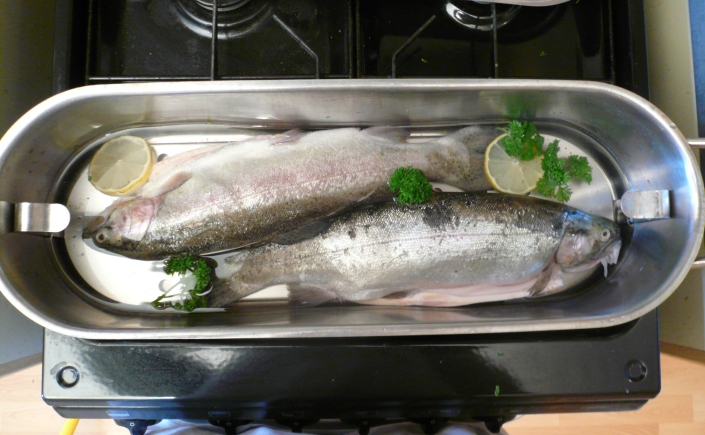
The phrase means a situation or process which is totally messed up or jumbled beyond immediate repair. The use of “kettle” here likely refers to the elongated english saucepan designed to cook or poach an entire fish, like so.
Yum!
How such a cooking pan has come to mean a completely muddled up state of affairs is not entirely clear, but the first reference to “kettle of fish” is from mid-1700’s in England. Speculation is that after the feast the kettle would contain the rather chaotic remains of the unfortunate marine beastie, although this origin story is by no means certain. Over the decades the phrase was made into a generic “thing” referring to a less-than-ideal state of affairs.
And while we’re at it, why are we so afraid of a “can of worms”? If you open the proverbial can of worms they just slowly crawl out and make an awful mess on that kitchen countertop you JUST cleaned. Now a can of BEES, well that would be a whole other kettle of fish.
My father loved trains. On our infrequent trips I can remember him seeking out train museums or other historical transportation venues. I don’t recall actually taking a trip ON a train, opting instead for the trusty ’51 Plymouth. He especially loved the vintage steam locomotives, the ones you would see in old black and white movies, heavy and loud and announcing their presence in a cloud of steam and grinding of wheels, steel on steel.
The steam whistle was deafening, actuated by the same super-heated steam that drove the great wheels. Modern trains use air horns to the same effect, namely to warn those near that this enormous machine cannot stop quickly.
These steam-powered trains were marvels of engineering, because while it is easy to imagine heat –> water –> steam –> pressure –> moving wheels, it is another thing altogether to actually build one.
Steam engine
My brothers and I had a stretch where we were serious HO Model Train Enthusiasts. “HO” was the type of train reproduced at 1:87 scale. We would lay out the tracks in the bedroom, attach the transformer, place the scale model trains on the tracks; caboose always taking up the rear. Crank up the juice and away they go! We had small tunnels, train stations, little fake trees and shrubs. We would build a little city around the train tracks, which is how it actually happened out here in the big world, scale 1:1.
Model town
I think we played for years with these trains, and I can imagine Pop watching us from the doorway, happy to have made this connection, he to us and now back again.
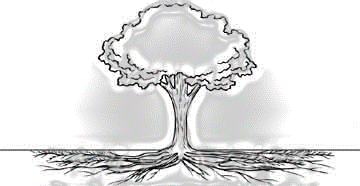
Trees and other plants use an underground system of roots that pulls nutrients and water from the soil, but also provides structural integrity. The fibrous root ball of some trees may extend horizontally the same distance as the tree is tall, so don’t plant trees to close to your house lest they slowly come to visit you.
Fibrous roots
Other types of trees and plants grow from a central vertical root, called a taproot.
Taproot with secondary branching roots
There is something solidly real and obvious about the taproot, a large anchor holding the tree down, and one that can seek water in the dark depths during times of drought. Taproots can go way down too, with the wild fig tree sending a root down 400 feet. Seriously, 400 feet? By the way, the wild fig is like the Great White of the botanical world, with these terrifying aerial root systems that reach out to neighboring trees and slowly strangle them, leaving withered husks where once an innocent tree stood.
While doing what I laughably refer to as research on this topic, I came across another category of taproot, the storage root, which itself is an edible part of the plant. Examples of storage roots include carrots, beets, radishes and turnips! So all this time you have been eating taproots! Ew!
I had assumed that the onion is also a taproot, but nooooo. It is a bulb, or a part of the plant’s stem growing at or just below the surface. The humble potato? Sorry that’s a tuber. Why can’t anything be simple?
Anyway, the word taproot is just very cool, all by its lonesome.








 whoisfenton