Coincidence.

pie-piThere can sometimes seem to be a certain randomness to events; a kind of chaotic Brownian motion that swirls about, absent direction, order or logic.  And it is definitely true that many occurrences are unconnected to one another; say, two people meeting at a ball game after not seeing each other for many months or years.  What a coincidence we say and we would almost certainly be right, unless one person was secretly stalking the other, but that is the stuff of Hollywood thrillers.

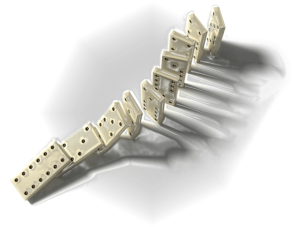
Yet we know from science that there are many events which ARE correlated and causal.  in fact much of science is devoted precisely to figuring out this vast cosmic puzzle.

doninoes

And then there are those events that seem to be connected but are not.  I have had those moments where I am convinced that something terrible is about to befall a friend or family member.  I call them and tell them to be careful, only to find, a few days later that they barely avoided a tree crashing down on the road in front of them.  Did I have a premonition of a future event?  Maybe I did, but to be honest it is far more likely that this premonition was another coincidence.  I have had many more feelings of impending danger, only to discover that nothing bad happened.   False alarm.  It is our nature to *report* the successes and remain silent on the “failures”, so the reported data is skewed toward those events which succeed.  

Finally there are events which are crafted to appear coincidental but ride on top of an underlying deception.  The fact that I was at the scene of the crime with a knife AND a gun is mere happenstance your Honor.  

And don’t get me started on fate and destiny.  Down that road lies a tree crashing down.

The Word: “Outlandish”

We hear the word “outlandish” and immediately think of extreme behaviors and appearance, like wearing red speedos to a wedding and dancing an Irish jig whilst singing ‘Old Man River’ in a deep baritone.   I know we can all relate to that.

The word itself has seemingly been around for nearly a thousand years and is derived from the Old English word “ūtlendisc“, or foreigner.  I guess that makes a kind of sense because when ancient peoples would encounter one another, it is fairly certain they would speak different languages or dialects, dress differently, have different customs and mores, etc.  

The fact that we are territorial in nature is not a surprise.  We seem to be wizards at making fences and borders and have a finely tuned sense of the “other”, the foreigner.  I wonder if that behavior is learned or genetic or a little of both?

I ask only that you be wary of wearers of red speedos.  They are simply outlandish and not to be trusted.

speedo-2

Kudzu.

If you live is the Southeast USA you will undoubtedly find it strange that this blog, purporting to speak of good things, would ever spare a kind word for this invasive species.  And while I would not include kudzu as a good thing, I will argue here that it is at least an “interesting” thing and one deserving of our understanding, like all things living or not.

Kudzu was introduced to the USA from Japan over 100 years ago.  At that time it was to be used as a fast growing shade-creating vine and effective ground cover.  How right they were!

kudzu-Picture1

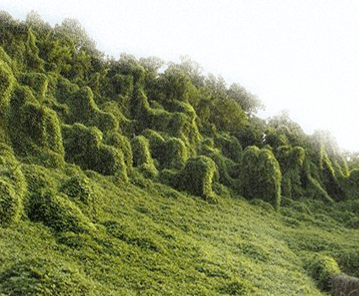
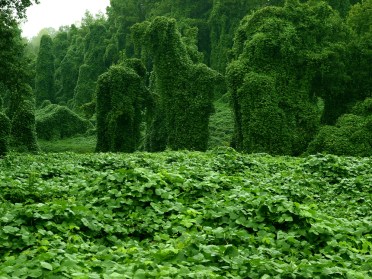
Kudzu is now understood to be a “structural parasite” in that it uses existing objects to climb up and over other plant species to gain access to the sun, thereby starving the plants below.  During the warm days of spring and summer the kudzu is incredibly prolific, growing at nearly 12 inches a day.

Kudzu uses nitrogen in the soil far more efficiently than other plants.  This can create “vine barrens” or forests and fields where kudzu is optimized to out-compete all other species.

kudzu-1

Given its growth patterns, my first thought was what if kudzu could be used for food?  After all people eat the monstrous clam so how much further down the food chain can we go?  Apologies to mollusk lovers everywhere, but by now my guck intolerance is well established.

It turns out that kudzu has been used as cattle feed and and has been found to contain some vague medicinal properties.  Sooner or later someone will bake a delicious kudzu pie, and it is at that point where the vine will face inevitable extinction; such is our propensity for PIE.

Although kudzu represents a nearly perfect example of an invasive species, I still admire it for its ability to survive, and the singular nature of its design.


VW Bug.

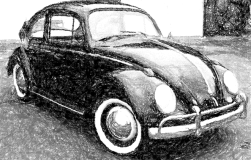
In Hawaii I used to drive older cars, perhaps as a sign of coolness.  My 1960 Volkswagen beetle was the ideal beach car, worn and weather-beaten to the point where driving it was challenge thrown into the face of Harold, God Of Foolish Risks.  I mean this car was so old that it didn’t have a gas gauge; just a lever down by your feet which, when thrown, would give you one more gallon accompanied by the urgent need to find a gas station pronto.  You could see the road whizzing by below you through the rust holes in the floor boards. 
bug-2

Nothing could damage this car as it had already taken the worse the world could throw at it and just kept on limping along.  Nothing that is until Thanksgiving Day, 1971.

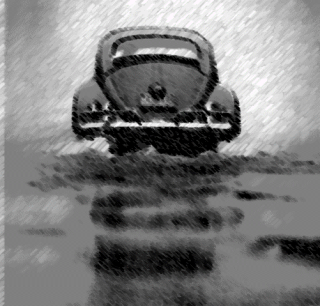
I had left UH Manoa pretty late that night, on my way home to Kahaluu on the windward side. There were ominous clouds over the Pali meaning that heavy rain was likely falling in the mountains (mauka). As I approached the turnoff to Kahaluu I noticed that the canal on my right was nearly full, belying the lack of local precipitation. I was about to learn firsthand about the concept of ‘runoff’, foreshadowing my future life with the Corps of Engineers. As I began to cross the narrow bridge, the stream beneath suddenly surged up and over the roadway, carrying the bridge, me and my bug off the road, down the river and ultimately out to sea.
vw-1

Most Bugs will float — this one no exception — and I think I would have stayed aboard had it not been for those pesky rust holes in the floorboards. A mini Titanic in the making, I instantly knew that James Cameron himself couldn’t save this puppy.  Screaming, “I’m Pawn Of The World!” I crawled out the window and swam for shore, previously known as The Road.

I dragged myself out of the raging torrent, thankful on Thanksgiving Day to be alive, only to discover that I escaped to the wrong side of the river, and would now have to re-cross in order to get home. Charon was nowhere to be seen, but I did have my constant companions, Youth and Stupidity, standing by ready to assist. To this day I’m not sure how I made it back across that flood, and it would have been fitting if somehow the Volkswagen, hung up on some branches, had suddenly released and come crashing over me in the ultimate revenge of Machine over Dumb Guy.  But no, I arrived at my door late that night, caked in mud from head to toe. My brother said that I was laughing hysterically, and although I cannot independently verify that, it has a certain ring of truth, and lends a touch of pathos to this otherwise ridiculous stumble-bum story.

I did find the car the next day, upside down in someone’s outhouse, or more accurately where the outhouse used to be. The bug was filled with, er,  mud, and I was captured on film by the local TV News crew as I bent to pull long strands of fibrous material from the prostrate form of my beloved Beetle. I peered hopelessly unto the dim, mud-filled interior, trying to see if anything could be salvaged. The TV guy attempted to interview me but by the time they had edited out all the “um’s”, “ya know’s” and “uh’s”, they barely had enough footage for a single frame, which zoomed past the 11 O’clock news audience in 1/16th of a second, a time precisely equal to my moment of fame.

A week or so passed and I began the process of buying another car; yes, another Beetle, as penance to automotive karma. As I bargained with the seller, he stared at me and asked, “Aren’t you the guy I saw on TV after the flood?”

Yes, I say, I am he from the television.

Timothy Leary would be proud.

The word “squall”.

Some words that begin with the letters “s q u” are very auditory, like “squawk” and “squeal“.  Word historians (etymologists) suggest the word “squall” was formed by a combination of the two above words, and describes the sound a very unhappy baby may make from time to time.

The other definition of “squall” is the onset of a sudden and very intense increase in wind speed, accompanied by heavy rain and/or snow.  I got hit with a rain squall the other night whilst walking.  There I was just bopping along without a care in the world when BAM, soaking wet in an instant, transformed from an elderly gentleman out for an evening stroll into a sodden and increasingly indignant humanoid rat, or Homo Ratian.

Those same etymologists theorize that this climatological meaning of the word “squall” comes from the Old Norse word “skvala” meaning literally, ‘to squeal’,  This makes sense because I made this very sound while getting soaked, skvala-ing like a banshee.

It is highly unlikely that a squalling baby will bring on periods of intense rain and wind, but should this happen I suggest you contact Stephen King immediately.


Sticky Rice.

rice

Rice is my vegetative albatross. I’m not talking about the dry, hard pellets of Uncle Ben’s USA or the ‘fragrant’ rice of South East Asia, but the white sticky rice of Japan, Korea and Hawaii. I’ve tried everything; the 4- step plan, the 8-step plan, the aleph-null-step plan, but I inevitably plunge back into the murky depths of cereal addiction.

For those who ascribe to mathematical purity, yes, I’m still working on the aleph-null plan.

Folklore

rice-fields

When the Kachins of northern Myanmar née Burma, were sent forth from the center of the Earth, they were given the seeds of rice and directed to a wondrous country where everything was perfect and where rice grew very well thank you.

In Bali, it is believed that the Lord Vishnu caused the Earth to give birth to rice, and the God Indra taught the people how to raise it.  I theorize that the God Fatso taught us to eat it, but I digress.

In China, tradition holds that “the precious things are not pearls and jade but the five grains”, of which rice is first.

According to Shinto belief, the Emperor of Japan is the living embodiment of Ninigo-no-mikoto, the god of the ripened rice plant.

All well and good, but all the Ninigo in the world won’t help the poor wretch found comatose under an overpass, rice bowl cast weakly aside, a set of frayed chopsticks clutched in his withered paw.

I have not descended to that dire state as yet but it’s only a matter of time. Just the other day I caught myself at the breakfast table eating rice and dried seaweed.

We used to have friends of Matt and Stephanie over, and I had to laugh when my kids raved about rice and seaweed.  No amount of cajoling could convince the visitors however and they would politely decline, preferring starvation over the consumption of such a dubious food-like material.  When I attempted a peace offering of tofu and noodles they quickly became dots on the horizon, accompanied by the faint sound of hurling.

Who knew?


Quanta.

(I wrote this back when I lived in Korea)

My life as a flatworm

When I was an undergraduate physics student in Hawaii, one of my classmates was named Claudia. I first noticed her in quantum mechanics, a class where the average test score was 30% and the faint popping sound of brain cells imploding could be heard.  I sat next to Claudia one day and I heard her humming to herself, seemingly taking no interest in the class itself.  Glancing over, I noticed her workbook was covered with the symbols of music: staff, notes and scales.  She hummed her way through that class, and at the end presented her ‘notes’ to the professor, telling him she had translated his lecture to music. She scored 100% on every test that semester and never stopped listening to her quantum mechanical opera. I later found out she had taken all the physics classes in undergraduate and graduate school.  She was 16 years old.

quanta

Speaking with Claudia about physics or math made us feel like flatworms trying to comprehend the nature of the stars in the sky.  She had an intuitive grasp of physical theory and the related mathematical tools. She could read math journals as we would read the Sunday paper. She was not a skilled instructor because she was unable to explain to us what was obvious to her. Like trying to describe the color “orange” to a person who has only seen ‘green’.  While we puzzled over the road signs, she was over in the next county, figuring a new way to draw the maps.

She always seemed amused, as if at the scene of some vast, cosmic joke. She wrote and published poems about the beauty of Hawaii. She was a campus activist (this was the early 70’s remember) and could often be found at the podium of some antiwar rally, microphone in hand. Sixteen years old and older than all of us put together.

Now that you have this picture of Claudia in your mind, this towering genius, I must tell you one more thing.  She was born into a life of grinding poverty on Philadelphia’s mean streets, growing  up in a place where all life’s markers are set to bring you down.  But she broke out through the opportunities offered by blind, random genetics, her own will, and I expect a modicum of good fortune.

This flatworm often wonders: how many other Claudia’s are trapped in the shadow-world; stars whose light (and music) are forever lost in the terrible gravity of circumstance?


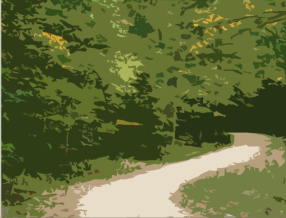
A gravel road through the woods.

roadSomething more than a trail
Or an ancient path
Or wagon wheel ruts;
A human hand
Has placed these stones
In the woods just so.

Signposts optional
On the gravel;
Landmarks prevail –
Turn right
At the old hickory,
Where branches beckon
With crooked arms.

The road crunches
With distinct echoes
Under heavy wheels
And cautious feet,
Almost natural
Like us.


Balsa Wood.

I spent my formative years growing up on the Patuxent Agricultural Station in Laurel Maryland.   Back in the 50’s Laurel was a small town located betwixt Washington DC and Baltimore Maryland, and the research station was an isolated enclave surrounded by miles of hardwoods and pines.  The Forest Service would periodically bring research associates to spend a summer doing field work.  Ed Zukoff was one such graduate student.  Ed had many hobbies, but the one I remember most was his interest in carving and sculpting elaborate and realistic objects from Balsa wood.

balsa=plane-3

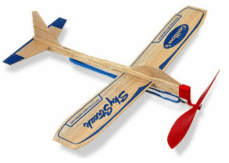
We were no stranger to balsa because our model airplanes came as kits made of this incredibly light wood.  Our models were powered by the energy stored in a wound-up rubber band, which when released would drive a propeller.  Properly balanced and glued together, our planes could take off from the ground and stay aloft for an incredible number of seconds!

The balsa tree is a species found natively in South America and Mexico.  Its scientific name is “Ochroma pyramidale” making it a leading contender for Name Of The Year in the arboreal sweepstakes. Balsa wood is filled with air-pockets and is very light, lighter in fact than cork and the lightest hardwood on the planet.  By contrast the heaviest wood, black ironwood, has a specific density 35 times that of balsa; so heavy that it will not float in water.   Balsa, as proven at the Fenton Flight School of Laurel, can fly.

You can still acquire these balsa-wood kits today and relive the wild days of your youth, but balsa has been mostly replaced by Styrofoam causing Irving, the God Of Recycling, to weep.  Of course time marches on and these days you are far more likely to see and hear quadcopter drones buzzing around the neighborhood.  Super cool, but something may have been lost along the way.

(excuse me for a moment)

Hey you kids, get off my lawn!


Dragonflies.

These spectacular fellows with the shimmering gossamer wings are found all over the place but especially near ponds or marshes.  This is largely because in the nymph stage of their life cycle they are these weird looking little aliens living under the water, sometimes for as long as two years.  They await some biological imperative to crawl up onto the stems of grasses and reeds and emerge as the familiar mystical beings of summer.

dragon-3

There are some things you should know about these guys.  First they are amazingly fast and agile, clocking in at around 35 mile per hour.  Second they are fierce and efficient predators, consuming hundreds of other flying insects per day — including mosquitoes — so the dragonfly is your friend.  Oh and scary though they may appear, they cannot sting or bite you.

The fossil record tells the story of an ancient earth which was home to all manner of creatures since extinct.  The dragonfly of 300 million years ago was ten times the size of the modern version and worse, the horrific prehistoric nymph was a foot in length.  Yikes.  Hollywood, take note.

Even if they once had 3-foot wingspans they don’t look much like dragons, so whence the name?  Several theories emerge from the depths of history. 

  • Swedish folklore posits that the Devil used the dragonfly to weigh people’s souls, as the ancient peoples of Sweden thought the dragonfly looked a bit like a weighing scale.  Personally, I am not seeing it.  
  • The Romanian story is my favorite.  It seems that once St George had slain the dragon threatening the village of Silence, the Devil changed his horse into a giant flying insect.  In the Romanian language, the word for dragonfly translates into Devil’s Horse or Devil’s fly. The Romanian word for devil is ‘drac’, which can also indicate dragon.

Devils Fly is not nearly so lyrical, huh?

drgon=fly-1

Regardless the name, the dragonfly shows us the possibilities of life on earth; how the natural world can engineer a being designed to last nearly unchanged for over 300 million years.   In the long sweep of time, will we be as persistent?  In our rush to change the world can we find the same balance, dancing there in the sunlight on incandescent wings?